
Iran’s World Cup opener in Los Angeles has turned one of America’s most distinctive immigrant communities into part of the story. The match is not only about football. It is also about memory, exile, family ties, politics and the complicated place that Iran occupies in the lives of many Iranian-Americans.
At the centre of that story is Tehrangeles, the nickname long used for Los Angeles’ Iranian and Persian community. The word blends Tehran and Los Angeles, but it has come to mean much more than a clever label. It refers to a diaspora built over decades across Westwood, Beverly Hills, West Los Angeles, Encino, Tarzana, Woodland Hills and other parts of Southern California.
For the World Cup, that community matters because Iran are not arriving in a neutral emotional space. They are playing in a city where many people still carry direct family memories of the 1979 revolution, later waves of migration, political repression, cultural loss and a continuing connection to relatives inside Iran.
Tehrangeles and the meaning behind the name
Tehrangeles became shorthand for the Iranian presence in Los Angeles after large numbers of Iranians settled in Southern California, particularly following the Islamic Revolution. Over time, the area developed its own cultural ecosystem: Persian restaurants, bakeries, grocery stores, media outlets, community organisations, music, bookshops and Nowruz celebrations.
Westwood Boulevard has often been described as one of the symbolic centres of that community, with Persian Square serving as a visible marker of Iranian-American life in the city. But Tehrangeles is not confined to one street. It stretches across neighbourhoods and generations, from first-generation exiles to American-born children and grandchildren who may speak English more fluently than Persian but still feel the pull of Iranian identity.
That layered identity is the reason Iran’s World Cup match in the Los Angeles area carries unusual force. For many fans, Team Melli still represents childhood memories, family gatherings, old songs, national pride and the rare chance to see Iran on a global stage. For others, the same shirt and flag are inseparable from the Islamic Republic, making public support difficult or even impossible.
Iran’s LA match turns football into a diaspora moment
Iran’s opening game against New Zealand in Inglewood has drawn attention far beyond the scoreline. The build-up has included expected protests, watch parties and visible debate inside the Iranian-American community. Some fans are preparing to cheer the national side. Others are expected to demonstrate outside the stadium, arguing that the team cannot be separated from the state it officially represents.
The tension has been sharpened by the broader political backdrop. Iran’s squad arrived in the United States after diplomatic and logistical complications, with reports of visa issues, disrupted preparations and a temporary base move to Mexico before the team travelled into California. Iran captain Mehdi Taremi said the strain around the tournament had affected the usual joy of playing at a World Cup, while coach Amir Ghalenoei has sought to keep the focus on football and the people of Iran. A detailed match build-up in The Guardian described the team’s arrival as one shaped by political tension as much as sporting preparation.
That makes Los Angeles a uniquely charged venue. In many host cities, Iran’s fans would be treated largely as travelling supporters. In Southern California, the crowd around the stadium may include people whose families left Iran because of the very system that still governs the country. Some will want to separate Iran as a nation from Iran as a state. Others will find that separation impossible.
Fans divided between pride and protest
The divide is not simple. Many Iranian-Americans love Iranian football while strongly opposing the Iranian government. Some still call the team Team Melli, the national team, with affection. Others see the side as compromised by official symbols, state control and years of pressure on athletes to avoid political expression.
That emotional conflict has appeared before at major tournaments, especially during moments when Iranian players and fans have been drawn into protests linked to rights, women’s freedoms and state repression. In Los Angeles, the same tension becomes more visible because the diaspora is large, organised and politically active.
For some families, attending the match could feel like a celebration of identity. For others, staying away or protesting outside the stadium may feel like the only honest response. A report by AP News noted that Iran’s World Cup experience has been overshadowed by war, visa complications and expected diaspora demonstrations in California.
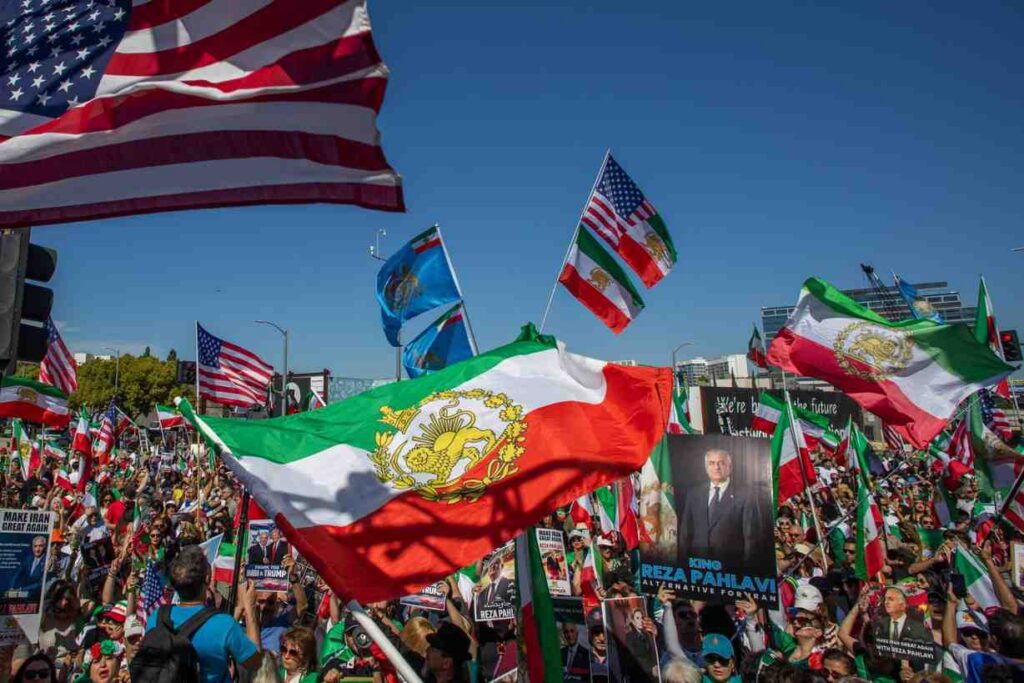
The issue of flags adds another layer. Many opponents of the Islamic Republic use pre-revolutionary symbols, including the Lion and Sun flag, to express a different idea of Iran from the one represented by the current state. Any restrictions on such symbols can become a flashpoint, because for protesters they are not just political banners but statements of belonging and memory.
Los Angeles gives the story global visibility
The World Cup is built for television, and that is one reason Tehrangeles matters so much. A protest outside a stadium in Los Angeles can quickly become part of the global story around Iran’s campaign. Chants, banners, divided reactions to the anthem, or visible tension between fan groups can travel far beyond California.
For the Iranian government, the national team’s image abroad has long mattered. For diaspora critics, the World Cup offers a rare international stage where opposition voices can be heard without being inside Iran. For players, that creates an almost impossible balance: they are expected to compete, represent a nation, avoid political traps and still speak to supporters whose expectations are deeply divided.
Tehrangeles also complicates simple narratives about patriotism. In Los Angeles, love for Iran does not always mean support for the Islamic Republic. Opposition to the current government does not always mean rejection of Iranian culture or football. The World Cup has brought those distinctions into public view.
That is why Iran’s LA fixture feels bigger than a group-stage match. It is a meeting point for sport and exile, pride and grief, national identity and political protest. For many in Tehrangeles, the question is not whether Iran matters. It clearly does. The harder question is who gets to speak for Iran when the world is watching.

Make Swikblog your go-to source on Google for reliable updates, smart insights, and daily trends.