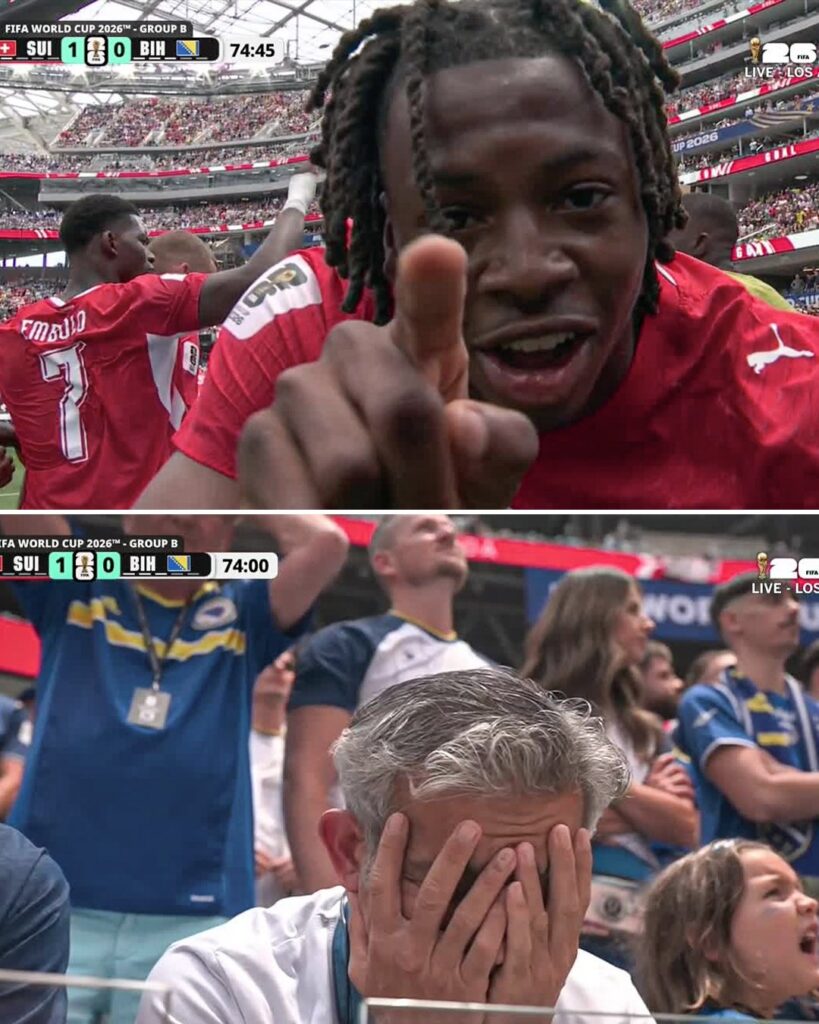

Johan Manzambi turned a tight World Cup match into Switzerland’s night. The young SC Freiburg midfielder came off the bench and scored twice as Switzerland beat Bosnia and Herzegovina 4-1 in a dramatic Group B finish at Los Angeles Stadium in Inglewood.
The scoreline looked impossible for long periods. Switzerland had control, territory and patience, but Bosnia and Herzegovina kept the game compact until the final quarter. Then Manzambi arrived, and the match changed almost instantly.
His first goal came in the 74th minute, when he reacted sharply to a loose ball and struck a powerful finish that broke Bosnia’s resistance. Ruben Vargas doubled the lead in the 84th minute, before Manzambi scored again in the 90th minute to complete a breakout World Cup performance.
Bosnia pulled one back through E. Mahmić in the 90+3rd minute, but Switzerland still had one more moment left. Captain Granit Xhaka converted a 90+7’ penalty to seal a 4-1 win that gives Switzerland a major lift in Group B.
Match summary: Switzerland dominated possession but needed their substitutes to unlock the game. Manzambi’s 74th-minute opener gave the Swiss the breakthrough, Vargas added a second, and Bosnia’s task became harder after T. Muharemović was sent off in the 80th minute. Manzambi struck again late, Mahmić replied for Bosnia, and Xhaka’s stoppage-time penalty completed Switzerland’s 4-1 win.
Who is Johan Manzambi?
Johan Manzambi is a Swiss midfielder born in Geneva on 14 October 2005. At the 2026 World Cup, he is still only 20 years old, which makes his two-goal performance against Bosnia and Herzegovina one of the most eye-catching young-player moments of the tournament so far.
Manzambi plays for SC Freiburg in Germany, where he has developed from a promising academy arrival into a senior-level midfielder with the energy and timing to affect matches from deeper and advanced areas. His official Bundesliga player profile lists him as a Freiburg midfielder, and his World Cup display has now pushed his name far beyond regular Bundesliga followers.
Before moving to Germany, Manzambi came through the Swiss football pathway in Geneva. He was part of the Servette setup before joining Freiburg in 2023, a move that placed him in one of Europe’s respected development environments for young players. His sudden breakthrough fits a wider tournament pattern in which younger players have been turning group-stage matches into personal launchpads, much like the Australian story behind Nestory Irankunda’s World Cup rise.
Another detail that makes his rise stand out is how early the journey began. Manzambi started playing football at around four years old, growing up in Geneva before moving through Servette’s youth structure and later taking the bigger step into German football. That path gives his Switzerland breakthrough a clear arc: local beginnings, a disciplined Bundesliga education and now a World Cup stage.
His game is built around intensity, movement and timing. He can press, carry energy through midfield and arrive late in attacking spaces. Against Bosnia, those qualities mattered because Switzerland had been moving the ball without consistently hurting the opposition. Manzambi gave the team a more direct edge.
Manzambi’s sudden World Cup impact did not come from nowhere. He had already been building a reputation as a right-footed, box-to-box midfielder with unusual running power for his age. At Freiburg, his 2025-26 Bundesliga season showed the physical side of his game clearly: 258.5km covered, 239 sprints and 1,317 intensive runs, numbers that help explain why he could enter a late-stage World Cup match and immediately change its rhythm.
Family roots and Freiburg rise
Manzambi was born and raised in Switzerland, but his family background reflects a wider international story. His parents have been reported as having roots in Angola and the Democratic Republic of Congo, adding to the multicultural identity of a Swiss squad that has long drawn strength from players with different family histories.
There are no widely verified public details naming his parents, and Manzambi has kept his private family life largely out of the spotlight. That makes it important to focus on what is known: his rise began in Geneva, moved through Swiss youth football, and accelerated after his switch to Freiburg.
Freiburg’s development model has helped Manzambi sharpen the parts of his game that stood out against Bosnia. He is not just a midfielder who passes safely and holds shape. He brings urgency into the final third, presses with purpose and has the confidence to attack second balls around the penalty area.
That was exactly what Switzerland needed. The match had been balanced for more than an hour, with Bosnia defending deep and trying to stay alive through transitions. Switzerland’s passing rhythm was steady, but the breakthrough required a player willing to gamble on a half-cleared ball. Manzambi did that in the 74th minute, and the match opened up from there.
The red card to Muharemović in the 80th minute made Bosnia’s task even harder. Switzerland quickly used the extra space, with Vargas scoring four minutes later. Manzambi’s second goal in the 90th minute turned a strong substitute appearance into a headline performance.
Even after Mahmić’s stoppage-time goal briefly cut the deficit, Switzerland finished with authority. Xhaka’s late penalty gave the scoreline a more emphatic look and underlined Switzerland’s control in the closing stages.
The brace against Bosnia also fits into a wider breakout year. Manzambi had already scored for Switzerland before the tournament, including in a 4-0 friendly win over the United States, and his progress at Freiburg had pushed him from promising youngster to a player trusted in senior football. FIFA had already described his rise toward the Switzerland squad as rapid before the tournament, with the midfielder becoming a regular part of Murat Yakin’s plans after his first senior call-up.
For Manzambi, the night could become a career marker. A World Cup goal is memorable enough; a World Cup brace as a young substitute is the sort of moment that changes public recognition overnight. It puts him in the spotlight for Swiss fans, Bundesliga followers and neutrals who may have been seeing him properly for the first time.
Switzerland’s 4-1 win will be remembered for its late rush of goals, but Manzambi’s impact was the turning point. He entered a match that needed invention, scored the opener, scored again near full time and left the pitch as the young player everyone wanted to know more about.

Make Swikblog your go-to source on Google for reliable updates, smart insights, and daily trends.