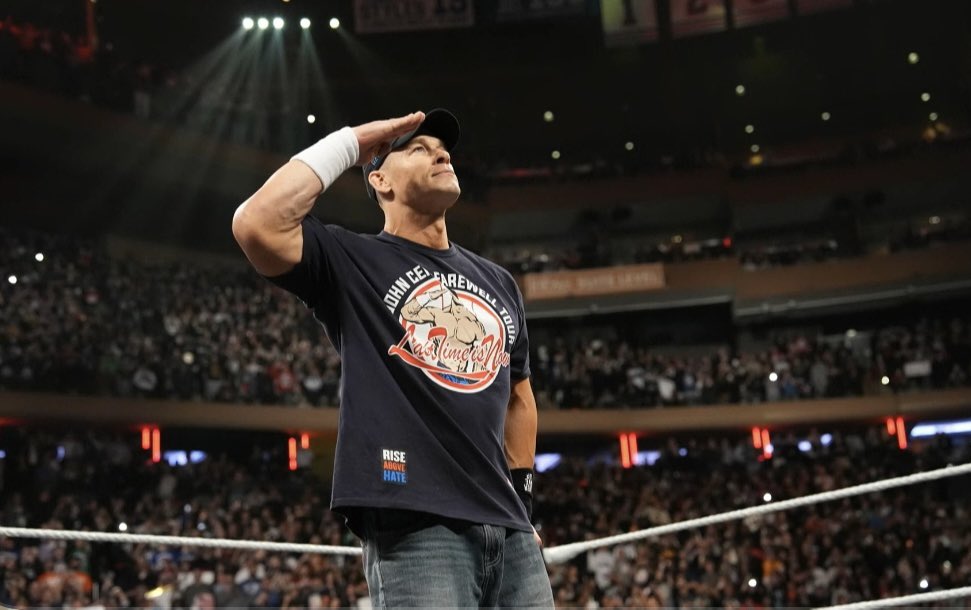
For more than two decades, John Cena was WWE’s constant — the face of an era, the soundtrack of childhoods, and the standard-bearer of modern sports entertainment. Tonight, that era quietly comes to a close. At Saturday Night’s Main Event, Cena steps into a WWE ring for what is being billed as his final match, turning a routine prime-time broadcast into a moment loaded with history, emotion, and finality.
WWE has avoided exaggeration in its promotion, but the messaging has been clear and consistent: this is not a comeback, not a nostalgia tour, and not a tease for another run. This is a farewell. For a company that rarely closes doors permanently, the tone surrounding Cena’s appearance feels deliberate — almost restrained — and that is precisely why it matters.
The Career That Defined a Generation
Since debuting in 2002, John Cena’s career has been unlike any other in WWE history. Sixteen world championships, countless main events, and a run at the top that spanned multiple locker rooms and eras. From the “Ruthless Aggression” days to the polished superhero figure of the PG era, Cena carried WWE through boom periods, cultural shifts, and intense scrutiny.
For many fans in the US and UK, Cena was not just a wrestler — he was the entry point. The chants, the merchandise, the split crowd reactions, and the eventual respect that replaced resentment all formed a uniquely modern wrestling legacy. WWE does not often get the chance to close the book on such a defining chapter in real time.
Why Saturday Night’s Main Event Matters
The choice of Saturday Night’s Main Event is no accident. Long before weekly television dominated WWE programming, SNME was reserved for moments that felt bigger than storylines. Reviving that platform for Cena’s final match signals intent: this is meant to be remembered, revisited, and archived as a milestone rather than just another episode.
Airing in prime time on Peacock in the US, with global distribution elsewhere, the broadcast taps directly into nostalgia while remaining accessible to casual viewers — a balancing act WWE rarely executes this cleanly.
The Opponent and the Subtext
Cena’s opponent, GUNTHER, represents everything WWE is today: physical, minimalist, and rooted in in-ring credibility rather than spectacle. This is not a farewell exhibition. It is a calculated contrast between eras — the face of the past meeting the embodiment of the present.
Whether Cena wins or loses is almost secondary. A victory offers one last heroic image; a defeat reads as a passing of the torch. Either outcome reinforces the same truth — WWE is moving forward, and Cena is choosing not to follow.
Why This Goodbye Feels Different
Unlike other “last matches” in wrestling history, there is no sense of unfinished business here. Cena has been candid in recent years about physical limitations, shifting priorities, and the importance of leaving before the decline becomes visible. His Hollywood success only underlines that this decision is not forced — it is intentional.
That honesty has shaped fan reaction. Online, the tone is less speculative and more reflective. Instead of debating what comes next, audiences are sharing memories, moments, and gratitude — a rare response in an industry built on anticipation.
Fans React: “This Is the End of an Era”
As news of John Cena’s final match spread, the reaction online was immediate and emotional. Across social platforms, the tone has been less about match predictions and more about reflection — a sign of how deeply Cena’s presence has been woven into fans’ lives.
“I started watching WWE because of John Cena,” wrote one fan. “I stayed because he made it feel like something bigger than wrestling.” Others echoed similar sentiments, describing childhood memories of entrance music, schoolyard debates, and family viewing rituals built around his matches.
Another widely shared reaction read: “This doesn’t feel like a storyline. It feels real. It feels final.” That sense of permanence — rare in an industry defined by comebacks — has shaped the night’s emotional weight.
Parents watching with their children have also become part of the conversation. “My kids know him from movies,” one post noted. “Tonight they’ll see why he mattered to us first.” It is a reminder that Cena’s reach has extended far beyond the ring.
Rather than speculation about surprises or future appearances, the dominant message has been gratitude. Simple phrases — “Thank you for everything,” “You carried an era,” “You’ll never be replaced” — have filled timelines, turning Saturday Night’s Main Event into a shared goodbye rather than just another broadcast.
A Moment Bigger Than the Match
In business terms, the match strengthens Peacock’s live-event pull and restores SNME’s relevance. In cultural terms, it closes a chapter many fans assumed would never truly end. WWE understands the value of permanence, and this farewell feels designed to last.
As detailed in WWE’s own career retrospectives and coverage from outlets like WWE.com and The Guardian’s WWE coverage, Cena’s legacy is already secure. Tonight is not about adding to it — it is about acknowledging it.
Thank You, Cena
When the bell rings tonight, it will not just signal the start of a match. It will mark the end of a relationship between performer and audience that spanned generations. Wrestling rarely offers clean endings. John Cena’s final walk to the ring feels like one of them.
Whatever happens next, this much is certain: WWE will move on, but it will never quite replace the era that ends at Saturday Night’s Main Event.
You may also like: Iron Maiden’s 2026 World Tour Confirmed — What Fans Can Expect Next

Make Swikblog your go-to source on Google for reliable updates, smart insights, and daily trends.