
Written by Daniel Harrington — a financial markets writer covering commodities, global macro trends, and central-bank policy.
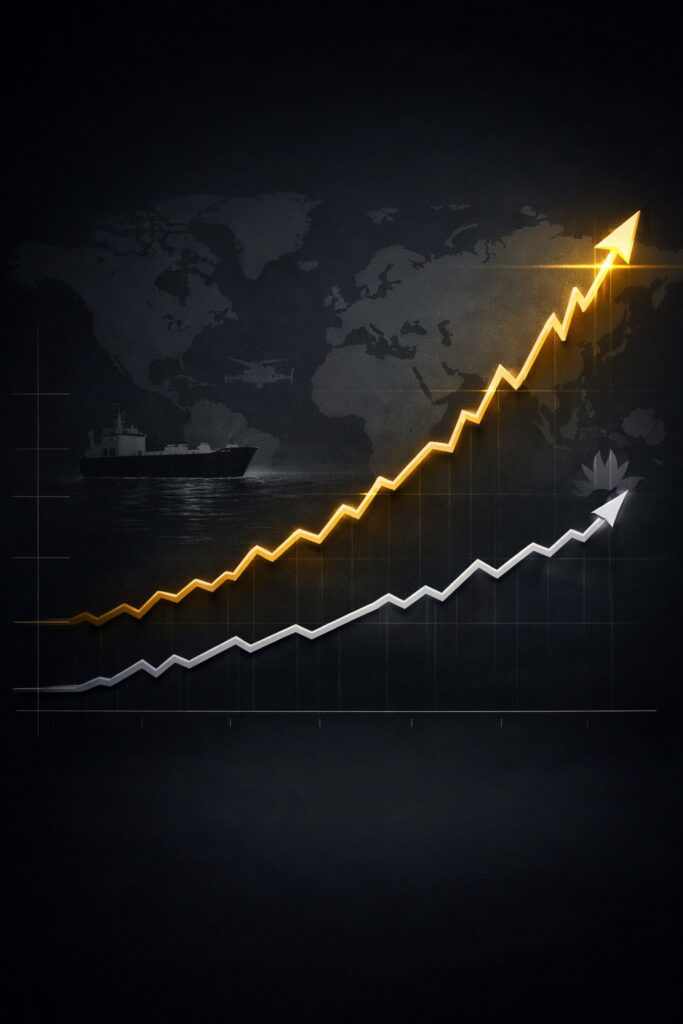
Gold and silver soared to unprecedented levels on Monday, with gold briefly topping $4,400 per ounce and silver approaching $70, as investors sought refuge amid rising geopolitical tensions and growing expectations of U.S. interest rate cuts.:contentReference[oaicite:0]{index=0}
Spot gold climbed as much as 1.4% above $4,400 before trading slightly lower, marking a rally that has lifted bullion roughly 67% this year and put it on track for its best annual performance since 1979. Silver’s gains have been even more dramatic, with year-to-date increases exceeding 130%, driven by robust investment demand and persistent tightness in supply.:contentReference[oaicite:1]{index=1}
Safe Haven Demand Meets Monetary Policy Expectations
The powerful rally in precious metals reflects a convergence of market forces. Traders are increasingly pricing in potential interest rate cuts by the U.S. Federal Reserve in 2026, a shift that generally supports non-yielding assets like gold and silver. Lower rates reduce the opportunity cost of holding bullion compared with yield-bearing assets such as bonds, making metals more attractive in uncertain economic environments.:contentReference[oaicite:2]{index=2}
At the same time, escalating geopolitical tensions are enhancing the appeal of safe havens. Key flashpoints — including intensified U.S. pressure on Venezuelan oil and military activity linked to the Ukraine-Russia conflict — have prompted investors to position for increased market volatility and seek assets that traditionally hold value during instability.:contentReference[oaicite:3]{index=3}
Market strategists note that the latest surge in gold and silver is being reinforced by expectations of easier U.S. monetary policy next year, with non-yielding assets historically benefiting when interest rates fall. Analysts have also pointed to sustained central-bank buying and renewed inflows into bullion-backed funds as key forces supporting prices at elevated levels, even as broader markets remain sensitive to geopolitical risk and shifts in global trade policy. According to Reuters, investors are increasingly positioning precious metals as long-term hedges rather than short-term trades amid concerns over inflation, debt and currency stability.
Central Banks, ETFs and Structural Demand
Beyond short-term drivers, structural demand factors have played a significant role in the rally. Central banks have continued buying gold aggressively as part of reserve diversification strategies, contributing to sustained upward pressure on prices. Meanwhile, inflows into gold-backed exchange-traded funds (ETFs) have remained elevated throughout the year, signaling broad investor interest and expanding the base of buyers beyond traditional institutions.:contentReference[oaicite:4]{index=4}
“The market is seeing strong positioning around rate-cut expectations, amplified by thin end-of-year liquidity,” said analysts at leading financial firms, noting that a weaker dollar has also helped support higher precious metals prices.
Silver and Other Precious Metals Rally Alongside Gold
Silver’s run toward $70 per ounce underscores its growing role as both a safe-haven asset and an investment play. The metal’s dual identity — as a precious metal and a key industrial input — has contributed to heightened volatility but also strong interest, particularly from speculative investors. Persistent supply disruptions in major trading hubs have further tightened the available physical metal, reinforcing upward momentum.:contentReference[oaicite:5]{index=5}
Other precious metals have not been left behind. Platinum climbed toward its highest levels in nearly two decades, while palladium rallied as investors diversified exposure across metals that are sensitive to both industrial demand and global risk sentiment.:contentReference[oaicite:6]{index=6}
What This Means for Investors
For investors, the historic rally in gold and silver presents both opportunities and risks. On one hand, precious metals are fulfilling their role as hedges against geopolitical instability and financial market uncertainty. A weaker dollar and expectations of future rate cuts have reinforced the narrative that gold and silver can serve as effective portfolio diversifiers.
However, analysts caution that momentum and technical dynamics could lead to increased volatility, especially as liquidity thins toward the end of the year. Seasonal patterns have historically supported precious metal strength in December, but profit-taking and shifting macroeconomic data — such as employment trends and inflation readings — could temper near-term gains.:contentReference[oaicite:7]{index=7}
Looking Ahead: 2026 and Beyond
Looking into 2026, major financial institutions suggest that precious metals may continue to find support if global uncertainty persists and monetary policy remains accommodative. Forecasts from some analysts include potential further upside for gold prices, with key resistance levels well above current trading ranges. However, these projections are contingent on evolving monetary policy and geopolitical developments, underscoring the importance of vigilant risk management for investors.
As gold and silver enter uncharted territory, their performance will remain a bellwether for broader economic sentiment and investor confidence. Whether prices sustain their upward trajectory or undergo corrective phases, the metals’ record-breaking run in 2025 has already redefined expectations for safe-haven assets in a rapidly changing global landscape.
Read also: Oracle Stock Crash Forecast and AI Bubble Fears in 2025

Make Swikblog your go-to source on Google for reliable updates, smart insights, and daily trends.