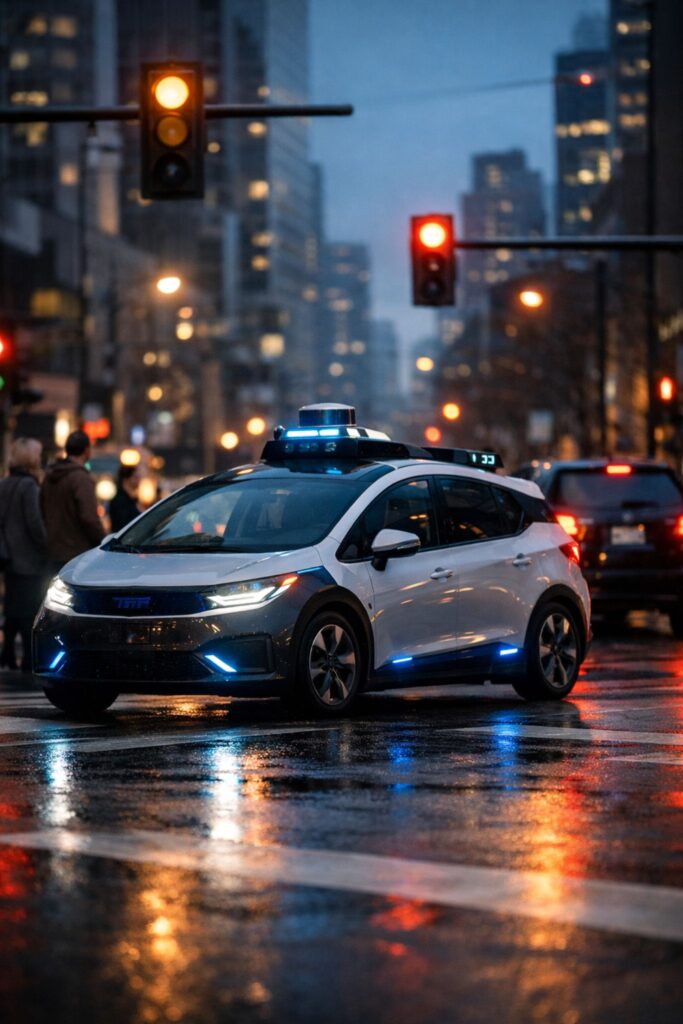

As driverless ride services scale from pilot projects to real-world networks, one question keeps resurfacing: are autonomous vehicles actually safer than the people they aim to replace? Key takeaway
Robotaxis may reduce certain types of crashes, but the uncomfortable truth is that we still don’t have a universal, apples-to-apples proof that they’re safer than human drivers in every city, every season, and every edge-case.
Why this debate is suddenly everywhere
Robotaxis aren’t a distant future concept anymore. New vehicles and partnerships are being announced, tested, and positioned for rollout in major metro areas. Expansion matters because safety claims don’t live in a lab — they live on real streets, with real pedestrians, cyclists, bad weather, confusing signage, and unpredictable human behavior.
And when robotaxis expand, public expectations rise with them. People tolerate human error because it’s familiar. But the tolerance for machine error is far lower — especially when a vehicle has no one behind the wheel to “make a judgment call.”
“Safer than humans” sounds simple. It isn’t.
The phrase “safer than a human driver” hides a huge problem: which human driver? A cautious commuter? A fatigued rideshare driver finishing a long shift? A distracted teen? A drunk driver at 2 a.m.? The baseline matters — and so does the environment. A robotaxi performing well on wide, well-marked roads in clear weather isn’t the same as a robotaxi navigating construction chaos, heavy rain, or a crowded nightlife district.
That’s why safety comparisons can feel persuasive and still be incomplete. If a company chooses a “benchmark” that doesn’t match where and how its vehicles operate, the comparison can mislead without technically being false.
What the current data can (and can’t) tell us
There are credible reasons to believe autonomous driving could be safer in the long run. Computers don’t get drunk, drowsy, distracted, or angry. They can monitor 360° consistently, keep safe following distances, and react quickly to predictable hazards.
- Where robotaxis may outperform humans: rear-end crashes, speed consistency, lane discipline, and routine driving where “rules-based” caution works well.
- Where robotaxis can struggle: rare edge-cases, ambiguous road signals, unusual pedestrian behavior, tricky merges, and complex “social driving” moments.
- Why it’s hard to conclude anything: the “hardest” driving situations are also the least common — and proving safety in rare scenarios requires massive, transparent datasets over time.
Another factor is exposure. If robotaxis make rides cheaper and more convenient, total miles traveled could rise. Even if robotaxis are individually safer per mile, a big jump in overall miles can complicate the real-world crash totals. That’s one reason some analysts argue we’re not just measuring “safety,” but also how technology changes travel behavior.
The reporting problem: why “proof” is still elusive
Here’s the part that rarely goes viral: safety isn’t just engineering — it’s also measurement. In the US, regulators have pushed for more transparency about crashes involving automated systems, but the public still faces an uneven information landscape.
Some companies publish safety summaries; others share selective metrics; some rely on insurance or claims-based analysis; many comparisons depend on assumptions about “equivalent” human driving. On top of that, the term “autonomous” gets blurred with driver-assist systems (where a human is still responsible), which can distort headlines and confuse readers.
If you want to understand how crash reporting is being handled at the federal level, the National Highway Traffic Safety Administration’s Standing General Order is a useful reference point for what companies and operators are expected to report: NHTSA crash reporting order.
So… are robotaxis safer right now?
The most honest answer today is: robotaxis may be safer in some conditions, but the overall verdict isn’t settled. In certain controlled comparisons, robotaxis appear to reduce specific kinds of incidents. But “safer than humans” is an extraordinary claim — and extraordinary claims require standardized measurement, transparent data, and enough real-world driving to cover rare but devastating scenarios.
What would convince skeptics? A shared, industry-wide set of safety metrics, independently audited reporting, and long-term performance across multiple cities — including tough conditions like heavy rain, poor visibility, and dense pedestrian zones.
What this means for riders and cities
If you’re a rider, the near-term question isn’t whether robotaxis are “perfect.” It’s whether they’re predictable and whether the operator can explain how the system behaves in common scary moments: sudden stops, emergency vehicles, pedestrians stepping into the street, and confusing intersections.
For cities, expansion raises bigger issues: where robotaxis operate, how they interact with public transit, what safety oversight looks like, and how quickly regulators can respond if patterns emerge. Transparent incident reporting, clear signage, and well-defined operating zones can matter just as much as the software itself.
The bottom line
Robotaxis are expanding fast — and that expansion is forcing a serious conversation about what “safe enough” means. The technology is improving, and there are real reasons to expect long-term benefits. But for now, sweeping claims that robotaxis are definitively safer than human drivers deserve a careful pause.
If you want a deeper look at why this debate is still unresolved — and why the numbers don’t settle it yet — Bloomberg’s feature provides a sharp overview of the uncertainty: Bloomberg’s analysis.
You May Also Like
- North London Derby recap: the moment that lit up social media
- Browse more trending stories on Swikblog
Written by Swikriti Dandotia

Make Swikblog your go-to source on Google for reliable updates, smart insights, and daily trends.