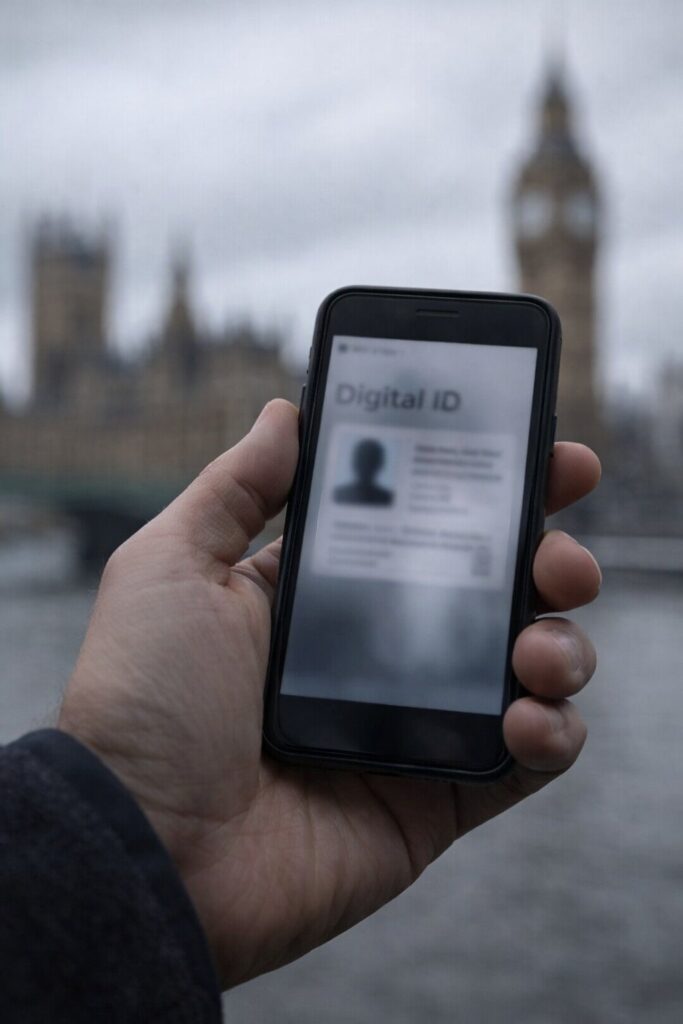

The UK government has performed a sharp U-turn on plans to make digital ID cards compulsory for workers, abandoning a policy that ministers had previously described as central to tackling illegal working and tightening immigration controls.
Under the original proposal, workers would have been required to hold a government-backed digital identity on their phone to prove their right to work in the UK. But following mounting political pressure, civil liberties concerns and criticism across Parliament, the government has now confirmed that digital ID will not be mandatory.
The decision marks one of a growing number of policy reversals and comes just months after senior ministers insisted the scheme would be unavoidable.
What was the digital ID plan?
The digital ID scheme was designed to modernise the UK’s right-to-work checks by replacing paper documents and manual verification with a smartphone-based identity system.
Ministers argued the existing process relied on what one government source described as a “hodgepodge of paper-based systems” that left employers vulnerable to fraud and abuse. Under the plan, anyone starting a new job — and potentially those renting a home — would have needed to present a digital ID linked to a central database confirming their entitlement to work and live in the UK.
The government said this would make it harder for people to work illegally, reduce exploitation, and improve border enforcement.
Why the government reversed course
Despite those claims, the proposal quickly attracted criticism from across the political spectrum.
Privacy campaigners warned that a compulsory digital ID risked becoming a de-facto national identity card, raising serious concerns about surveillance, data security and state overreach. Trade unions and migrant rights groups argued it could disproportionately affect migrant workers, gig economy staff and those without consistent access to smartphones.
Opposition parties also seized on the plan as evidence of policy instability. The Conservatives accused the government of weakness and indecision, while the Liberal Democrats said the scheme was “doomed to failure” and would have cost billions of pounds while delivering little benefit.
Facing growing backlash, ministers have now confirmed that while right-to-work checks will remain mandatory, digital ID cards themselves will not be compulsory.
What replaces mandatory digital ID?
According to reports, workers will still need to prove their right to work, but employers will be able to accept alternative documentation — including passports, biometric residence permits and electronic visas — rather than a single digital ID app.
This approach mirrors the current system, albeit with greater use of digital verification where appropriate. The government insists it remains committed to improving right-to-work checks but says any future digital ID system will follow a full public consultation.
In a statement, a government spokesperson said digital identity could still play a role in making public services “more joined-up and effective”, but stressed the importance of inclusion and flexibility.
A politically damaging reversal
The abandonment of the digital ID requirement has been widely framed as another high-profile U-turn.
Just four months ago, ministers had stated plainly that people would not be able to work in the UK without a digital ID. That certainty has now evaporated, fuelling criticism that the government announced a sweeping policy before fully thinking through its consequences.
Shadow ministers described the reversal as humiliating, while Liberal Democrats mocked the pace of policy changes, questioning whether departments were prepared for implementation at all.
For the government, the episode risks reinforcing a narrative of instability at a time when trust and competence remain central political battlegrounds.
What this means for workers and employers
For now, the practical impact is clear:
- Workers will not be forced to hold a digital ID card
- Employers must still carry out right-to-work checks
- Existing forms of identification remain valid
Businesses had privately raised concerns about the cost and complexity of transitioning to a mandatory digital system, particularly for smaller employers. Many will see the reversal as a relief, at least in the short term.
However, uncertainty remains over whether a revised digital identity scheme could re-emerge later in this Parliament.
What happens next?
Ministers say a public consultation on digital identity is still planned, suggesting the idea is not entirely dead. Any future proposal, however, is likely to be narrower in scope and voluntary rather than compulsory.
The government will also face pressure to clarify how much public money has already been spent developing the abandoned scheme, and whether those funds will be redirected to frontline services such as the NHS or policing.
As debates over immigration, civil liberties and digital surveillance intensify, the digital ID U-turn highlights the difficulty of balancing enforcement with public trust.
For now, mandatory digital ID cards for workers are off the table — but the political fallout is far from over.
Read more UK politics on Swikblog’s UK Politics section.
Source coverage: Sky News | The Telegraph

Make Swikblog your go-to source on Google for reliable updates, smart insights, and daily trends.