
By Swikriti Dandotia | January 19, 2026 | Eastbourne, East Sussex
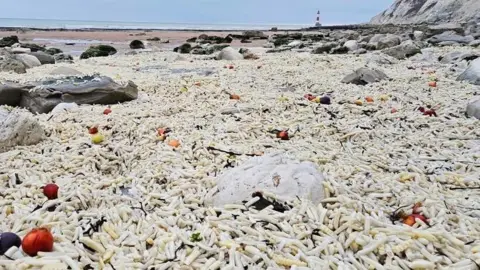
People walking the south-coast shoreline near Eastbourne over the weekend thought they were seeing a trick of the light — a pale, sand-like blanket that didn’t match the season or the tide. Up close, it was stranger: thousands upon thousands of uncooked chips, scattered in drifts along the beach, many still inside torn plastic bags.
The most heavily affected stretch appears to be Falling Sands, a more remote patch of coastline close to the Beachy Head cliffs. Photos shared locally show the chips piled in thick bands where the last tide line settled, with packaging snagged in shingle and seaweed.
While the scene has the absurdity of a seaside prank, the likeliest explanation is far more sobering: cargo lost at sea during rough weather in the Channel. In recent days, HM Coastguard has been monitoring reports of shipping containers and debris washing ashore, including along parts of Sussex, after storm conditions offshore. HM Coastguard updates have previously detailed container losses in the Solent and the south coast region, and the latest beach finds fit the same pattern of currents pushing contents landward.
A volunteer clean-up started almost immediately
By Sunday, locals were already organising to clear what they could. The chips are not just messy — as they break down, they can become slippery underfoot and attract scavenging wildlife, while the plastic packaging is a more direct hazard: easy for animals to ingest, and difficult to collect once it fragments.
In Eastbourne, the response has been practical and fast. People have brought sacks, gloves and grabbers, focusing on the most visible concentrations while reporting larger items to the relevant authorities. It is the kind of community clean-up that has become familiar on Britain’s coastlines — except, this time, the beach is littered with something that looks, at a distance, like food meant for a chip shop.
Why chips — and why now?
When containers are lost in heavy seas, their contents can travel for days — sometimes weeks — before washing ashore, depending on wind direction, tides and the density of the cargo. Food items sealed in plastic can float longer than you’d expect. Bags split, spill, refloat, and then strand again on the next tide.
The “chips” in this case are understood to be industrial, pre-cut potatoes — the sort of bulk frozen product supplied to catering and food service — rather than snack crisps. That matters because they can quickly turn into a sour, decomposing mass once they thaw and absorb seawater, making cleanup unpleasant and time-sensitive.
The broader context is that Sussex beaches have seen a run of odd arrivals recently, not limited to chips. Brighton, for instance, has also dealt with large quantities of onions and other debris turning up along the shoreline — another clue that multiple cargo loads may have entered the water during storm periods. The Guardian’s reporting on the Brighton onions connects the dots between container losses and the strange mix of household and food items ending up on the same stretch of coast.
What officials typically advise the public to do
The guidance in these situations is usually consistent: keep a safe distance from any large debris (especially containers), avoid handling unknown materials, and report significant finds through the appropriate coastal and local authority channels. Even seemingly harmless items — food, packaging, broken insulation — can carry contamination risks after prolonged time in seawater.
For dog owners and families, the key point is that washed-up food waste can be tempting but unsafe. Waterlogged, spoiled produce can cause illness, and plastic packaging is an obvious choking hazard. A cautious walk is still possible, but this is the moment to keep pets on leads and children away from the tide line until the worst of the debris is cleared.
A bigger story hiding inside a bizarre one
The image of a beach carpeted in chips is the kind of headline that travels fast — but it also underlines a quieter reality of modern shipping. When severe weather hits, the ocean does not just swallow what falls overboard; it returns it, piece by piece, to places where people swim, walk and fish.
On the Sussex coast, that return has arrived in the most unexpected form: a winter shoreline that looks, for a moment, like it’s been dusted with pale “sand” — until you recognise the shape of a chip, and the plastic crinkling in the surf.
Related on Swikblog: UK weather updates · Environment & local impact
Thousands of chips Eastbourne beach, Falling Sands chips, Beachy Head chips wash up, Sussex beach cargo spill, shipping container contents wash ashore, HM Coastguard containers Solent, Brighton onions beach, marine litter Sussex coast, Eastbourne volunteer beach clean-up

Make Swikblog your go-to source on Google for reliable updates, smart insights, and daily trends.