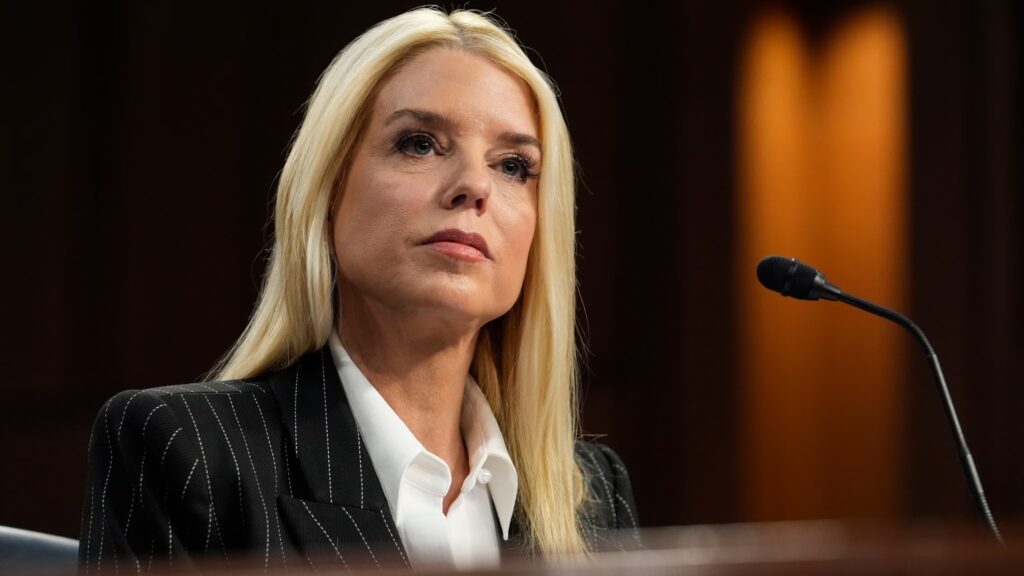
Lindsey Halligan has stepped aside from the role of U.S. attorney for the Eastern District of Virginia after a rare and escalating confrontation with federal judges over whether she had the legal authority to hold the job at all. The departure closes a tense chapter in one of the nation’s most important federal prosecutor’s offices, where judges had been openly warning that court filings still listing Halligan as the district’s top prosecutor were not just confusing, but potentially improper.
At the center of the dispute was a basic question with enormous consequences: who has the lawful power to lead the office when the Senate has not confirmed a nominee. Halligan had been serving in an interim capacity, but judges repeatedly pointed to the limits imposed by federal law, and to a prior ruling that her appointment did not comply with those requirements. In blunt language more typical of a political showdown than courtroom procedure, one judge described the continued use of the U.S. attorney title as a “charade” and warned that lawyers attaching her name to official pleadings could face professional consequences.
The clash grew sharper over recent weeks as judges pressed for answers to a question that, in ordinary times, would never need to be asked: why does an attorney keep presenting herself as the head of an office after a court has ruled she was unlawfully appointed? In multiple cases, the issue wasn’t abstract. The legitimacy of prosecutions, signatures on indictments, and representations made to the court all depend on whether the prosecutor occupying the post is legally empowered to act.
Catch up on the latest funding deal and why it matters—then return here for the legal fallout shaking the Justice Department’s leadership fight.
The Justice Department, in defending Halligan’s standing, argued in filings that the executive branch retained authority to manage temporary appointments and keep the work of the office moving. But the judiciary’s response was unusually direct: judges made clear that their courtrooms would not accept paperwork that, in their view, ignored binding orders about her status. The tone mattered as much as the substance. A sharply worded judicial order criticized what it described as rhetoric unfit for a department expected to model restraint and precision.
The timing added urgency. Interim appointments come with a clock, and judges noted that even if the appointment had been valid, the temporary window was ending. Within the courthouse, the atmosphere turned procedural and public at the same time: rather than quietly negotiating behind the scenes, the court moved to begin identifying a lawful replacement. That shift carried its own message—one the bench rarely sends in such plain terms—about who the judges believe must step in when the normal confirmation process stalls.
Read about the latest tuna recall affecting multiple states and what consumers need to know before your next seafood purchase.
Under federal law, when there is no Senate-confirmed U.S. attorney in place, judges can appoint an interim leader to keep the office running until the vacancy is filled through the confirmation process. In this case, the court signaled that it was prepared to exercise that authority. It also underscored that the job is not simply a title on letterhead; it is a legal status with consequences that spill into every case filed, every negotiation conducted, and every representation made to a judge.
In disputes like this, the stakes aren’t just political. They are procedural: whether filings are accurate, whether indictments are valid, and whether a courtroom can trust the government’s representations.
Attorney General Pam Bondi announced Halligan’s exit publicly and framed the outcome as a loss for the department, while placing responsibility on Senate dynamics that made a permanent confirmation unlikely. Halligan’s nomination had not cleared the Senate, and Virginia’s senators signaled they were not inclined to support her. With that path effectively blocked, the confrontation shifted from Washington’s confirmation politics to the practical reality of whether the courts would recognize her authority in day-to-day litigation.
For the Eastern District of Virginia, the episode landed as more than an internal personnel shuffle. The office is known for handling high-stakes national security work, complex fraud investigations, and politically sensitive cases that demand credibility in front of judges. In that setting, courtroom confidence is not optional. When judges begin openly questioning who is in charge—and whether the government is accurately identifying its own leadership—the reputational damage can be immediate, even if no single case becomes the headline.
The court has already begun the formal process of seeking interest from lawyers who may be willing to serve as an interim, court-appointed U.S. attorney while the Senate confirmation process remains unresolved. The vacancy notice makes clear the court’s view that the role must be filled through lawful channels, with the authority to speak for the government in court beyond question. You can read the court’s public vacancy announcement here: Eastern District of Virginia interim U.S. attorney vacancy announcement .
What happens next will likely be quieter than what came before, but no less consequential. The larger question raised by the standoff—how far a temporary appointment can stretch before courts reject it—has implications beyond Virginia. For now, one thing is certain: in the Eastern District of Virginia, judges signaled they were no longer willing to treat the dispute as a paperwork issue. They treated it as a rule-of-law issue. And they demanded it end.

Make Swikblog your go-to source on Google for reliable updates, smart insights, and daily trends.