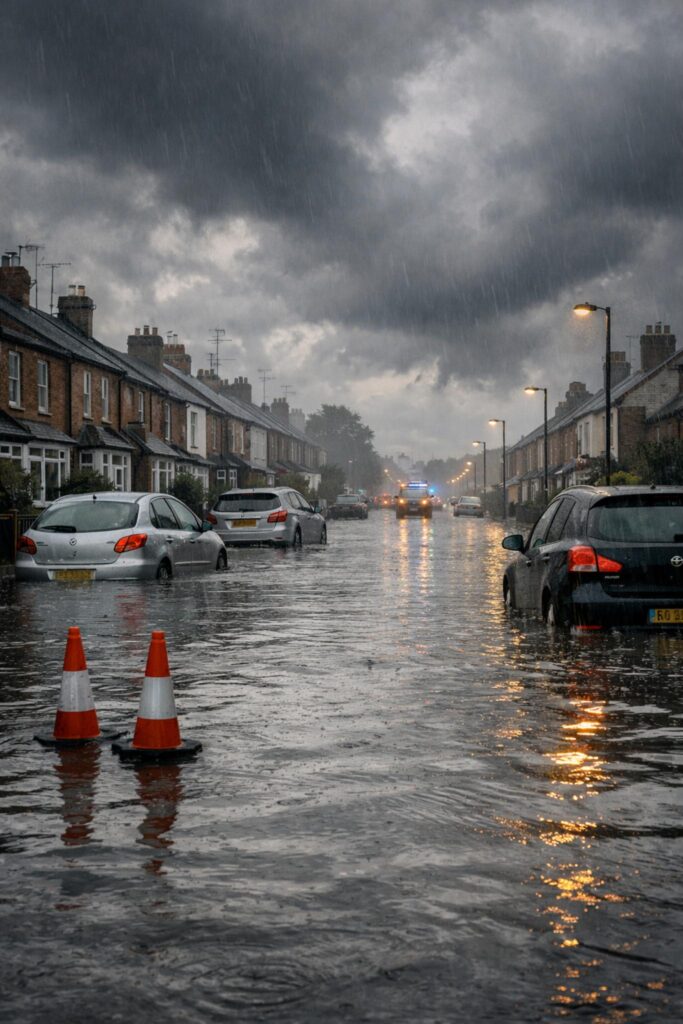

The UK is still reeling from Storm Chandra, with flood water lingering on already saturated ground and fresh warnings keeping communities on edge. Here’s what’s happening, where the risks remain highest, and what to do if you’re in the path of rising rivers.
Storm Chandra has left a stubborn legacy: more than 100 flood warnings across parts of the UK, with emergency responders still dealing with the knock-on effects of intense rainfall, fast-rising rivers, and roads that can turn treacherous in minutes. Even where the skies look calmer, the danger hasn’t necessarily passed — because flood water often arrives late, travelling downstream through river systems and pooling across low-lying land.
The most immediate risk remains around rivers already under pressure and in areas where drainage has struggled to cope. In the South West, communities have faced some of the sharpest impacts, including significant surface-water flooding, disrupted transport links, and repeated calls from authorities to avoid unnecessary travel. When rain falls on ground that’s already soaked, it doesn’t take much for small streams to become torrents — and for familiar routes to become impassable.
Quick facts people are searching right now
- Flood warnings and alerts remain widespread, with some communities facing continued river-level pressure even after the heaviest rain has moved on.
- Parts of the South West have seen rescues from vehicles caught in flood water and repeated road closures on key routes.
- Travel disruption has rippled outward, with rail and road problems compounded by localised flooding and debris.
- Northern areas have also faced wintry hazards, adding ice and snow risk to already difficult conditions.
Somerset has been among the areas under the harshest spotlight, after a major incident response was triggered to coordinate help for communities dealing with extensive flooding. The concern there isn’t just what has already happened, but what comes next: water moving through the system can keep the Levels and Moors vulnerable for days, especially when rivers and drains are already running high. For residents, it can feel like the storm won’t end — because the clean-up starts before the water has fully left.
Devon has also seen intense impacts, with river levels surging rapidly and flood risks escalating in a matter of hours. In fast-changing situations like this, official warnings can be upgraded quickly, then downgraded as levels fall — but that doesn’t mean it’s safe to relax. Flooding can return with the next band of rain, and damage to roads, bridges and rail lines can keep journeys disrupted long after the worst weather has passed.
Away from the South West, disruption has been felt in multiple regions. School closures and power issues have affected parts of the UK and Ireland, while rail operators and local councils have warned of ongoing delays where tracks, cuttings and access roads have been hit by flooding. For commuters, the practical question is often simple: can I get to work safely — and can I get back? In storms like Chandra, that second part is the one that’s easiest to underestimate.
If you’re trying to work out what applies to your postcode, the simplest rule is to rely on official, live updates rather than social media screenshots that may already be outdated. The Environment Agency’s live service is the quickest way to see the latest status for your area, including whether a warning has escalated: check current flood warnings here.
Practical safety advice remains consistent — and it matters because most storm injuries happen in ordinary places, during ordinary decisions. Don’t drive through flood water, even if it looks shallow. Avoid walking near swollen rivers and fast-flowing streams. Keep an eye on updates from your local council, and if you live in a flood-prone area, move valuables upstairs and prepare to turn off electricity if water enters your home. If you’re asked to evacuate, treat it as time gained, not time wasted.
For many households, Storm Chandra has become a familiar modern story: extreme weather, saturated ground, and disruption that outlasts the headline moment. The coming hours will be shaped by how quickly river levels fall, whether further rain bands arrive, and how much damage has been done to the infrastructure that keeps communities connected. For now, the message is simple — heed the warnings, don’t take chances with flood water, and plan journeys as if conditions could change again at short notice.
Read more UK updates on Swikblog.

Make Swikblog your go-to source on Google for reliable updates, smart insights, and daily trends.