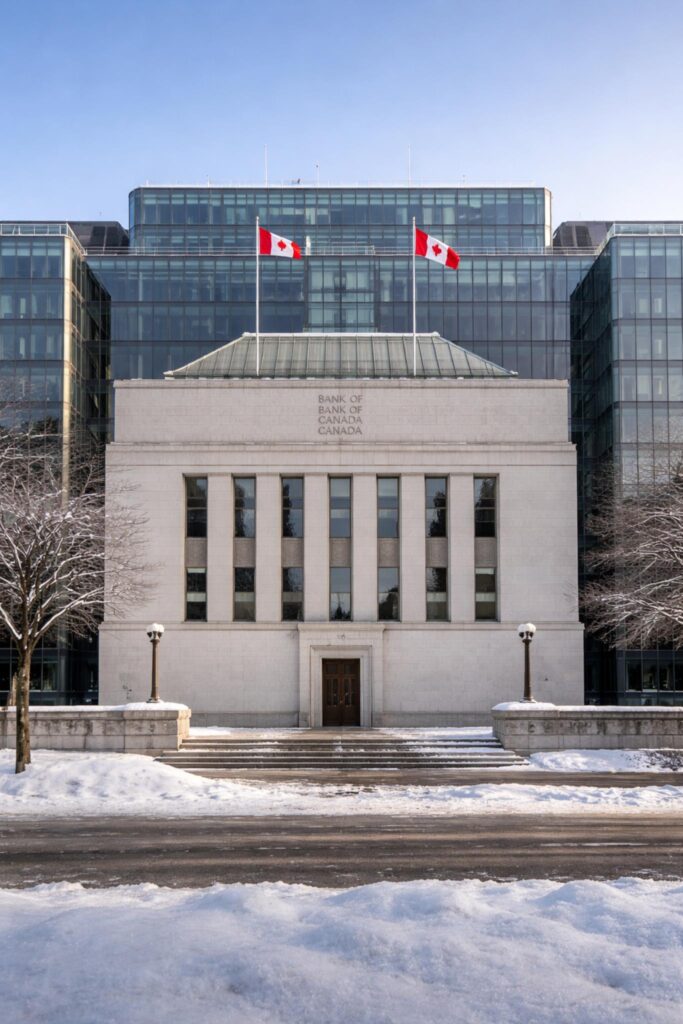

Canada’s first big monetary policy moment of 2026 lands today, with the Bank of Canada set to deliver an interest rate decision alongside updated economic forecasts in its monetary policy report. For households watching mortgage payments, businesses weighing investment plans, and investors tracking the Canadian dollar, the question isn’t just what the bank does with rates — it’s what the new forecasts reveal about the road ahead.
The policy rate currently sits at 2.25 per cent, and economists widely expect the Bank of Canada to keep that benchmark unchanged. A hold would reinforce the idea that the central bank wants more clarity before making its next move, especially as the economy navigates a mix of steady inflation signals and rising uncertainty tied to trade policy.
Today’s update matters because a rate decision is only half the story. The monetary policy report’s forecasts shape how markets interpret the bank’s next steps — whether officials see growth firming up, slowing down, or holding in a narrow range. Even without a rate change, a shift in language about inflation, employment, or consumer spending can move expectations in a hurry.
A major complication is trade. The Canadian economy faces an uncertain outlook as the scheduled review of the Canada–U.S.–Mexico trade agreement approaches later this year. Trade reviews can influence business confidence, investment timelines, and hiring plans — all of which filter into how quickly inflation cools or re-accelerates. When the future path of trade policy looks less predictable, central banks often default to caution.
Governor Tiff Macklem has signaled that the bank believes inflation is likely to hover around its two per cent target this year, while also stressing the bank is prepared to respond if the outlook shifts. That “prepared to respond” line is doing heavy lifting: it keeps the door open to action later, while acknowledging that the current baseline view depends on incoming data staying broadly consistent.
Another clue comes from business sentiment. In the bank’s business outlook survey released last week, sentiment at the end of last year was described as subdued, though improved from the lows seen in the second quarter of 2025. That combination — not booming, but not collapsing — often supports a steady-rate stance. It suggests some resilience, yet not enough momentum to justify forcing tighter financial conditions.
So what should readers watch for today? Here are the signals that tend to drive the biggest reaction, even if rates remain unchanged:
- Whether the bank’s updated forecasts tilt more cautious on growth, or more confident on a soft landing.
- How firmly the report anchors inflation around the 2% target — and whether risks are described as balanced or skewed.
- Any emphasis on trade uncertainty and how it could change business investment and consumer demand.
- Language that hints at what would need to happen for the next rate move — stronger inflation persistence, a sharper slowdown, or a material shock.
For homeowners and would-be buyers, the near-term takeaway is straightforward: if the bank holds steady, borrowing costs may stay broadly stable in the short run. But the bigger story is the trajectory. If the bank’s forecasts suggest the economy can absorb today’s rate without overheating or stalling, it strengthens the case for patience. If the outlook looks shakier — especially with trade uncertainty looming — markets may start pricing in a different path, which can feed into mortgage pricing and the currency even before the bank acts.
For businesses, today’s message can influence everything from inventory decisions to hiring. When sentiment is subdued, small changes in confidence matter. A steady-rate decision paired with forecasts that lean cautious can make companies more defensive. A steady-rate decision paired with forecasts that look steadier can encourage firms to proceed with plans that were paused during last year’s softer stretch.
If you want to track the official decision and statement as soon as it posts, the central bank publishes details directly on its site via the Bank of Canada’s key interest rate page. (That’s also the fastest way to confirm the rate and read the exact wording that markets latch onto.)
From a reader’s perspective, this is the moment to separate the headline from the hints. The headline is the rate itself. The hints are in the forecast language: how confident the bank sounds about inflation staying near target, how it frames growth, and how loudly it flags trade uncertainty as a risk. Those details are often what determine whether a “rate hold” feels calm — or like the quiet before the next move.
For more fast, reader-first updates in this style, you can also browse the latest posts on Swikblog as the story develops through the day.

Make Swikblog your go-to source on Google for reliable updates, smart insights, and daily trends.