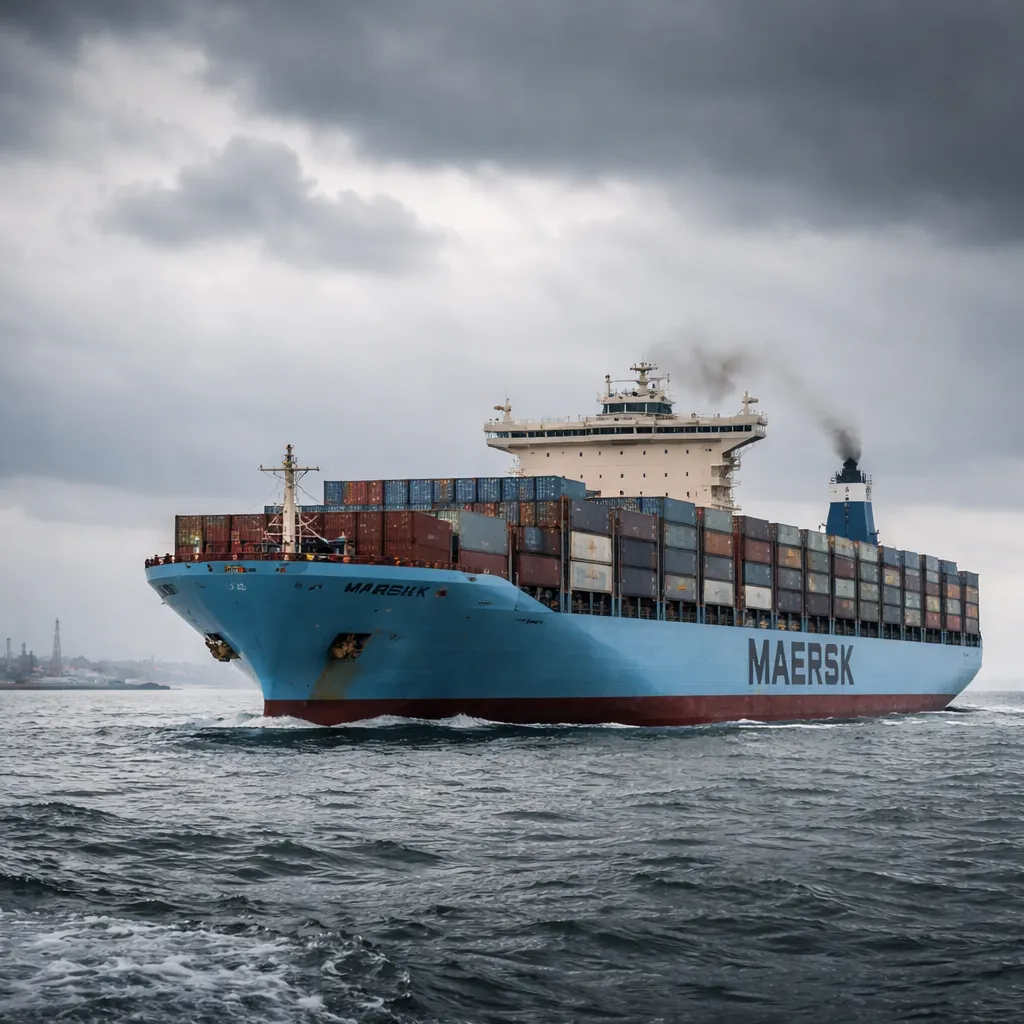

A.P. Moller – Maersk A/S shares moved lower in early trading on Friday after the Danish shipping giant deepened its response to the fast-worsening Middle East crisis, adding another layer of disruption to already strained global trade routes. Maersk stock was seen around DKK 16,725, down DKK 215 or about 1.27%, after the company confirmed it had suspended two shipping services linking the Middle East with Asia and Europe.
The latest move came as the conflict involving Iran continued to shake freight markets, port operations, and shipping schedules across some of the world’s most important maritime corridors. For investors, the market reaction underlined the growing concern that what began as a regional security shock is now turning into a broader supply-chain event with consequences for container volumes, vessel routing, transit times, and freight pricing.
Maersk suspends two key services
According to the company’s latest customer advisory, Maersk has temporarily halted its FM1 service, which connects the Far East to the Middle East, and its ME11 service, which links the Middle East to Europe. The company described the decision as a precautionary step aimed at protecting personnel and vessels while reducing wider operational disruption across its network.
That language matters because it shows Maersk is not simply reacting to isolated delays. It is actively trying to ring-fence the rest of its network from a conflict zone that has become harder to navigate safely. In practical terms, the suspension of these services raises the risk of delayed cargo, longer lead times for shippers, and renewed pressure on trade lanes that were only beginning to normalize after a prolonged period of Red Sea disruption.
Suez and Hormuz risks are back at the center of the market
The fresh service suspensions follow an earlier Maersk decision to pause sailings through the Bab el-Mandeb Strait and the Suez Canal, while rerouting ships around the Cape of Good Hope. That rerouting significantly lengthens voyages between Asia and Europe, increases fuel and operating costs, and reduces schedule reliability across global shipping networks.
Maersk also said it had suspended all vessel crossings in the Strait of Hormuz until further notice, though it continued accepting cargo bound for the Middle East. The company warned that services calling at ports in the Arabian Gulf could face delays, rerouting, and schedule changes. Taken together, those moves signal that pressure is now building across multiple strategic chokepoints rather than one isolated corridor.
Key market snapshot: Maersk shares traded near DKK 16,725, versus a previous close of DKK 16,940. The day’s range shown in early trading was DKK 16,685 to DKK 17,060, reflecting how closely investors are tracking each new development tied to the Middle East shipping crisis.
Why the crisis matters for global supply chains
The shipping story is no longer just about route security. It is increasingly about the knock-on effects hitting importers, exporters, retailers, manufacturers, and freight buyers. The conflict escalated sharply after the United States and Israel launched major attacks on Iran, triggering a new wave of operational caution across the maritime sector.
Freight analytics firm Xeneta said the fallout has already left 147 container ships sheltering in the Gulf. That kind of vessel clustering can quickly feed into port congestion, berth delays, and equipment bottlenecks, especially when carriers are forced to reschedule arrivals or divert capacity. It also tends to lift freight rates, which can eventually pass through to cargo owners and, in some cases, consumers.
For Maersk, one of the world’s largest container shipping groups, the issue is not only whether ships can move safely through specific waterways. It is also whether the company can preserve network efficiency while protecting crew, cargo schedules, and customer commitments. Every detour around southern Africa adds sailing time. Every suspended loop forces planners to rebalance equipment and vessel deployment. Every delay at Gulf ports creates additional uncertainty for customers moving goods into Europe, Asia, and the Middle East.
What investors may be watching next
Investors will likely focus on three pressure points from here. First is whether the current suspension of FM1 and ME11 remains temporary or expands to other services. Second is whether congestion in Gulf ports worsens as more vessels wait for security clarity. Third is whether higher freight rates offset some disruption-related costs for carriers, or whether the broader earnings effect turns more negative as network inefficiencies build.
There is also a wider question hanging over the sector. Maersk had only recently been moving toward a gradual return of some services to the Suez route after nearly two years of trade disruption linked to Red Sea attacks. That normalization thesis is now back under pressure. If the conflict remains elevated, the shipping industry may again have to plan around longer voyages, tighter capacity management, and another volatile period for global logistics pricing.
A detailed Reuters report on Maersk’s latest shipping suspensions captured how quickly the crisis has spread from security headlines into freight operations and investor sentiment. For the market, Friday’s slide in Maersk shares looked less like a routine pullback and more like a direct response to the risk that Middle East instability could now weigh on one of global trade’s most important operators.
With the Suez Canal route under renewed pressure, the Strait of Hormuz effectively closed to Maersk crossings for now, and two major services suspended, the company is once again at the center of a supply-chain story that reaches far beyond shipping. The stock move may have been modest in percentage terms, but the message from the market was clear: investors are pricing in a period of elevated uncertainty for global freight, trade flows, and maritime operations.

Make Swikblog your go-to source on Google for reliable updates, smart insights, and daily trends.