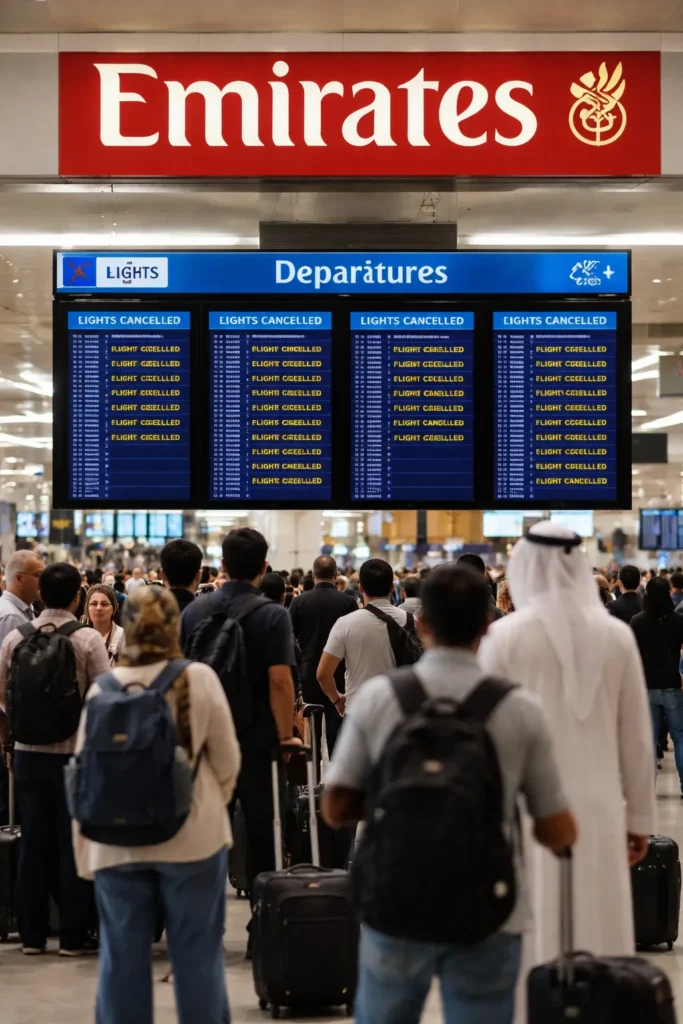

The war between the US, Israel and Iran has pushed Gulf travel disruption into a more alarming phase, with Emirates suspending all flights to and from Dubai until further notice as regional missile and drone threats continue to unsettle one of the world’s busiest aviation hubs. For travellers, airlines, tourism operators and Gulf residents, Saturday brought a fresh jolt: Dubai’s flagship carrier told passengers not to travel to the airport, while UAE authorities said air defence systems were actively intercepting incoming threats and urged the public to remain in safe locations.
The latest developments underline how quickly a military confrontation can spill into everyday life across the Gulf. Dubai has spent years building its reputation as a stable global transit centre, but the conflict has now forced mass schedule disruption, emergency alerts, venue closures and renewed safety advisories. What was once a regional geopolitical story is now directly affecting flights, family travel plans, business routes, tourism activity and supply chains across the UAE and beyond.
Important update: Emirates said all flights to and from Dubai are suspended until further notice. Passengers were advised not to travel to the airport, while all city check-in points across Dubai were temporarily closed.
Emirates halts Dubai operations as safety takes priority
Emirates said the safety of passengers and crew remains its highest priority, a message that captures the seriousness of the current operating environment. The airline outlined support options for affected customers, including rebooking for travel on or before April 30 for eligible bookings and the ability to request refunds. Passengers who booked through travel agents were asked to contact those agents directly, while customers who booked with Emirates can manage changes through the airline’s official support channels.
The suspension is significant not only because of Emirates’ size, but because Dubai sits at the heart of global long-haul aviation. When Emirates pauses broad operations, the effect is felt far beyond the UAE. Transit passengers connecting between Europe, Asia, Africa and Australia are suddenly exposed to cancellations, reroutings and extended delays. That turns a military conflict into an immediate global travel shock.
More breaking coverage: Follow wider world, aviation and market updates on Swikblog.
UAE air defences activated as residents receive emergency alerts
Earlier in the day, the UAE Ministry of Defence confirmed that air defence systems were responding to missile and drone threats. Officials said the loud sounds heard by residents were linked to interception activity rather than direct impacts in populated areas, and an emergency alert was sent to mobile phones instructing people to seek shelter, stay away from windows and open areas, and wait for official instructions.
Dubai authorities also said a minor debris incident had been contained with no injuries reported. Officials pushed back against inaccurate online claims about incidents at Dubai International Airport and repeated a now-familiar message in times of crisis: rely on verified official updates, not rumours moving across social platforms.
The picture that emerges is one of a country still functioning, but functioning under strain. The UAE has tried to project order, readiness and resilience, stressing that public services continue, supply chains remain active and defence systems are prepared. Yet the combination of flight suspensions, mobile emergency alerts and venue closures shows that the security environment remains highly fluid.
Dubai attractions close while the region hardens its response
The broader precautionary response inside the UAE added to the sense of disruption. Global Village said it would remain closed on March 7 and 8, while Ain Dubai and Dubai Parks and Resorts were also closed for the weekend as safety measures. These closures matter because they hit consumer confidence and tourism sentiment at the very moment the emirate would usually be welcoming heavy visitor traffic.
At the same time, major retailers and logistics operators moved to reassure the public. Lulu Group said it had begun flying in fresh food supplies on chartered cargo flights, including large produce and meat shipments, to help maintain stock levels in UAE supermarkets. That message was designed to calm nerves and prevent panic buying, signalling that authorities and major businesses are trying to keep daily life as normal as possible despite the conflict overhead.
The war widens across the Gulf
Saturday’s updates showed the conflict is no longer confined to direct exchanges between Israel and Iran. Saudi Arabia reported intercepting drones targeting Shaybah oil field and another drone east of Riyadh, while Bahrain said its air defence systems had destroyed 84 missiles and 147 drones since the start of the attacks. Kuwait, Qatar and other Gulf states also continued to adjust transport, education and emergency responses as threats and disruptions spread.
Israel’s military said more than 80 fighter jets struck military sites in Tehran and central Iran, while Iran’s Revolutionary Guards signalled defiance around the Strait of Hormuz, one of the most sensitive energy chokepoints in the world. The Arab League, meanwhile, is set to hold an emergency meeting on Sunday to discuss Iranian attacks on several Arab countries.
That matters because the crisis is now pressing on three critical pillars of the regional economy at once: aviation, energy and public confidence. Dubai’s airport ecosystem, Gulf oil infrastructure and the Strait of Hormuz all sit at the center of global trade. Any instability across those areas can ripple quickly through airline schedules, insurance costs, shipping routes and commodity markets.
What this means for passengers and the wider Gulf economy
For passengers, the message is clear: travel plans tied to Dubai are vulnerable to sudden change. Anyone booked on Emirates in the coming days will need to monitor official updates closely, make sure contact details are current, and avoid heading to the airport without confirmation that a flight is operating. The closure of city check-in facilities further underscores that this is not routine disruption but a high-alert operating environment.
For the UAE, the challenge is now as much reputational as operational. Dubai’s strength has always been certainty, efficiency and connectivity. A prolonged shutdown or repeated stop-start air traffic pattern would test that model. Even if infrastructure remains intact, uncertainty alone can damage tourism, corporate travel and regional confidence.
The UAE’s authorities continue to emphasise readiness, resilience and national security. But Emirates’ decision to suspend all Dubai flights until further notice shows the conflict has crossed a new threshold. This is no longer only a war measured in air strikes and official statements. It is being felt in terminals, tourist districts, family itineraries and the everyday rhythm of a city built on movement.
For passengers, the safest course is to follow updates directly from Emirates travel updates and official UAE channels as the situation develops.

Make Swikblog your go-to source on Google for reliable updates, smart insights, and daily trends.