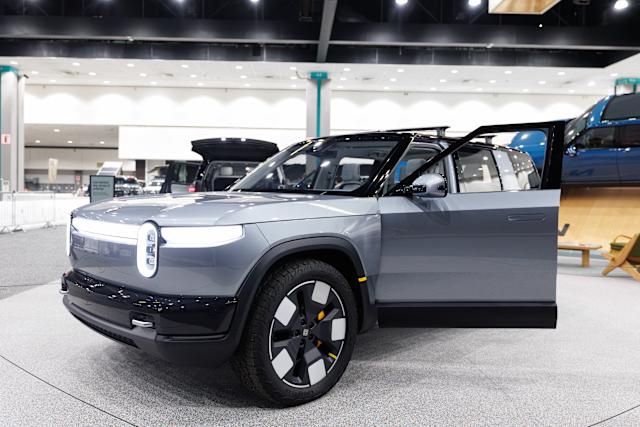

Rivian has snapped back into the market spotlight after a major robotaxi agreement with Uber triggered a sharp pre-market rally in the stock. Shares of Rivian Automotive (RIVN) finished the regular session at $15.53, down 1.83%, before jumping to around $16.85 to $16.86 in pre-market trading, a gain of roughly 8.5%. The move followed news that Uber plans to back Rivian’s robotaxi push in a deal worth up to $1.25 billion, instantly changing the tone around one of the EV sector’s most closely watched turnaround stories.
Uber deal gives Rivian a major robotaxi growth trigger
The agreement outlines a large commercial opportunity for Rivian at a time when investors have been looking for stronger visibility on future demand. Uber and its fleet partners are set to purchase 10,000 Rivian R2 robotaxis, with an option to acquire another 40,000 vehicles starting in 2030. The first rollout is expected to begin in San Francisco and Miami in 2028, with the service later expanding to as many as 25 cities by 2031.
Uber’s total commitment could reach $1.25 billion, though the funding is tied to certain autonomous milestones. An initial $300 million has been committed, subject to regulatory approval. That combination of capital support and long-term fleet demand has given Rivian a fresh catalyst just as the company prepares for its next major production chapter.
R2 demand outlook moves back to the center of the story
For Rivian, the significance of the partnership goes beyond the headline number. The R2 is widely seen as the company’s most important next-generation vehicle because it is intended to push Rivian into a broader and more affordable segment of the EV market. A large order tied to Uber’s platform gives investors a clearer sense that the vehicle may arrive with built-in commercial relevance rather than depending only on consumer momentum.
That matters for a business still trying to prove it can scale efficiently and move closer to sustained profitability. A guaranteed pipeline of at least 10,000 vehicles, combined with milestone-based funding, gives Rivian a stronger demand narrative than it had just days ago. It also gives the market a more concrete reason to connect the R2 launch with future revenue growth instead of treating it as a purely speculative product cycle.
Key figures moving RIVN today: Rivian closed at $15.53, fell 1.83% in the regular session, then climbed roughly 8.5% in pre-market trading to $16.85+ after Uber announced a robotaxi partnership that includes an initial $300 million commitment and a potential total of $1.25 billion.
Uber expands its autonomous strategy with another major partner
Uber has spent the past several months broadening its autonomous vehicle strategy through partnerships across the sector. The Rivian agreement adds another major lane to that plan. This time, however, the emphasis is not just on adding robotaxis to the Uber app, but on pairing Uber’s ride-hailing network with Rivian’s in-house autonomous technology and manufacturing platform.
That gives Uber another route into the fast-growing robotaxi race while reducing reliance on a single partner or technology path. It also shows that major mobility players are still willing to place large bets on autonomous expansion despite the operational complexity, regulatory scrutiny, and capital demands tied to the sector. A recent Yahoo Finance report described the agreement as one of the bigger new moves in the robotaxi space, and the market reaction suggests investors view it the same way.
Why the stock reaction was so sharp
The rally in pre-market trading reflected more than simple excitement around a new partnership. Rivian has spent much of the past year facing a difficult backdrop that included EV demand concerns, margin pressure, and ongoing questions about the path to profitability. A deal that links fresh outside capital to future autonomous vehicle orders directly addresses some of those concerns, even if it does not remove them entirely.
Investors appear to be focusing on three immediate positives. First, the agreement improves Rivian’s long-range demand visibility. Second, it supports the idea that the R2 can become a platform with both consumer and fleet relevance. Third, it places Rivian more firmly inside the autonomous mobility conversation rather than leaving it boxed into a narrower EV-only narrative.
Valuation debate is unlikely to disappear
Even with the stock moving higher in pre-market action, this announcement does not erase execution risk. The full value of the Uber commitment depends on Rivian meeting autonomous milestones, and that means there is still a wide gap between headline potential and final financial impact. Manufacturing scale, regulatory timing, software performance, and capital discipline remain critical variables for investors watching the company.
That is why the valuation debate around Rivian is still very much alive. Bulls will see the Uber deal as a sign that Rivian is gaining strategic importance in a future mobility market that stretches far beyond traditional EV sales. Skeptics will argue that the business still has to prove it can deliver production scale and margin improvement before any partnership-driven optimism deserves a much larger rerating. The stock’s sudden move shows that the market is willing to reward progress, but it also means expectations can rise quickly.
Fresh momentum arrives at a crucial time for Rivian
The timing of this development is hard to ignore. Rivian has been trying to build momentum around the R2 as the product that could reshape its long-term positioning. Now it has a major commercial partner ready to build a robotaxi fleet around that vehicle. That gives the company a stronger strategic story at exactly the point when investors want more clarity on where future growth will come from.
For now, the key takeaway is simple: Rivian’s regular-session weakness was quickly overshadowed by a much bigger after-effect from Uber’s announcement. The stock closed lower, but the pre-market surge told a completely different story. With up to 50,000 robotaxis now part of the conversation and a funding package worth up to $1.25 billion on the table, Rivian has re-entered the market discussion with a level of momentum that had been missing.

Make Swikblog your go-to source on Google for reliable updates, smart insights, and daily trends.