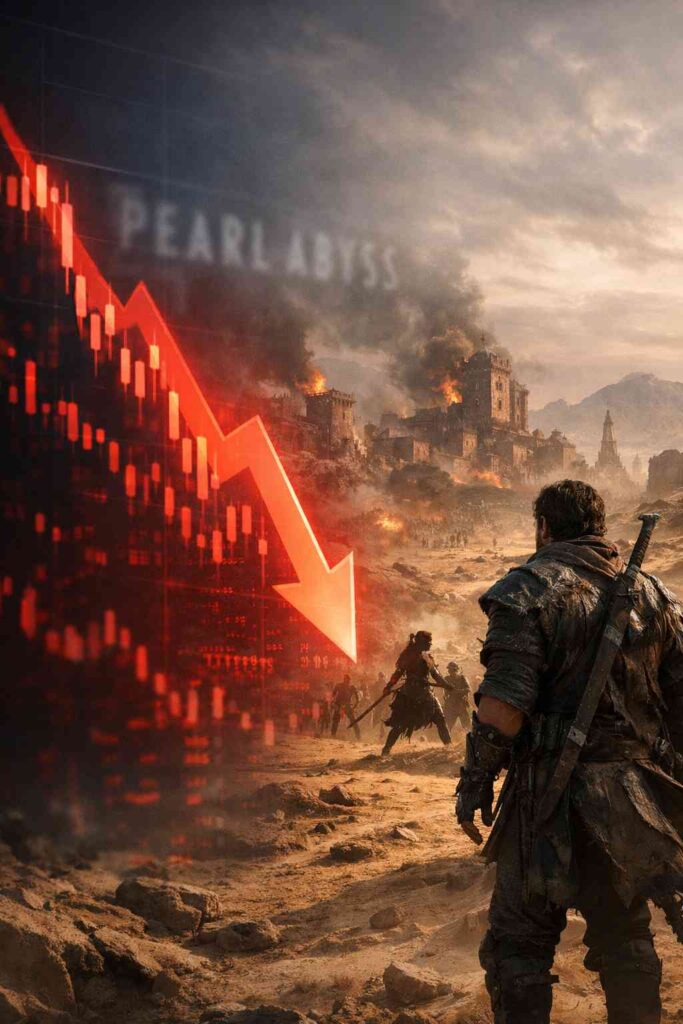

Pearl Abyss shares plunged as much as 29% in early trading on March 19, 2026, after disappointing preview reviews of its long-awaited game Crimson Desert triggered a sharp investor sell-off. The stock dropped to 46,600 won at one point, down 19,000 won from the previous session, reflecting a brutal reassessment of expectations that had been building for years.
The decline comes after global review aggregator data showed that Crimson Desert received a Metacritic score of 78 out of 100 based on early critic reviews. While a score above 75 is generally considered positive, the result fell short of market expectations, which had been set much higher in the mid-to-high 80s range. That gap between expectation and reality proved enough to spark a steep correction in the company’s valuation.
Seven-Year Development Faces Market Reality
Crimson Desert is not just another game release for Pearl Abyss. It represents one of the company’s most ambitious projects to date, with approximately seven years of development and an estimated 200 billion won invested into production alone. The game was designed as a large-scale open-world action-adventure experience, aiming to establish a new global franchise beyond the company’s flagship Black Desert series.
Given that scale of investment, investor expectations had risen significantly ahead of launch. Many market participants viewed the title as a potential blockbuster capable of driving strong global sales, boosting recurring revenue, and repositioning Pearl Abyss as a top-tier global game developer.
However, the early review consensus suggests that while the game is solid, it may not deliver the breakout impact investors had priced in.
Mixed Reviews Trigger Investor Sell-Off
The review landscape for Crimson Desert has been notably mixed. Some global outlets, including Forbes and MMORPG.com, praised the game’s technical polish, expansive world design, and overall content scale. These positives highlight Pearl Abyss’ strength in building visually rich and technically advanced gaming experiences.
On the other hand, several major gaming publications such as Game Informer, GameSpot, and Eurogamer assigned scores in the 60–70 range. These reviews pointed to weaknesses in narrative execution, clunky controls, and an overly complex content structure that could impact player accessibility and long-term engagement.
This divergence in opinion has created uncertainty around the game’s commercial trajectory. While not a failure, the lack of overwhelming critical acclaim appears to have undermined confidence in its ability to become a major global hit.
Why a 78 Score Was Not Enough
Under normal circumstances, a Metacritic score of 78 would be considered a strong outcome. However, in the context of Crimson Desert, it fell short of elevated expectations that had been building over several years. Investors were effectively pricing in a top-tier release, and anything less created downside pressure.
Gaming stocks are particularly sensitive to sentiment shifts around flagship titles. When expectations are high, even a “good” result can trigger a sharp sell-off if it fails to exceed forecasts. In this case, the market reaction reflects disappointment not with the game itself, but with the perceived gap between anticipated and actual performance.
For a project with a long development cycle and significant capital investment, the margin for error becomes much smaller. That dynamic appears to have played out aggressively in Pearl Abyss’ stock movement.
Global Launch Across Major Platforms
Crimson Desert is scheduled for a simultaneous global release across multiple major platforms, including PC (Steam), Apple Mac, PlayStation 5, Xbox Series X|S, and GeForce Now. The wide platform availability is expected to support broad market reach and maximize early adoption.
Despite the mixed reviews, the game’s large-scale distribution strategy means its commercial success will ultimately depend on player reception, engagement levels, and post-launch performance rather than critic scores alone.
Investors will now closely monitor early sales data, user reviews, and streaming trends to assess whether the initial market reaction was overdone or justified.
What Investors Should Watch Next
The sharp decline in Pearl Abyss shares highlights how quickly sentiment can shift in the gaming sector. Going forward, several key factors will determine whether the stock stabilizes or faces further pressure.
First, player engagement and retention metrics will be critical. A strong user response could offset mixed critic reviews and support longer-term revenue potential. Second, global sales performance during the initial launch window will provide clearer insight into demand strength. Finally, updates, patches, and content expansions could improve the game’s reception over time.
Investors can track ongoing critic updates and score changes on the Metacritic page for Crimson Desert, while official updates and announcements are available on the official Crimson Desert website.
For now, the market’s message is clear. After years of anticipation and heavy investment, Crimson Desert needed to exceed expectations. Instead, it delivered a mixed reception — and that was enough to wipe out nearly 29% of Pearl Abyss’ market value in a single session.

Make Swikblog your go-to source on Google for reliable updates, smart insights, and daily trends.