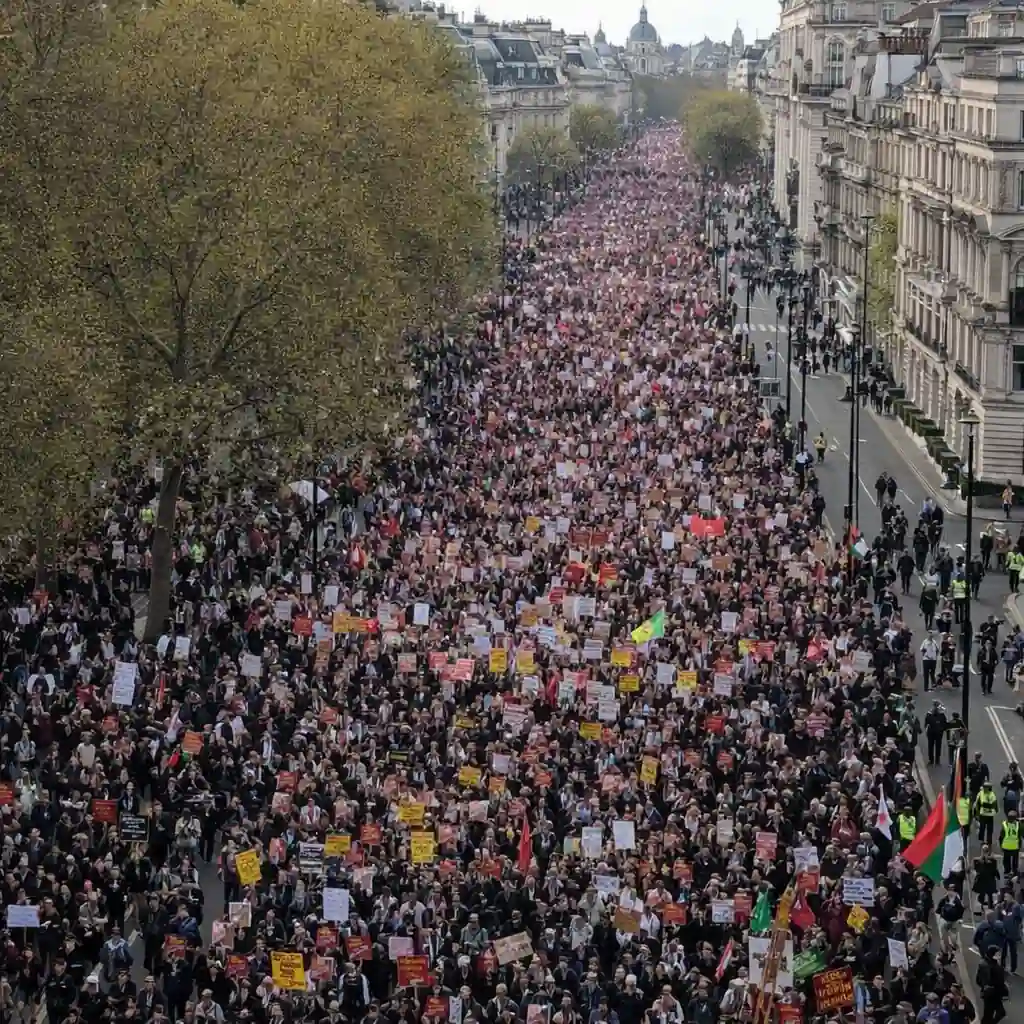

Central London turned into the centre of one of the UK’s largest political demonstrations in recent years as massive crowds gathered for an anti–far right march on Saturday. Organisers behind the Together Alliance rally claimed that as many as 500,000 people took part, describing it as the biggest protest ever held in Britain against far-right politics. Police, however, offered a far more conservative early estimate of around 50,000, highlighting a familiar dispute over crowd size.
Despite the disagreement, the scale of the turnout was impossible to ignore. From Park Lane through Piccadilly and into Whitehall, the streets were packed with protesters carrying banners, chanting slogans and marching in dense groups that stretched across central London. A rally followed in Whitehall, with speeches, music and political messages reinforcing the theme of unity against division.
The demonstration, organised by the Together Alliance, brought together a wide coalition of activists, trade unions, campaign groups and public figures. It was not a single-issue protest. Alongside opposition to far-right politics, participants voiced support for refugees, condemned racism and raised concerns about the direction of political discourse in the UK.
Mass turnout, strong messaging and visible diversity
One of the most striking aspects of the march was the diversity of the crowd. Families, students, teachers, union members and long-time activists all took part. Placards carried messages such as “Refugees are welcome here”, “No to racism” and “You cannot divide us”. Chants echoed through the streets, creating a constant background of sound as the march moved forward.
There were also creative and symbolic elements throughout the protest. Some participants wore costumes, including figures representing political or environmental themes. Environmental groups such as Extinction Rebellion were present, alongside musicians and cultural figures, adding to the sense that the protest extended beyond traditional political boundaries.
Public figures and politicians were also seen among the crowd, including prominent voices from across the progressive left. Their presence reinforced the idea that this was not just a grassroots demonstration but a broader political moment attracting national attention.
Importantly, organisers emphasised that the protest was intended to be peaceful. Police had imposed conditions under public order laws, including fixed routes and a strict end time of 5pm for the Whitehall rally. A heavy police presence was visible throughout the day, with officers lining key routes and monitoring the flow of crowds.
Why this protest happened now
The march comes amid growing concern over the rise and normalisation of far-right rhetoric in the UK. Organisers said the event was a direct response to what they described as an “unprecedented growth” in support for far-right ideas. For many participants, the protest was not just about opposing specific groups, but about pushing back against a wider political climate they believe is becoming increasingly divisive.
There was also a clear link to previous demonstrations. The event took place months after a large right-wing rally in London that drew over 100,000 people and saw incidents of disorder. Saturday’s march was framed as a counter-mobilisation — an attempt to show that opposition to such politics is both larger and more organised.
Organisers even suggested that the size of the crowd may have discouraged a stronger counter-protest presence. While a small number of counter-protesters were reported along parts of the route, there was no major confrontation, and the day remained largely peaceful.
At the same time, a separate march organised by the Palestine Coalition joined the main route before the final rally, adding to both the numbers and the political complexity of the day. This convergence of movements contributed to the scale and visibility of the demonstration.
For those interested in the official arrangements and policing strategy, the Met Police plan for the protests outlined strict routes, dispersal zones and safety measures designed to manage what was expected to be a high-turnout event.
500,000 vs 50,000 debate fuels wider conversation
The sharp difference between organiser and police estimates quickly became a central part of the story. Organisers maintained that half a million people attended, while police suggested a much smaller figure. Such disagreements are common in large-scale protests, where accurate counting is difficult due to the spread of crowds across multiple streets and locations.
But beyond the numbers, the visual impact of the protest told its own story. Aerial footage and ground images showed densely packed crowds stretching across central London. Social media amplified these visuals, turning the march into a widely shared and discussed event within hours.
This visibility matters. In the digital age, perception can carry as much weight as precise figures. The images of packed streets and continuous lines of marchers gave the protest a sense of momentum and scale that is difficult to dismiss.
More importantly, the demonstration highlighted a broader public response that often receives less attention than more extreme political voices. It showed that large numbers of people are willing to mobilise in defence of inclusion, diversity and anti-racism when they feel those values are under threat.
For continuous updates and detailed reporting from the ground, coverage by The Guardian followed the march as it unfolded across the capital.
Whether the final count proves closer to 500,000 or significantly lower, the message from London was clear. A large, visible and determined crowd came together to take a stand against far-right politics, sending a signal that the debate over the UK’s political direction is far from settled.

Make Swikblog your go-to source on Google for reliable updates, smart insights, and daily trends.