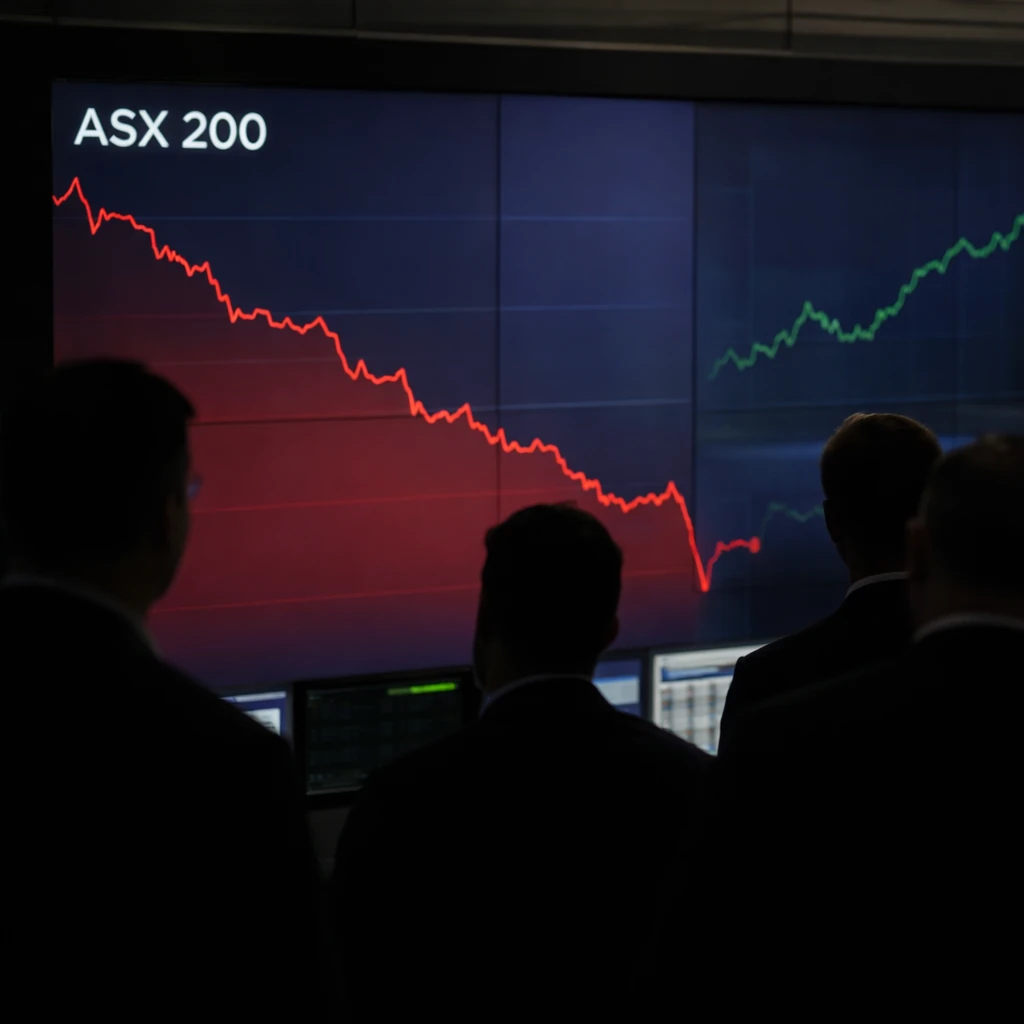

Australia’s benchmark index came under renewed pressure today, with the ASX 200 falling to 8,410, down 1.24%, as a wave of global uncertainty driven by surging oil prices, geopolitical tensions and rising interest rate expectations weighed heavily on investor sentiment.
The weak start was widely anticipated. SPI futures had already signaled a decline of around 0.7% to 0.8%, tracking a negative lead from Wall Street where US markets extended their losing streak. The Dow Jones and S&P 500 both dropped 1.7%, while the Nasdaq fell 2%, highlighting a broader risk-off mood across global equities.
Despite the sharp fall today, the ASX had shown some resilience last week, gaining 87 points to close at 8,516 and snapping a three-week losing streak. But that momentum has quickly faded. The index is now down 7.42% for March and 2.27% for the first quarter, reflecting sustained pressure from external shocks.
At the center of the latest selloff is a powerful surge in oil prices. Brent crude has remained above $110 per barrel, after climbing as high as $119.50 earlier this month. The spike has been driven by escalating conflict in the Middle East, which has disrupted critical shipping routes including the Strait of Hormuz and raised fears of prolonged supply constraints.
This energy-driven volatility is proving difficult for markets to absorb. Higher oil prices feed directly into inflation, and that is now becoming a growing concern for policymakers and investors alike. Australia’s Treasurer Jim Chalmers has already warned that earlier inflation forecasts may have been too conservative, suggesting inflation could rise into the high 4% to low 5% range, rather than peaking in the high threes as previously expected.
While the government maintains that Australia is likely to avoid a recession, the outlook is becoming more complicated. “The economy will continue to grow, but it will take a sizable hit,” Chalmers noted, pointing to the lingering economic consequences of the Middle East conflict.
The Reserve Bank of Australia’s stance is also back in focus. The central bank recently raised the cash rate by 25 basis points to 4.10%, and markets are increasingly pricing in the possibility of further tightening if inflation remains elevated. Investors will be closely watching the upcoming RBA meeting minutes for clues on the policy path ahead.
Sector performance on the ASX reflects the shifting dynamics. Materials stocks were among the strongest performers last week, rising 4.57%, supported by higher commodity prices. Utilities also gained 3.36%. In contrast, Information Technology stocks dropped 4.77%, as higher interest rate expectations weighed on growth-oriented sectors.
At the stock level, volatility has been even more pronounced. Lithium players Pilbara Minerals and Liontown Resources surged more than 21% last week, while Amplitude Energy plunged 41.76%, underscoring the uneven impact of current market conditions.
Currency markets are also reacting to the shifting landscape. The Australian dollar has weakened by around 1% to US$0.6876, as investors move toward the safety of the US dollar amid rising uncertainty. Meanwhile, commodities remain mixed—gold has dropped sharply by 3.9%, while copper and aluminium have moved in opposite directions.
Beyond markets, attention is also turning to Australia’s fuel security. The federal government is preparing for worst-case scenarios, with Prime Minister Anthony Albanese set to convene a national cabinet meeting alongside state leaders. Discussions are expected to include contingency planning for fuel shortages, including potential measures to manage demand if supply disruptions worsen.
While officials have emphasized that fuel rationing remains a last resort, the fact that such scenarios are being actively considered highlights the seriousness of the situation. Authorities are focused on preventing panic buying and maintaining stable supply chains, but the risk of further disruption remains.
The broader global picture adds to the pressure. European markets have also turned lower, reversing recent gains, while concerns continue to build around global growth and inflation. Investors are now looking ahead to key economic data, including US labour market figures, which could further influence market direction.
For those tracking energy markets and their global impact, updates can be followed via Reuters Commodities.
For now, the ASX 200’s drop to 8,410 reflects more than just a single day’s weakness. It signals a market increasingly shaped by global forces—oil shocks, geopolitical risks and policy uncertainty—all of which are likely to keep volatility elevated in the near term.
You may also like: Air China Pyongyang Flights Restart as North Korea Reopening Gains Momentum

Make Swikblog your go-to source on Google for reliable updates, smart insights, and daily trends.