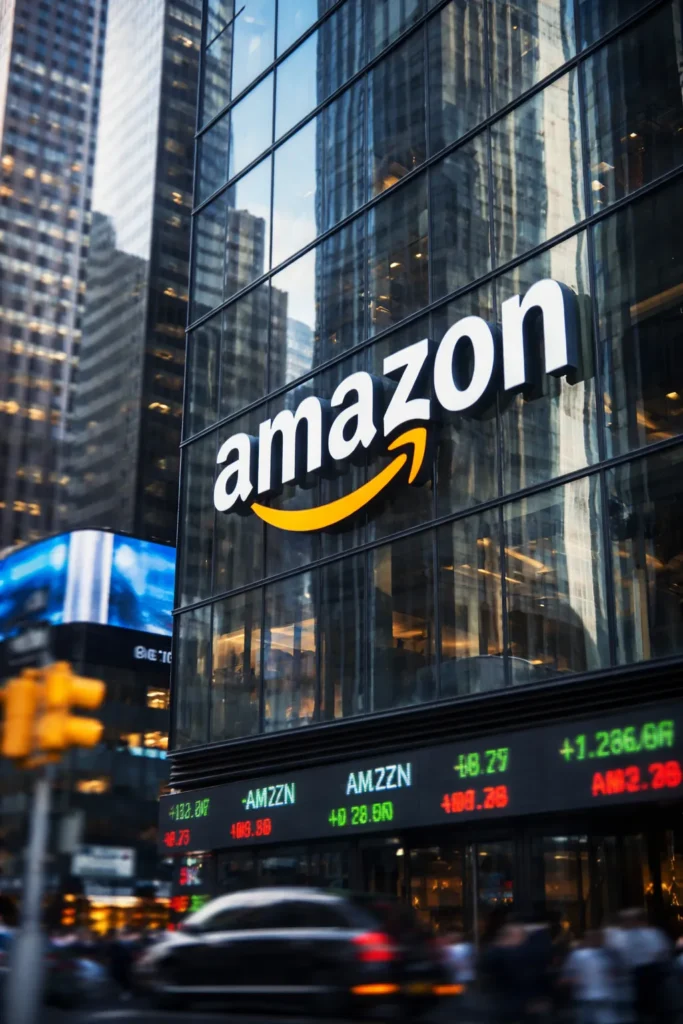

Amazon.com Inc. (NASDAQ: AMZN) climbed to $211.82, gaining nearly 1%, as investors reacted to Intel’s push to secure Amazon as a customer for its advanced AI chip packaging business.
The move signals a deeper shift in the AI race. It’s no longer just about chip performance, but how efficiently those chips are packaged and connected.
Intel is positioning its EMIB (Embedded Multi-die Interconnect Bridge) and next-gen EMIB-T as more flexible and power-efficient alternatives to Taiwan Semiconductor (NYSE: TSM).
The upcoming EMIB-T platform, expected to roll out this year, aims to improve chip density while reducing power usage and long-term costs.
For Amazon, this development comes at a critical time. AWS remains the global cloud leader with a 32% market share, ahead of Azure at 22% and Google Cloud at 12%.
The company is also scaling its in-house AI chips. Trainium and Inferentia have already reached a $10 billion annual run rate, reflecting strong enterprise demand.
Unlike rivals relying heavily on Nvidia GPUs, Amazon is focused on lowering AI costs. Its custom chips allow customers to train models more efficiently and at reduced expense.
Intel’s packaging technology could enhance that advantage. Better integration between chip components reduces latency and energy consumption—key factors in AI workloads.
However, adoption is not guaranteed. Some customers are waiting to see whether Intel can deliver consistently on its broader manufacturing roadmap.
There are also strategic concerns. Companies like Amazon have deep ties with TSM, and shifting supply chains could trigger competitive responses. From an investor standpoint, AWS remains Amazon’s profit engine. The segment typically delivers operating margins in the mid-20% range, far higher than retail.
At the same time, Amazon’s e-commerce business continues to dominate. The company holds nearly 40% of the U.S. online retail market, supported by logistics scale and Prime loyalty.
This dual-engine model—cloud and retail—now has a third pillar: AI infrastructure. That includes chips, services, and potentially new cost advantages. The broader AI market is evolving quickly. Nvidia still leads, but rising costs are pushing hyperscalers to explore alternatives and build in-house solutions.
Intel’s strategy highlights a key shift. Innovation is moving beyond chip design into packaging, where efficiency gains can directly impact performance and cost.
For Amazon, flexibility is crucial. Combining its own chips with external partners like Intel could create a more resilient and cost-effective AI ecosystem.
Still, growth questions remain. AWS expansion has stabilized in the mid-teens, and investors are watching whether AI demand can accelerate momentum.
On the bullish side, Amazon’s vertical integration gives it an edge. On the bearish side, execution risks and competition from Microsoft and Google remain key concerns.
As noted in broader industry coverage from Reuters Technology, the AI race is expanding into every layer of the stack, including packaging.
Amazon’s latest gain reflects confidence that it will remain central to that shift, even as the competitive landscape continues to evolve.
You may also like: Claude AI outage 2026 triggers login errors and chat failures.

Make Swikblog your go-to source on Google for reliable updates, smart insights, and daily trends.