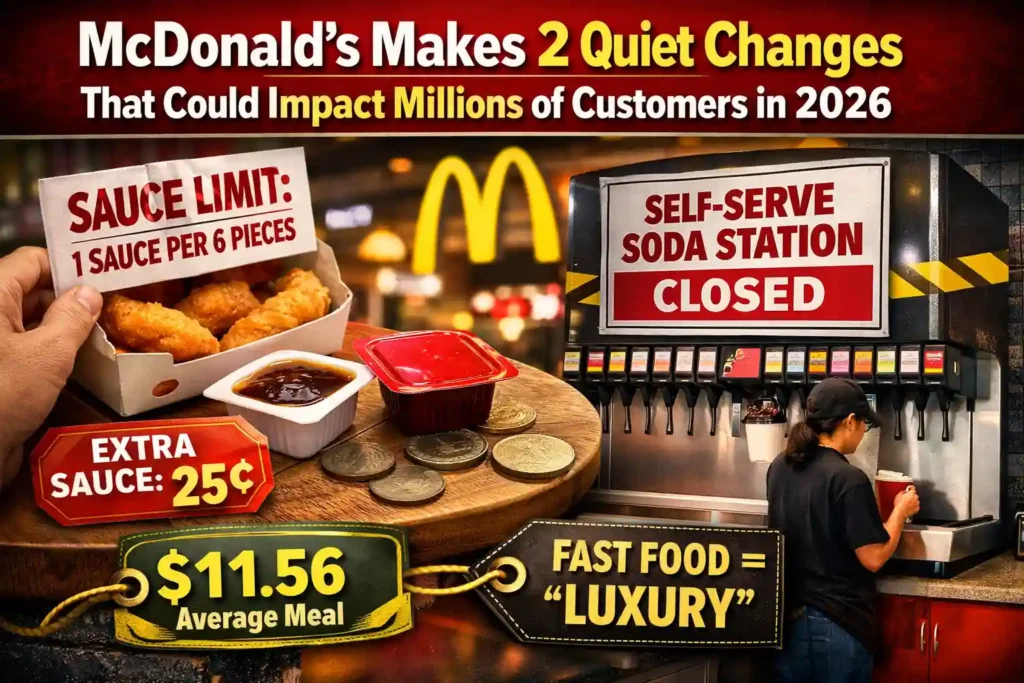

McDonald’s is doubling down on its “value” message in 2026, but behind the scenes, the fast-food giant is quietly making changes that could reshape how millions of customers experience its restaurants. While the company continues promoting affordable meals, two subtle shifts — stricter limits on free dipping sauces and the gradual removal of self-serve soda stations — are already being noticed across multiple locations.
These changes come at a time when fast food is no longer seen as cheap. In fact, the average fast-food meal now costs around $11.56 in major U.S. cities, with prices going even higher in places like San Francisco. As a result, nearly 78% of Americans now view fast food as a “luxury,” a dramatic shift from its traditional image as a budget-friendly option.
That shift puts McDonald’s in a difficult position. It needs to attract price-sensitive customers while also managing rising costs — and that’s where these quieter operational changes come into play.
Fewer sauces, more charges: small change, big reaction
One of the most noticeable changes for customers is happening with dipping sauces. For years, McDonald’s had a relatively flexible approach when it came to handing out sauces with items like Chicken McNuggets. That flexibility is now tightening at some franchise locations.
In certain outlets, a six-piece McNuggets order may now come with just one sauce, while a ten-piece meal might include only two. Customers who want more are increasingly being asked to pay extra — and those charges vary by location. In New York City, additional sauces can cost around 22 to 30 cents, while some areas have seen prices climb even higher.
Importantly, this is not a uniform corporate policy, but rather a franchise-level decision being adopted more widely as operators look to cut costs and reduce waste. Still, for customers, the distinction matters little. What they notice is simple: something that used to feel free and unlimited now feels restricted.
These kinds of changes may seem minor on paper, but they have a disproportionate impact on perception. When customers already feel they are paying more for fast food, even small extra charges can amplify the sense that value is slipping away.
The end of self-serve soda and the push for control
The second, more structural change is McDonald’s plan to phase out self-serve soda stations across its restaurants. While the rollout will take time — with some locations allowed to keep them until 2032 — many outlets have already started removing the machines.
Self-serve drink stations have long been a defining feature of the fast-food experience. They allowed customers to refill drinks, mix flavors, and control their own portions. Now, that control is shifting back to employees.
McDonald’s says the move is designed to create a more consistent experience across all ordering channels, including drive-thru, app, kiosk, and dine-in. But there’s also a financial angle. Self-serve drinks can lead to waste and unlimited refills, while employee-served beverages offer tighter portion control and potential for additional charges.
For customers, however, the change may feel like the removal of another small but meaningful perk. It’s not just about the soda — it’s about the overall experience becoming more controlled and less flexible.
Rising costs, digital push, and changing customer behavior
These changes are part of a broader shift happening inside McDonald’s. The company is increasingly focused on operational efficiency, pushing customers toward digital ordering through mobile apps and in-store kiosks. This reduces reliance on front-counter staff and helps streamline service, especially during peak hours.
At the same time, not all customers are comfortable with this transition. Some have reported difficulties using kiosks, particularly when trying to customize orders, highlighting a growing gap between digital convenience and user experience.
Behind all of this is cost pressure. McDonald’s is dealing with rising beef prices, labor challenges, and a more cautious consumer base. To balance this, the chain has leaned heavily into value offerings like discounted meals, app deals, and low-priced items such as snack wraps.
According to company leadership, these value strategies are working. The brand has seen improved affordability scores and stronger engagement from lower-income consumers, while franchisees have benefited from increased cash flow tied to these promotions.
But maintaining those value offerings while protecting margins requires trade-offs — and that’s exactly where these quieter changes fit in.
McDonald’s is also experimenting with new technologies, including AI-powered ordering systems, though scaling these across thousands of locations remains a complex challenge. The goal is clear: reduce friction, improve efficiency, and adapt to a rapidly changing fast-food landscape.
Still, the risk is that too much focus on efficiency could come at the expense of customer experience. Fast food has always been about more than just price — it’s about speed, ease, and familiarity. When those elements begin to shift, even slightly, customers tend to notice.
For now, McDonald’s continues to walk a fine line. It is promoting affordability while quietly tightening operations. For millions of customers, the impact of these changes may only become clear over time — not through big announcements, but through small moments at the counter, the drive-thru, or the kiosk. For a closer look at the original report, you can read TheStreet’s full coverag
You may like: Costco Membership Lawsuit Over Auto-Renewal and $65 Charge
Make Swikblog your go-to source on Google for reliable updates, smart insights, and daily trends.