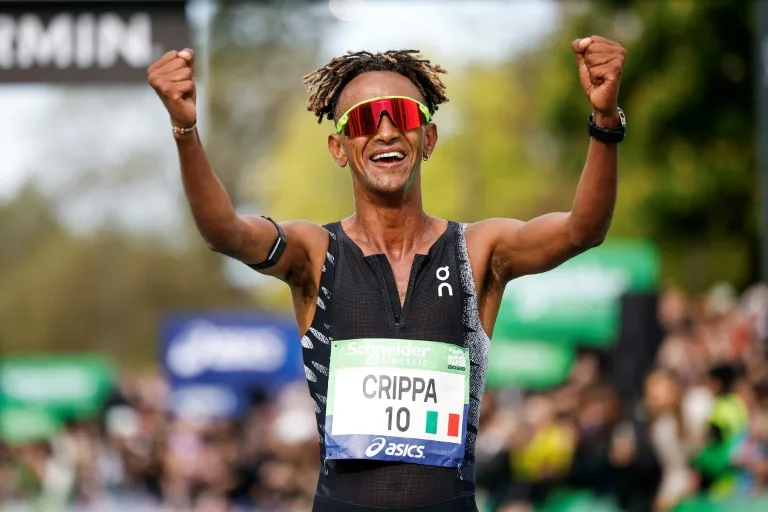

Yemaneberhan Crippa produced the defining run of his marathon career on Sunday, winning the Paris Marathon in 2:05:18 after a decisive late move that finally turned his promise over 42.195km into a major victory. The Italian’s success quickly stood out as one of the day’s biggest athletics stories, not just because it was his first marathon win, but because it made him the first European man to win the race since 2002.
The 29-year-old broke away from Ethiopia’s Bayelign Teshager on the long descent in the final kilometre onto Avenue Foch, then held his advantage through the sharp right-hand turn and into the finish. Crippa crossed the line five seconds clear, with Teshager second in 2:05:23 and Kenya’s Sila Kiptoo third in 2:05:28 in a tightly packed finish.
What made the victory more significant was the context surrounding it. Crippa arrived in Paris in excellent form after smashing his Italian half marathon record with a 59:01 run to win in Naples in February. Yet his relationship with the marathon had remained uncertain. He failed to finish at the World Athletics Championships in Tokyo last year and could manage only 2:10:59 in Valencia in December, leaving open the question of when his ability at shorter distances would truly translate to the classic distance.
Paris gave him that answer. A large lead pack was still together through halfway in 63:14, but Crippa grew stronger as the race unfolded. His second half of 62:04 was a major negative split and the clearest sign yet that he has begun to master the demands of elite marathon racing, not simply endure them.
A breakthrough built on patience and form
This was not a win built on chaos or collapse ahead of him. It came from control, patience and timing. Crippa stayed composed while the race remained crowded, then trusted his strength when the moment came to attack. On a course where hesitation can cost everything, he chose the final downhill section perfectly and turned a close contest into a landmark result.
That performance matters well beyond the stopwatch. Crippa had already established himself as one of Europe’s top distance runners through his track and half marathon results, but the marathon had remained the missing piece. Sunday’s run changed the conversation around him. He is no longer a talented athlete still searching for a breakthrough at this distance; he is now a marathon winner with a world-class time.
His victory also helped shape a broader European story in the men’s race. Norway’s Awet Kibrab finished fifth in 2:05:46, while France’s Emmanuel Roudolff-Levisse took sixth in 2:05:58, shattering his lifetime best. With three Europeans inside the top six, the race offered a reminder that while East African runners continue to set the standard, Europe’s leading names are increasingly capable of forcing their way into the sharp end of major marathons.
Demise dominates women’s race as Vainio shows consistency
The women’s race delivered a commanding performance of its own, with Ethiopia’s Shure Demise taking victory in 2:18:34. Her run gave the Paris Marathon another high-level result and underlined the strength of Ethiopian distance running across both elite races.
There was also another notable European performance behind her. Finland’s Alisa Vainio finished sixth in 2:21:35, the third fastest marathon of her career. That result followed her back-to-back Finnish records of 2:20:48 in Valencia and 2:20:39 in Seville, meaning she has now produced three marathons in the 2:20 to 2:21 range in the space of four months.
France’s Mekdes Woldu was the leading home finisher in the women’s race, placing eighth in 2:26:25. Together with Roudolff-Levisse’s run in the men’s field, it gave local supporters enough to note even if the headline belonged elsewhere.
For Crippa, though, Paris was about more than a finishing time or a place on the podium. It was the moment his marathon story finally matched the quality he had shown for years over shorter distances. After months of mixed outcomes and unfinished business, he left the French capital with a personal best, a first major marathon victory and a performance that may redefine what comes next in his career. More details on the event can be found on the official Paris Marathon website.
You may like: Capital Summertime Ball 2026 Tickets: Sale Date, Presale & How to Buy

Make Swikblog your go-to source on Google for reliable updates, smart insights, and daily trends.