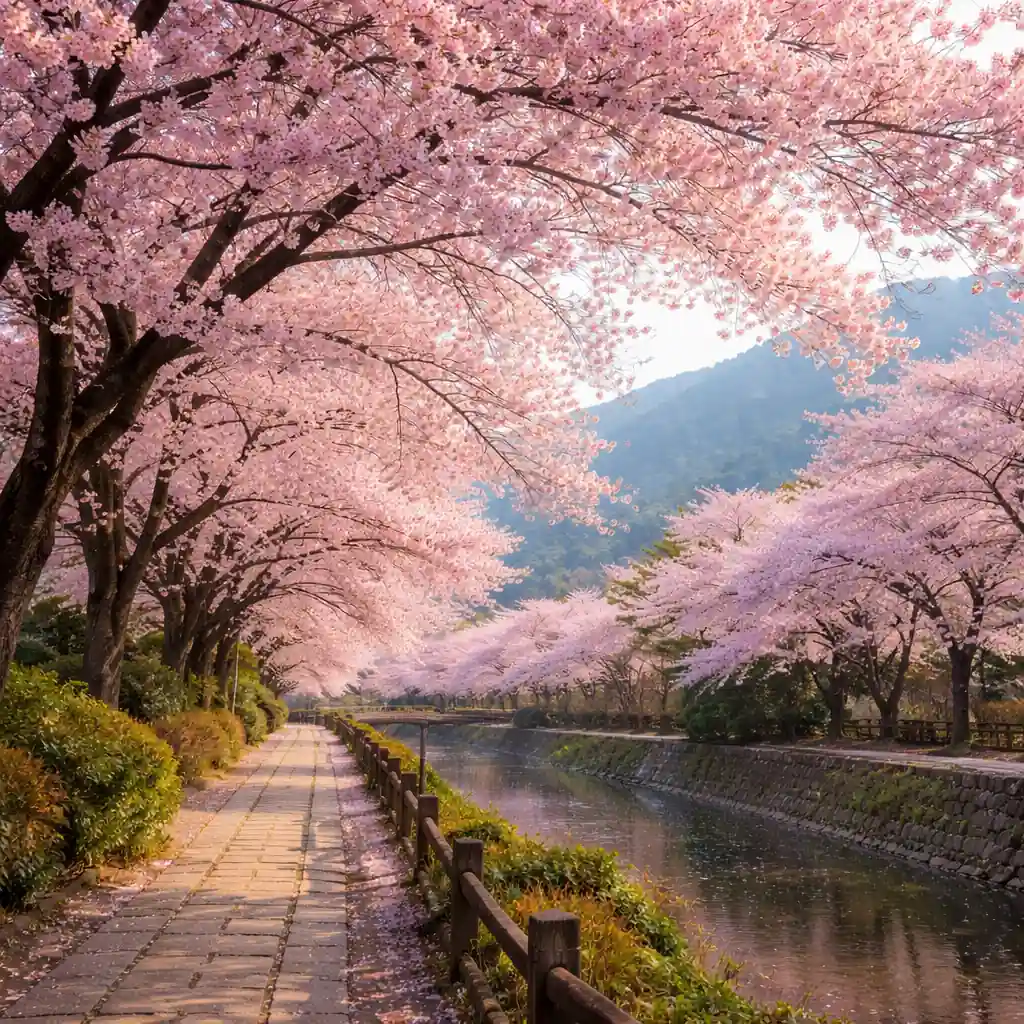

KYOTO, JAPAN — For more than 1,200 years, the arrival of cherry blossoms in Kyoto has been quietly recorded, year after year, forming one of the longest continuous climate records on Earth. But in 2026, that historic record came dangerously close to ending.
The reason was deeply personal. Prof. Yasuyuki Aono, the Japanese scientist who had spent decades maintaining and expanding the dataset, died in August last year. In his final months, he was still doing what he had always done — tracking the bloom of the mountain cherry trees.
His last entry, recorded in April 2025, noted the peak bloom date as April 4. Beneath it, he had already created a row for 2026. It remained empty.
For climate scientists, that blank row was more than a missing data point. It was the possible end of a record stretching back to the year 812 — a dataset that has become a powerful symbol of how climate change is reshaping the natural world.
A scientist’s life work nearly lost
Aono’s work was anything but routine. To build the dataset, he went far beyond modern observations. He taught himself to read ancient forms of Japanese so he could interpret centuries-old documents, many of them references to cherry blossom festivals held in Kyoto’s imperial past.
From those records, he reconstructed flowering dates going back over a millennium, focusing on a specific species — the mountain cherry, known as Prunus jamasakura — and a single location: Arashiyama in Kyoto.
That consistency is what made the dataset so valuable. Unlike broader monitoring projects, Aono’s work tracked the same species in the same place over centuries, allowing scientists to compare changes with remarkable precision.
Over time, a clear pattern emerged. Cherry blossoms were blooming earlier.
In fact, the peak bloom dates recorded in 2021 and 2023 were the earliest in the entire 1,200-year history — occurring on the 85th and 84th day of those years. For researchers, it was one of the clearest biological signals of climate change.
Yet when Aono died, no formal plan existed to continue his observations. By early 2026, scientists began to worry that the record might simply stop.
That concern grew when colleagues noticed that Aono’s university webpage had disappeared. Soon after, they confirmed his death — and realised that no one had stepped forward to take his place.
A last-minute effort brings relief
The turning point came when researchers and data scientists began actively searching for someone in Japan who could continue the work. The challenge was not just finding any observer, but someone who could follow Aono’s exact method — monitoring the same species, at the same site, using comparable criteria.
The response was unexpectedly strong. Dozens of people reached out, offering help.
Finally, a researcher in Japan agreed to take on the responsibility. While the arrangement is still being finalised, the individual has already begun consulting the same historical sources Aono used and is expected to confirm the 2026 peak bloom date.
The relief among scientists has been immediate.
Long-term datasets like this are rare, and once broken, they can lose much of their scientific value. Maintaining continuity is essential — especially for a record that spans more than a millennium.
According to analysis shared by Our World in Data, biological indicators such as flowering dates provide some of the most visible and relatable evidence of climate change, linking rising temperatures directly to changes in everyday natural events.
The cherry blossom record is one of the most striking examples.
In recent decades, warmer winters have not only shifted bloom dates earlier but also begun to affect the quality of the blossoms themselves. Scientists have observed that milder conditions can disrupt the trees’ natural cycle, sometimes causing buds to fall before fully opening.
The result is a less vibrant display — a subtle but telling sign of environmental stress.
This has implications beyond science. Cherry blossom season is central to Japanese culture and tourism, drawing millions of visitors each year. Changes in timing and quality could reshape how the season is experienced in the future.
For those who worked with Aono, the continuation of the dataset is also deeply emotional.
He was known for his meticulous approach and long-term vision. Even as he updated his records in 2025, he was clearly planning to continue.
Now, thanks to a new researcher stepping forward, his work will not end with him.
The 2026 entry — once left blank — is expected to be filled in the coming days, ensuring that a 1,200-year record continues into the modern era.
In a world where most climate data spans only decades, that continuity offers something rare: a direct connection between past and present, showing how deeply human activity is now intertwined with nature’s oldest rhythms.
You may like: Clavicular Overdose Livestream Hospitalized: What Happened and Latest Updates

Make Swikblog your go-to source on Google for reliable updates, smart insights, and daily trends.