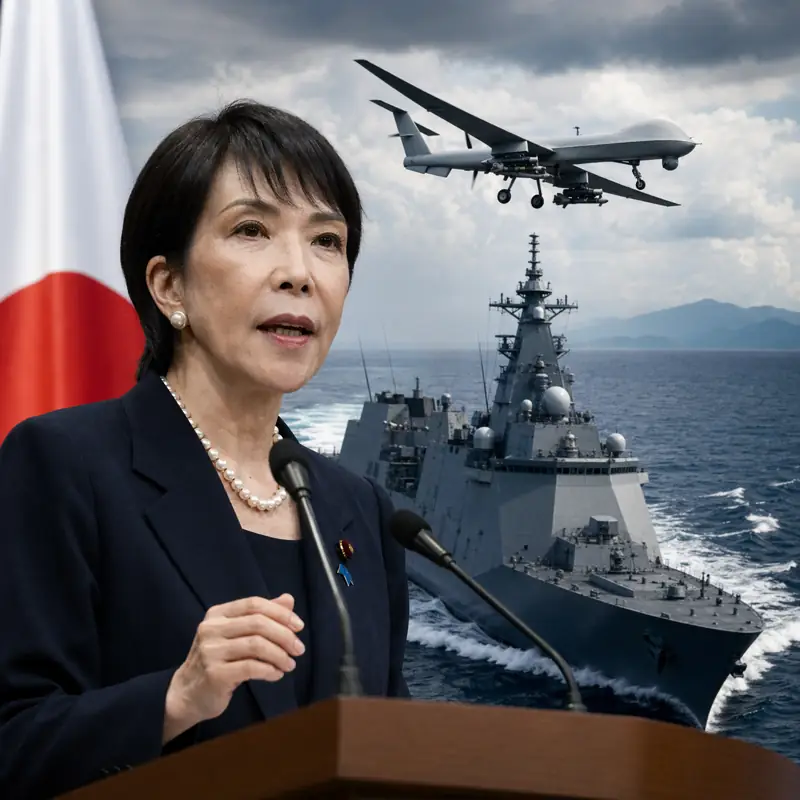

Japan’s decision to allow broader exports of lethal defence equipment is more than a policy adjustment. It is a signal that Tokyo is redefining how it sees its role in a more volatile Asia-Pacific security landscape. After decades of tightly controlled military trade under the shadow of its post-war pacifist identity, Japan is now opening the door to overseas sales of weapons systems such as warships, missiles and combat drones to a limited group of trusted partners.
The shift matters because it comes at a moment when defence planning across the region is changing quickly. Governments are no longer thinking only about national stockpiles or bilateral alliances in isolation. They are increasingly focused on supply chain resilience, long-term military interoperability and access to dependable equipment from politically aligned countries. In that environment, Japan is presenting itself not just as a security partner, but as a future supplier with advanced industrial capability.
The new framework will not create a free-for-all export market. Tokyo has said sales will be restricted to 17 countries that already have defence equipment and technology transfer agreements with Japan. Those transfers must also clear approval by the National Security Council, and Japanese authorities have indicated they will monitor how the exported systems are managed after delivery. That gives the policy a dual character: strategically ambitious on one hand, but still cautious and highly supervised on the other.
Why Japan Is Moving Now
The timing of the policy change is closely tied to the deteriorating security climate around Japan. China’s military activity in nearby waters, pressure around Taiwan and continuing territorial friction in the East China Sea have pushed Japanese policymakers to think beyond the older model of minimalist defence posture. North Korea’s missile development has added another layer of urgency. For Tokyo, the question is no longer whether the regional environment has changed, but whether its own institutions and defence policies are changing fast enough to keep up.
There is also a wider global backdrop to this move. The wars in Ukraine and the Middle East have exposed how stretched the global defence industrial base can become during prolonged crises. Many governments that once relied on a small number of major suppliers are now trying to diversify procurement. That creates an opening for Japan, whose manufacturers have long had strong engineering credentials but limited access to the international defence market. An authoritative overview from Reuters’ Asia-Pacific coverage has highlighted how countries are rethinking defence sourcing as strategic uncertainty grows.
Japan’s leadership has framed the export rule change as a response to this harsher reality. The message from Tokyo is that security can no longer be protected by one nation acting alone. Supporting partners with equipment, technology and defence cooperation is now being treated as part of Japan’s own national interest.
What the Rule Change Means for Allies and the Region
Australia stands out as one of the most significant beneficiaries of the new framework. Defence ties between Canberra and Tokyo have been deepening for years, and the latest policy change gives that relationship a more practical industrial dimension. Australia recently signed an agreement linked to Mitsubishi Heavy Industries’ upgraded Mogami-class frigates, including the delivery of vessels and joint production plans. That is important not only as a commercial deal but as evidence that Japan wants defence cooperation to extend into co-production, technology sharing and long-term capability building.
The Philippines is another country watching the shift closely. Manila has been strengthening defence engagement with Tokyo as tensions in the South China Sea continue to rise. Philippine officials have openly welcomed the possibility of greater access to Japanese defence equipment, seeing it as a way to reinforce deterrence and improve domestic resilience. That reaction fits a broader regional pattern: states facing maritime pressure want more options, and Japan is now offering itself as one of them.
The announcement also arrived alongside a visible display of military coordination. Japanese troops recently joined a major training exercise with forces from the United States, Australia and the Philippines, including live-fire drills in waters connected to the South China Sea and the Taiwan Strait. That context matters. Japan’s export rule change is not happening in isolation from regional security activity. It is unfolding as part of a wider alignment among Indo-Pacific partners that are trying to improve readiness and signal collective resolve.
Supporters of the new policy argue that it will strengthen deterrence. Their case is straightforward: trusted allies with better equipment, shared standards and closer defence integration are less vulnerable to coercion. Critics, however, worry that the move could feed a broader militarisation cycle in Asia. China has already signalled sharp concern, portraying the decision as evidence of a dangerous departure from Japan’s post-war restraints. That criticism was predictable, but it also underlines how politically sensitive this shift will remain.
For Japan itself, the challenge is not only strategic but domestic. Pacifism is not a marginal idea in the country’s public life; it is deeply tied to the national memory of war and reconstruction. That means every expansion of military policy still carries symbolic weight. Tokyo appears aware of that, which is why it continues to stress that its core principles have not changed even as its defence toolkit evolves. The government is trying to reassure voters that stricter oversight, limited partner eligibility and case-by-case approvals will prevent the policy from drifting into something more expansive than intended.
From an economic perspective, the rule change could eventually reshape Japan’s defence industry. Companies involved in shipbuilding, aerospace, sensors and advanced weapons systems may gain access to export demand that was previously unavailable. If managed carefully, that could support domestic production capacity, innovation and supply chain resilience. But the bigger story is geopolitical rather than commercial. Japan is stepping into a new role: not simply a country protected by alliances, but one contributing more actively to the military capability of those alliances.
That is why this moment feels larger than a regulatory revision. It reflects a Japan that is gradually moving from strategic restraint toward strategic participation. The country is still trying to preserve the language of caution, and the safeguards around the new rules are real. Yet the direction of travel is unmistakable. Tokyo is preparing for a world in which defence cooperation includes not only exercises, diplomacy and basing agreements, but also the export of lethal systems to selected partners.
Whether that strengthens long-term stability or sharpens regional rivalry will depend on how carefully the policy is executed and how other powers respond. What is already clear, though, is that Japan’s security identity is evolving in a way that would have been politically difficult to imagine just a generation ago.
You may like: Splatoon Raiders Release Date Set for July 23 on Switch 2

Make Swikblog your go-to source on Google for reliable updates, smart insights, and daily trends.