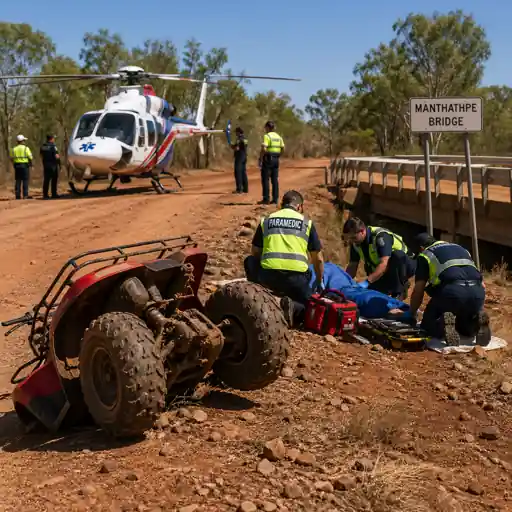

A teenage boy has died after a quad bike crash in Wadeye, in a tragedy that has left two other riders injured and triggered a police investigation in one of the Northern Territory’s most remote communities. The incident unfolded on Wednesday morning near Manthathpe Bridge, in the township roughly 400 kilometres south-west of Darwin, and has now added to growing concern around serious vehicle incidents in regional parts of the Territory.
Police say four males were on the quad bike when it crashed at about 11am: a 16-year-old boy, a 12-year-old boy, and two 19-year-old men. Local health staff attended and brought the group from the crash site to the Wadeye clinic, where early reports pointed to abdominal injuries and abrasions. At first, the injuries appeared serious but manageable. That changed later in the afternoon when the 16-year-old’s condition worsened dramatically. By shortly after 3pm, clinic staff informed police that the teenager’s condition had rapidly deteriorated. He was declared dead a short time later.
Two of the other injured riders — one of the 19-year-old men and the 12-year-old boy — were later flown to Darwin by CareFlight for further assessment and treatment. Authorities have not publicly released detailed updates on their medical condition. The second 19-year-old, who was also riding on the quad bike at the time of the crash, has not been identified as among those transferred, though police have made clear all four occupants form part of the investigation now underway.
What happened in Wadeye and why investigators are focusing on the full sequence
In the first hours after a fatal crash, the known facts are often limited, and that is the case here. Northern Territory Police have confirmed that detectives from the Major Crash unit are being sent to Wadeye to support local officers and establish exactly how the incident unfolded. For investigators, that work is likely to include reconstructing the moments leading up to the crash, confirming who was operating the vehicle, examining the condition of the quad bike, and assessing the environment around the bridge area where the incident occurred.
Those questions matter because quad bike crashes can rarely be understood through one detail alone. The number of people on the vehicle, the condition of the surface, the speed involved, and the way the bike was being ridden can all shape the outcome. In remote communities, vehicles like quad bikes are part of everyday movement and practical life, which can make them seem familiar and low-risk. But when something goes wrong, the consequences can be severe, especially when emergency care, specialist trauma support and transfer options are separated by long distances.
That reality gives this story a weight that goes beyond a single police update. Wadeye is not a place where a major hospital is minutes away. When serious injuries happen in communities far from Darwin, treatment decisions carry an added urgency. Even with local health workers responding quickly, the gap between first response and specialist care can become crucial. In this case, the teenager’s death after an initial assessment at the clinic underlines how fast a crash can turn fatal, even when injuries do not immediately appear catastrophic from the outside.
A fatal crash that also points to wider Territory road safety pressures
The teenager’s death has taken the Northern Territory’s road toll for 2026 to six, according to the official tally published by NT Police, Fire and Emergency Services. That figure matters because it shows road trauma in the Territory is not confined to major highways, sealed roads or urban traffic corridors. In the NT, fatal incidents can happen in remote townships, on regional roads, near communities, and in places where emergency access is more difficult and the margin for survival can narrow quickly.
There is also a broader social impact that official numbers cannot fully capture. In a close community, the death of a 16-year-old is not just another incident on a running yearly count. It is a loss carried by family, schoolmates, neighbours and frontline clinic staff who were forced to respond in real time. The two injured survivors now face treatment and recovery away from home in Darwin, while police begin the slower process of working out what happened and whether it could have been prevented.
That is why the investigation matters so much. The purpose is not only to establish the facts for this case, but to understand whether any lessons can be drawn from it. Fatal crashes in remote Australia are often discussed only in hindsight, after families have already paid the highest price. But each inquiry can shed light on patterns that deserve closer attention, from rider behaviour and vehicle use to infrastructure, community awareness and emergency response challenges.
For readers seeking the latest official public context on the Territory’s fatality count, the NT Police, Fire and Emergency Services road toll page tracks lives lost on Territory roads throughout the year. It offers a broader picture of how individual incidents fit into a larger road safety story that continues to affect urban, regional and remote communities alike.
As detectives continue their work in Wadeye, the central facts remain stark. Four people were on a quad bike when it crashed near Manthathpe Bridge. A 16-year-old boy later died after his condition deteriorated at the local clinic. A 12-year-old boy and a 19-year-old man were airlifted to Darwin. Another 19-year-old was also involved. The cause is still being investigated, and police are asking anyone with information to contact 131 444.
For now, the story is less about speculation and more about loss. A young life has ended suddenly, two others are recovering far from home, and a remote community is left absorbing another tragedy before answers have fully arrived. For more breaking coverage in a clean, reader-first format, visit Swikblog.
You may like: International English Language Day 2026: April 23 Celebrates Language and Culture Worldwide

Make Swikblog your go-to source on Google for reliable updates, smart insights, and daily trends.