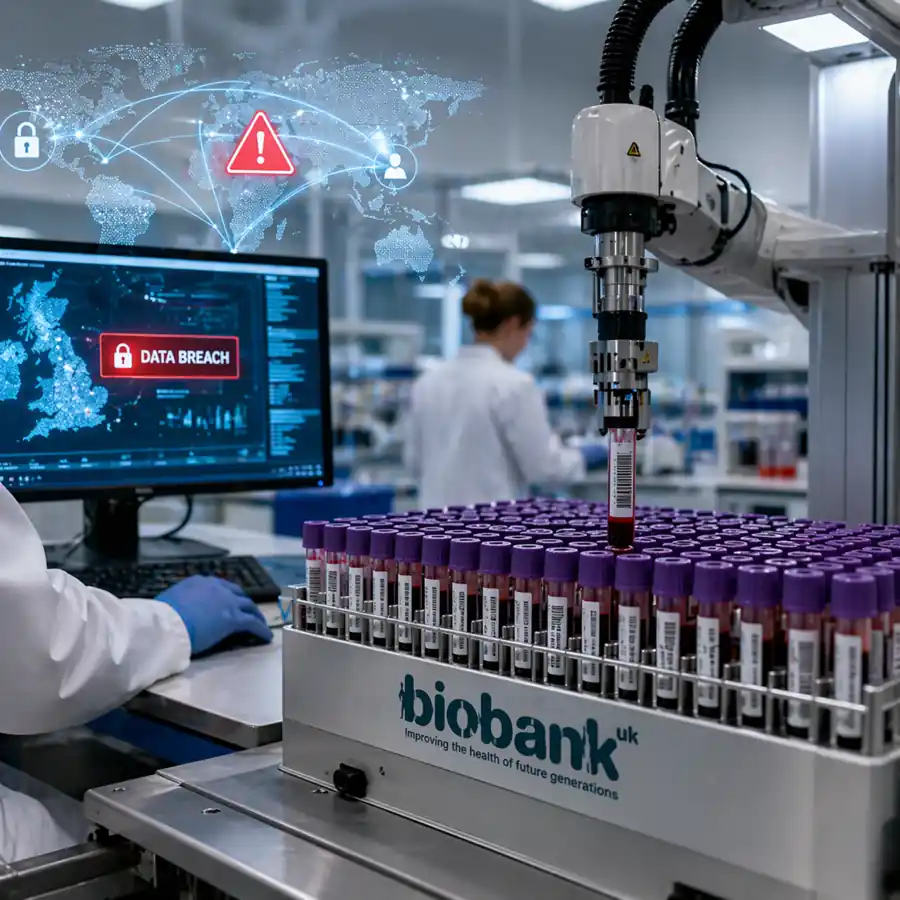

The confirmation that UK Biobank data linked to 500,000 volunteers appeared on a Chinese online marketplace has landed as more than another data-security headline. It touches a far deeper issue: the fragile trust that makes modern medical research possible. For years, UK Biobank has been held up as one of the most important health research resources in the world, built on the willingness of ordinary people to share deeply personal biological and lifestyle information so scientists can better understand cancer, dementia, Parkinson’s disease and many other conditions. That public-minded mission is exactly why this incident matters so much.
Government ministers said the material listed online did not include names, addresses, phone numbers or direct contact details. UK Biobank also told participants that their personally identifying information remained safe and secure. But that reassurance only answers part of the concern. Health information does not need to contain a person’s name to feel sensitive. When a dataset includes age bands, birth month and year, biological measurements, self-reported medical history, socioeconomic indicators and other detailed variables, the public reaction is naturally different from the reaction to an ordinary commercial data issue.
That distinction is central to this story. The problem is not simply whether a spreadsheet had names attached to it. The problem is that information entrusted for public-interest science was reportedly advertised for sale, and that alone is enough to test confidence in the system. In health research, trust is infrastructure. Once it weakens, every future project becomes harder to defend, recruit for and expand.
The real pressure point is governance, not only security
One detail makes this episode especially significant: ministers said this was not presented as a conventional cyberattack. Instead, the data had been accessed through organisations that had been given legitimate research access, with officials saying access for the institutions involved has since been revoked. That shifts the debate away from the familiar language of hackers and toward a more uncomfortable question about research governance.
Large-scale medical databases now depend on international collaboration, cloud-based analysis environments and complex rules on what approved researchers can export. Those systems are designed to accelerate discovery while keeping participants protected. But the UK Biobank episode suggests that contractual controls and accreditation checks are not enough on their own if downloaded outputs can still travel beyond the intended environment. In other words, the challenge is no longer just who is allowed in. It is also what can leave, in what form, under what monitoring, and with what real-world consequences if rules are broken.
UK Biobank has already said it is pausing access while tighter controls are put in place, including stricter limits on file exports and daily monitoring for suspicious behaviour. It also said it plans to develop an automated system designed to stop de-identified participant data being taken off its research platform while still allowing legitimate science to continue. That response matters because it points to the likely next phase of health-data protection: not less research access, but far more technical control over research outputs.
Why participants may still feel uneasy
For the volunteers behind UK Biobank, the episode is likely to feel personal regardless of the technical language used around de-identification. Many of them joined between 2006 and 2010, giving blood, urine and saliva samples, answering detailed questionnaires and agreeing to long-term follow-up because they believed the project served medicine and the public good. Their contribution was never about commercial exposure or geopolitical tension. It was about future treatments, earlier diagnosis and better prevention.
That is why official statements that no sales are believed to have taken place, while important, may not fully settle public concern. Once people hear that health-related records were listed online, the psychological line has already been crossed. Confidence is shaken not only by confirmed misuse, but by the visible possibility of misuse.
There is also a broader lesson here for every institution handling sensitive research data. Public consent is not a blank cheque. It is conditional on good stewardship. Participants may accept global scientific access when they believe the guardrails are robust, the oversight is meaningful and the accountability is real. They are much less likely to remain comfortable if governance looks reactive rather than preventive. Guidance from the Information Commissioner’s Office makes clear that organisations handling personal and sensitive information are expected to build security and responsibility into their systems from the start, not after a high-profile incident.
The UK government has described the episode as an unacceptable abuse of participant trust, and that wording may prove to be the most important part of the official response. This story is not only about one charity, one marketplace or one set of listings. It is about the social contract behind data-driven medicine. Britain wants to remain a leader in life sciences, biomedical discovery and AI-enabled healthcare. That ambition depends on vast, high-quality datasets. But those datasets exist only because citizens believe the benefits of sharing outweigh the risks.
UK Biobank still has enormous scientific value, and that should not be lost in the fallout. The project has helped support thousands of discoveries and remains one of the most powerful research tools in global health. Yet precisely because it is so important, the standard applied to it will now be even higher. The immediate story is about records appearing online. The bigger story is whether institutions can prove that the systems built to protect volunteer data are strong enough for the age of cross-border, high-value biomedical research. That is the question participants, policymakers and researchers will all be asking now.

Make Swikblog your go-to source on Google for reliable updates, smart insights, and daily trends.