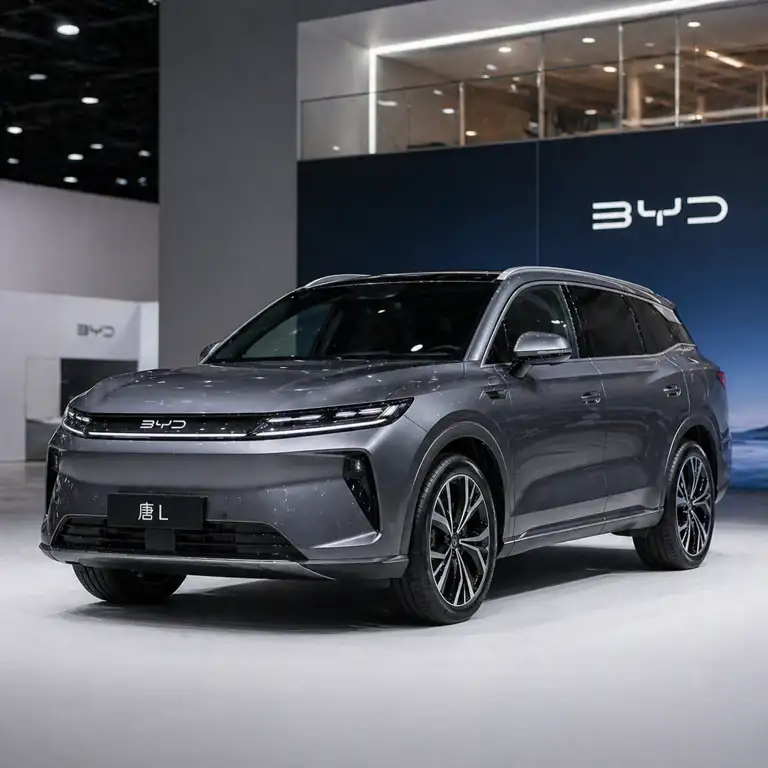

BYD’s new Great Tang has entered China’s electric SUV race with the kind of early traction that automakers usually hope for but rarely achieve. Within the first day of pre-sales, BYD confirmed more than 30,000 firm pre-orders for the flagship SUV. Dealer-side figures reported by Chinese media suggest the wider reservation pipeline may have climbed toward 60,000 units within 48 hours, pointing to strong early interest in one of BYD’s most important launches of 2026.
The Great Tang made its public appearance at the Beijing Auto Show, where BYD positioned it as a larger, more advanced step above the existing Tang family. The SUV is aimed at buyers looking for a full-size, seven-seat vehicle with long-range capability, high-speed charging, premium cabin technology and the flexibility of both electric and plug-in hybrid powertrains.
The headline number is striking, but it needs careful reading. BYD’s official figure is based on confirmed pre-orders supported by non-refundable deposits. Dealer-level figures can include a broader mix of refundable bookings, early reservations and customer leads entered into retail systems. That difference explains why the market is seeing two separate numbers: more than 30,000 confirmed by BYD in 24 hours, and roughly 60,000 indicated through dealer channels over 48 hours.
Even with that distinction, the launch appears to have created meaningful momentum. BYD’s Dynasty sales network, which covers more than 1,800 outlets across China, gave the company immediate nationwide reach. Dealers in large cities including Beijing and Shanghai reportedly saw dozens of bookings at individual stores, while some high-demand locations such as Zhengzhou recorded much larger volumes shortly after pre-sales opened. Smaller markets, including cities such as Chongqing and Zhongshan, also contributed steady demand rather than a short-lived spike limited to top-tier cities.
The Great Tang’s appeal comes from more than its badge. The battery-electric version is claimed to offer up to 950 km of CLTC range, equivalent to about 590 miles, putting range anxiety at the center of BYD’s answer to premium SUV buyers. It also uses BYD’s second-generation Blade battery and a 1000V high-voltage architecture, technology designed to support faster charging and stronger efficiency. For buyers comparing large EVs, those specifications matter because charging speed and real-world usability are becoming just as important as headline range.
Performance is another major part of the pitch. The dual-motor all-wheel-drive version can produce up to 585 kW and accelerate from 0 to 100 km/h in around 3.9 seconds. That puts the Great Tang in the same conversation as performance-focused premium SUVs, while still being marketed as a practical family vehicle. BYD is clearly trying to show that a large seven-seat SUV does not have to feel slow or compromised.
The chassis technology also signals BYD’s move into more premium territory. The Great Tang is expected to offer DiSus-A dual-chamber air suspension with road-preview functionality, rear-wheel steering and a crab-walk mode for tight spaces. These features are increasingly important in China’s high-end EV segment, where buyers now expect comfort, maneuverability and technology-led convenience rather than just battery capacity.
Inside, BYD is leaning heavily into luxury and digital features. Reported highlights include a 3nm-grade cockpit chip, a 7.1.4-channel Devialet sound system with 27 speakers and a panoramic “Sky Mirror” roof made with hollow laminated glass. These details suggest that BYD wants the Great Tang to compete not only on value but also on cabin experience, an area where domestic Chinese brands have become increasingly aggressive.
The plug-in hybrid versions broaden the model’s reach. The DM-i variant combines a 1.5-liter turbocharged engine with a 300 kW electric motor, while the DM-p version uses dual electric motors with combined output of around 400 kW and a 0 to 100 km/h time of about 4.3 seconds. This gives BYD a wider customer base: urban EV buyers may prefer the pure-electric model, while long-distance drivers or families in regions with uneven charging coverage may lean toward the hybrid options.
The timing is important for BYD. The existing Tang L had been losing momentum before the Great Tang’s arrival. Data cited by China EV DataTracker showed Tang L domestic sales at 2,039 units in the first quarter of 2026, down sharply from 8,373 units in the fourth quarter of 2025. Sales were higher earlier, with 11,698 units in the third quarter of 2025 and 18,689 units in the second quarter of 2025. That decline makes the Great Tang more than a routine update; it is a reset for BYD’s large SUV strategy.
China’s large electric SUV market is also becoming more crowded. Domestic rivals are moving quickly with long-range EVs and plug-in hybrids, while buyers are becoming more selective. Models such as Geely’s Galaxy M9 have already shown that demand for large electrified SUVs remains strong when pricing, technology and brand confidence align. BYD now needs to prove that early reservation strength can translate into sustained deliveries.
The broader backdrop remains favorable. China continues to dominate global electric vehicle adoption, supported by scale, battery supply chains and rapid product cycles. The International Energy Agency’s Global EV Outlook has highlighted China’s central role in global EV growth, while BYD’s own expansion has made it one of the most closely watched manufacturers in the sector.
Still, pre-orders are not the same as final sales. Refundable reservations can fall away, dealership estimates can be revised, and delivery timelines can influence customer decisions. The real test will come when BYD begins converting these early bookings into registered deliveries. If conversion rates remain strong, the Great Tang could help BYD rebuild momentum in the premium SUV category and strengthen its position against China’s fast-moving EV challengers.
For now, the Great Tang has achieved what every new model needs at launch: attention, traffic and a large early order book. Whether the final number settles closer to BYD’s confirmed 30,000 figure or the dealer-indicated 60,000 level, the response shows that China’s appetite for large, technology-heavy electrified SUVs remains strong. For BYD, that gives the Great Tang a powerful start in a segment that is likely to become even more competitive through 2026.
You may like: Audi recalls 19,000 e-tron EVs over brake pedal defect risk

Make Swikblog your go-to source on Google for reliable updates, smart insights, and daily trends.