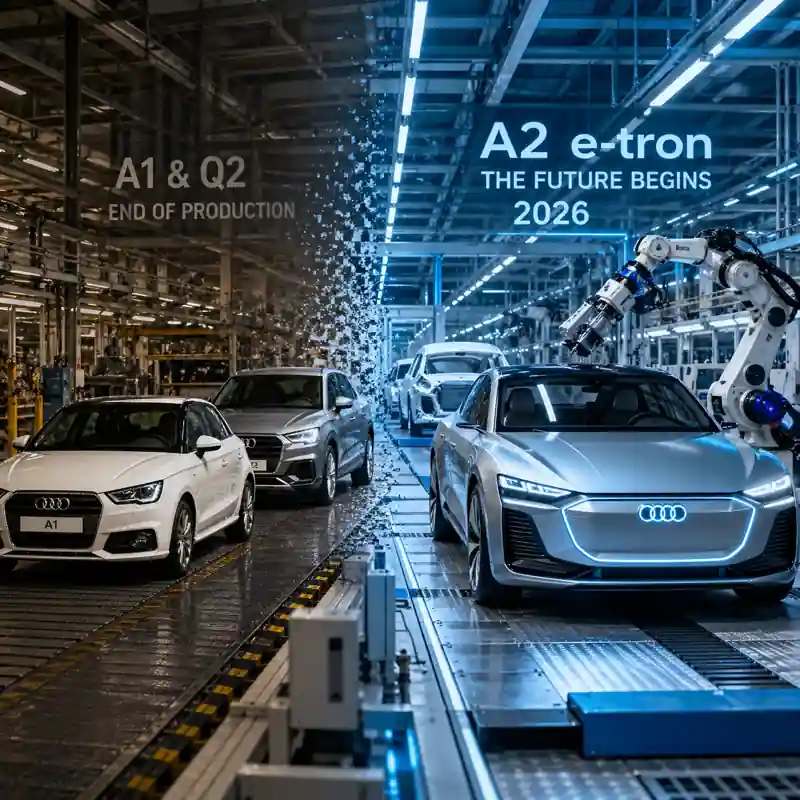

Audi is executing one of the most significant production shifts in its recent history, ending two long-running compact models while accelerating its move toward electrification across Europe. The company has confirmed the discontinuation of the Audi Q2 and Audi A1, bringing an end to combined production of more than 2.26 million vehicles as it prepares for a new generation of electric models.
The transition is centered on Audi’s German manufacturing network, particularly the Ingolstadt plant, which is being reconfigured to handle increased electric vehicle output while maintaining a flexible mix of combustion and hybrid production.
Q2 and A1 exit after strong European demand
The Audi Q2 concludes production at Ingolstadt in April 2026 after a nine-year run that began in 2016, reaching a total of 887,231 units. The compact SUV established itself as a consistent performer in core European markets, including Germany, the UK, and Italy.
At the same time, Audi is ending production of the Audi A1 at its Martorell facility in Spain. Since its launch in 2010, the model has recorded more than 1,389,658 vehicles, making it one of the brand’s most successful entry-level offerings.
The decision to phase out both models is not tied to declining demand but instead reflects a strategic shift toward electrification and manufacturing efficiency, as automakers globally realign production toward EV platforms, a trend highlighted across automotive industry developments.
A2 e-tron anchors Ingolstadt’s EV expansion
The capacity freed by the Q2’s exit will be used to introduce the Audi A2 e-tron, a compact fully electric model scheduled to begin production in fall 2026 at Ingolstadt. The model will become the plant’s third dedicated EV line, following the launch of the Q6 e-tron in 2023 and the A6 e-tron in 2024.
In addition to the A2 e-tron, Audi has confirmed that another fully electric model line will enter production in autumn 2026, further strengthening the plant’s EV capacity. This positions Ingolstadt as a central hub in Audi’s electrification strategy while maintaining output of the Audi A3 and combustion-engine Q3 models during the transition.
Integrated Q3 production connects Germany and Hungary
Audi is also introducing a cross-border manufacturing system for the Audi Q3, beginning in mid-2026. The program links Ingolstadt with Audi Hungaria’s plant in Győr, creating a shared production model designed to balance capacity and demand.
Under this structure, vehicle bodies will be produced in Hungary and transported via rail to Germany, where painting and final assembly will take place. Audi established the logistics chain between the two sites within a year, highlighting increased coordination across its European operations.
The move allows Audi to sustain SUV production volumes without expanding a single plant’s footprint, while ensuring Ingolstadt’s assembly lines remain fully utilized during the shift from internal combustion to electric vehicles.
Neckarsulm expands production and AI capabilities
At Audi’s Neckarsulm facility, the company is undertaking one of the largest production ramp-ups in its history, focusing on updated A5 and A6 model families. The rollout includes new engine variants and performance models such as the recently launched RS 5.
Beyond vehicle production, Neckarsulm is being developed into a center for digitalisation and artificial intelligence. Its proximity to the Heilbronn Innovation Park for Artificial Intelligence allows Audi to integrate AI-driven applications into manufacturing processes and future vehicle technologies.
Electric sports model confirmed for 2027
Looking ahead, Audi is preparing its Böllinger Höfe facility for the production of a fully electric sports car, scheduled to begin in 2027. The model is expected to build on the design direction introduced by Audi’s Concept C, signaling the brand’s push into high-performance electric vehicles.
Across its European network, Audi is deliberately maintaining a mixed powertrain strategy, continuing production of combustion, hybrid, and electric vehicles simultaneously. This approach allows the company to respond to regional demand differences while gradually expanding its electric portfolio without committing to an immediate full EV transition.

Make Swikblog your go-to source on Google for reliable updates, smart insights, and daily trends.