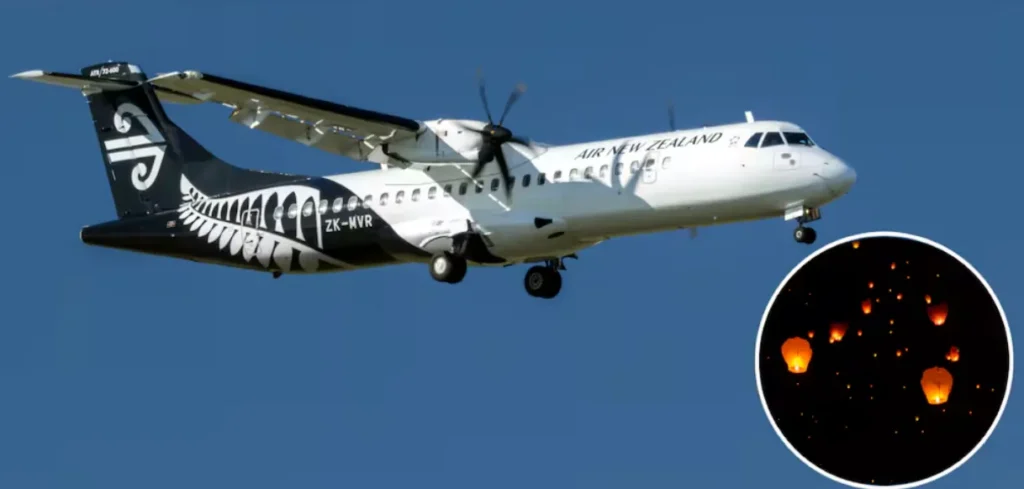

An Air New Zealand flight travelling from Auckland to Tauranga was forced to abandon its landing and return to Auckland on Friday night after a cluster of floating sky lanterns drifted into Tauranga Airport’s flight path, triggering an unexpected aviation safety scare.
Flight NZ5145 had almost completed its journey when air traffic control alerted the crew to lanterns floating near the airport approach area around 9pm. The aircraft entered a holding pattern over Matakana Island for roughly 20 minutes while authorities assessed whether the airspace could be cleared safely.
When the lanterns continued drifting through the approach path, the decision was made to cancel the landing attempt and send the aircraft back to Auckland.
The unusual incident quickly became one of New Zealand’s most talked-about aviation stories overnight, with passengers describing seeing glowing lights outside the aircraft windows while family members waiting at Tauranga Airport watched what looked like “a huge cluster of stars” above the runway area.
Passengers describe sudden change before landing
Passenger Rebecca Sharp told local media the aircraft appeared close to touching down before the pilot abruptly changed direction.
“The pilot said there’d been an unexpected situation of Chinese lanterns across the airspace and that we’d gone into a holding pattern,” she explained.
Sharp said passengers were later informed the airspace could not be cleared in time and the plane would need to return to Auckland instead of continuing the landing.
“Then they said they couldn’t clear it, so we’re going to have to return to Auckland,” she said.
Passengers onboard could reportedly see some of the lanterns glowing outside the windows during the diversion. Meanwhile, people on the ground near Tauranga Airport described the floating lights as appearing like a cluster of stars moving across the sky.
After arriving back in Auckland late at night, many travellers were left scrambling to organise alternative transport. Sharp said the next direct Tauranga flight was not available until the following evening, while a bus option would not leave until the next morning.
Instead, she hired a car and drove to Tauranga overnight.
“There will probably still be people on their way down,” she said, adding that some passengers appeared distressed and uncertain about replacement travel arrangements.
Read More
Police and aviation authorities respond
Police confirmed they were contacted by air traffic control shortly after 9pm following reports that floating lanterns had been released from an unknown location near Tauranga.
Officers were sent to the suspected area where the lanterns were thought to have originated, but nobody was located and no additional lanterns were released.
The Civil Aviation Authority also confirmed the incident and said initial inquiries had begun.
In a statement, the authority reminded the public not to release airborne objects near airports or in locations where they could interfere with aircraft operations.
New Zealand aviation safety guidance warns that objects such as lanterns, drones, balloons and kites can create hazards for aircraft, especially during take-off and landing when pilots have less room and time to respond. Official aviation safety information can be found through the Civil Aviation Authority of New Zealand.
Although sky lanterns are often used during celebrations, festivals and gatherings, aviation experts say they become unpredictable once airborne because wind direction can change rapidly.
Unlike fireworks, lanterns can remain in the sky for extended periods and drift long distances beyond where they were originally released.
That unpredictability becomes particularly dangerous near airport flight paths where aircraft operate at lower altitudes during landing approaches.
Flight tracking data showed extended holding pattern
Data from FlightRadar24 showed the aircraft circling near Matakana Island before eventually turning back toward Auckland instead of proceeding into Tauranga Airport.
The aircraft’s extended holding pattern suggests pilots and air traffic controllers initially hoped the lanterns would clear from the approach path quickly enough for a safe landing.
When conditions failed to improve, aviation protocols required the crew to prioritise safety over schedule.
Commercial airline pilots are trained to avoid unnecessary risk during final approach because this phase of flight requires precise positioning, stable visibility and immediate communication with air traffic control.
Even relatively small airborne objects can create uncertainty around safe landing conditions.
The Tauranga diversion adds to growing concerns globally about uncontrolled airborne objects entering restricted airspace near airports.
Authorities internationally have repeatedly warned that even lightweight objects can distract pilots, interfere with visibility or create operational risks near active runways.
Swikblog recently reported on another aviation-related disruption affecting Tauranga travellers in this coverage of regional flight cancellations linked to volcanic ash conditions: Flights Cancelled After Whakaari Ash Cloud Disrupts Tauranga Routes.
For passengers on NZ5145, the incident turned a short regional flight into a stressful overnight travel disruption. But aviation authorities say the diversion demonstrated exactly how safety systems are designed to work when unexpected hazards appear near an airport.
While the lanterns may have appeared harmless from the ground, once they entered controlled airspace they became a genuine aviation concern — serious enough to force a fully operational commercial flight to abandon its landing and return to Auckland.

Make Swikblog your go-to source on Google for reliable updates, smart insights, and daily trends.