
Japan Airlines is preparing to bring humanoid robots into one of the most physically demanding parts of airport operations, as the carrier looks for new ways to support ground staff during a sharp rise in travel demand and a worsening labour shortage.
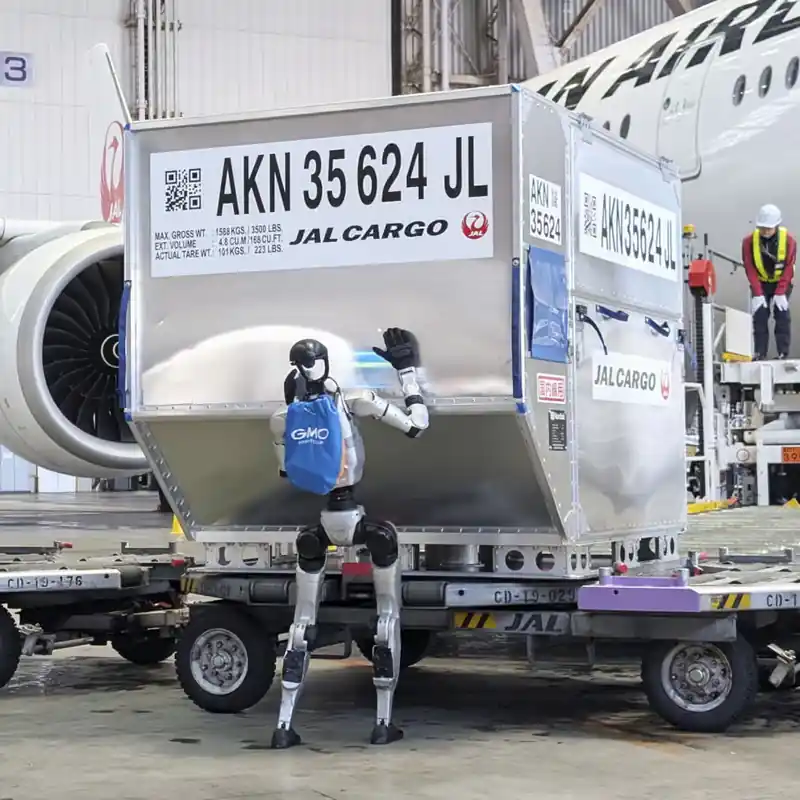
The airline will begin testing robots at Tokyo’s Haneda Airport from May, focusing first on baggage and cargo-related work on the tarmac. The project is being carried out with GMO AI & Robotics and is expected to continue until 2028, giving Japan Airlines time to assess whether humanoid machines can safely become part of daily airport operations.
Unlike the automation passengers usually see at airports, such as check-in kiosks, security scanners and digital boarding systems, this trial targets the hidden labour behind every flight. Baggage handling, cargo movement and aircraft turnaround work still depend heavily on human teams, even at some of the world’s most advanced airports.
Why Japan Airlines Is Turning to Robots
Japan’s aviation industry is facing two pressures at the same time. Tourist arrivals have surged after the reopening of international travel, while the country’s working-age population continues to shrink. Haneda Airport, one of Tokyo’s main aviation hubs, handles more than 60 million passengers a year, making reliable ground operations essential for keeping flights on schedule.
According to the Japan National Tourism Organization, Japan welcomed more than 7 million foreign visitors in the first two months of 2026, after receiving a record 42.7 million visitors in the previous year. That growth has increased pressure on airports, airlines, hotels and transport providers already struggling to secure enough workers.
For Japan Airlines, robots are not being introduced as a headline-grabbing gimmick. The company is testing whether they can reduce the physical burden on staff who handle heavy and repetitive tasks. Ground handling work often involves lifting, pushing and moving luggage or cargo in tight spaces, sometimes under harsh weather conditions and strict time limits.
Japan Airlines currently relies on thousands of ground handling employees, but recruitment has become more difficult as Japan’s labour pool contracts. The airline’s ground service leadership has said robots could offer meaningful support to workers, especially in jobs that place strain on the body. However, the company has also made clear that safety-sensitive duties will remain in human hands.
The trial will use humanoid robots made by China’s Unitree, a robotics company based in Hangzhou. The machines stand about 130cm tall and are designed to assist with tasks such as pushing cargo onto conveyor systems and supporting loading operations around aircraft.
The robots are still limited. They can work continuously for only around two to three hours before needing to recharge, which means they cannot yet replace a full human shift. Their movements also need to be tested carefully in a live airport environment where aircraft, vehicles, workers and equipment operate close together.
That limitation may actually make the trial more realistic. Rather than presenting robots as a complete replacement for airport workers, Japan Airlines is testing them as support tools. If they can take over selected heavy or repetitive tasks, human staff could focus more on supervision, coordination and safety management.
A Test Case for the Future of Airport Work
Airports are often seen as highly automated places, but much of the work behind the scenes remains manual. This is especially true in ground handling, where delays can quickly affect aircraft schedules. A shortage of workers in this area can create wider disruption, from slower baggage delivery to longer turnaround times for flights.
GMO AI & Robotics has pointed out that airport back-end operations still rely heavily on people despite the advanced systems visible to travellers. That gap between front-end automation and back-end manual work is exactly where humanoid robots could become useful.
If the Haneda trial proves successful, Japan Airlines may expand the robots’ duties beyond baggage and cargo. Possible future uses include aircraft cabin cleaning and operation of ground support equipment. These are areas where repetitive work, time pressure and staffing shortages often overlap.
The broader economic context makes the experiment even more important. Japan is under pressure to find new ways to maintain productivity as its population ages. Some estimates suggest the country may need more than 6.5 million foreign workers by 2040 to meet growth targets. At the same time, immigration remains politically sensitive, pushing companies to explore automation as one part of the solution.
Robots are already visible in parts of Japan’s service economy, including airport patrols, retail support and customer guidance. But using humanoid machines for ground handling is a more demanding test. The work is physical, safety-sensitive and closely tied to airline punctuality.
For the wider technology sector, Japan Airlines’ experiment shows how robotics is moving from controlled demonstrations into practical workplace use. The question is no longer whether robots can walk, wave or carry objects in a showroom. The bigger question is whether they can perform reliably in complex environments where human safety and business continuity matter.
There is also a human side to the story. In industries facing labour shortages, automation is often discussed as a threat to jobs. But in Japan’s airport sector, the immediate issue is different: there are not enough workers for all the work that needs to be done. In that environment, robots may be used less as replacements and more as tools to prevent existing employees from being overworked.
The Japan Airlines trial will be closely watched by other carriers and airport operators. If humanoid robots can safely support baggage handling at Haneda, similar technology could appear at other major airports dealing with staff shortages, rising passenger numbers and pressure to improve efficiency.
For now, the robots remain part of an experiment, not a permanent workforce. But the direction is clear. As travel demand rises and labour challenges intensify, airports may increasingly rely on a mix of human expertise and robotic assistance to keep operations moving.
Japan Airlines’ test at Tokyo’s Haneda Airport could therefore become more than a local trial. It may become an early example of how aviation adapts to a future where fewer workers, more passengers and smarter machines all meet on the airport tarmac.
You may like: Apple Rolls Out 12-Month Subscription Plans With Monthly Payments on App Store

Make Swikblog your go-to source on Google for reliable updates, smart insights, and daily trends.