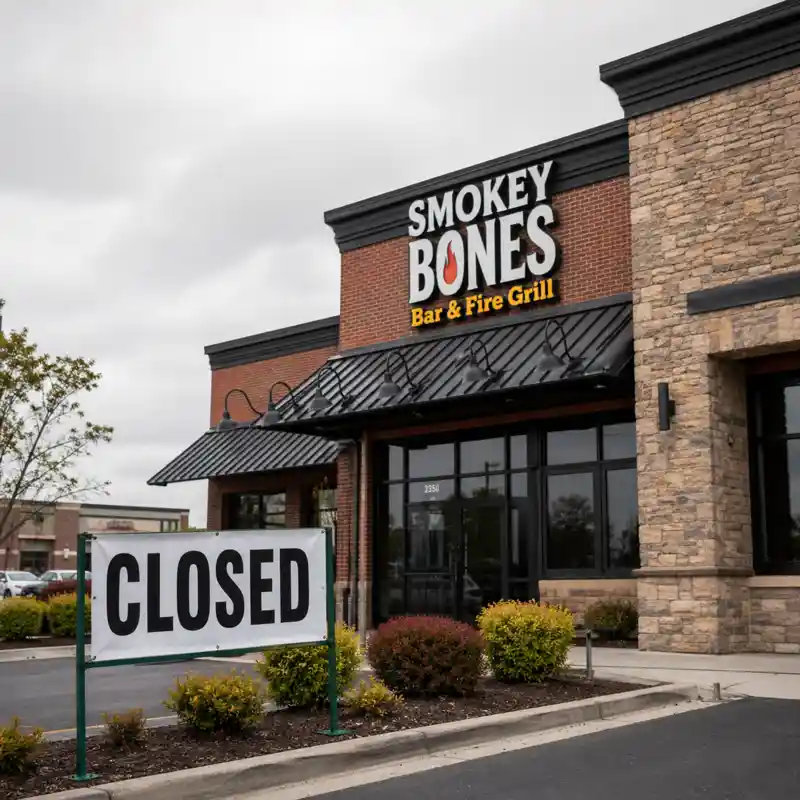

Smokey Bones Bar & Fire Grill is shrinking again, and the latest shutdowns suggest the barbecue chain’s restructuring is moving faster than many workers and customers expected. Several restaurants across Pennsylvania, Michigan and New York closed on Tuesday, April 28, leaving employees with little warning and cutting the brand’s presence in multiple local markets.
The closures add another chapter to the sharp decline of a restaurant chain that once had a far wider national footprint. Smokey Bones, known for ribs, wings, smoked meats and casual sports-bar dining, has been reduced dramatically from its peak years as its parent companies focus on bankruptcy restructuring, weaker store closures and possible conversions into other restaurant concepts.
In Western Pennsylvania, the closures were especially significant. Restaurants in Hempfield, Cranberry and Frazer, near The Village at Pittsburgh Mills shopping center, all shut down the same morning. Those locations had been the last Smokey Bones restaurants left in the Pittsburgh area after the Robinson restaurant closed in January.
The impact was not limited to Pennsylvania. In Lansing Township, Michigan, the Smokey Bones near Eastwood Towne Center also closed permanently. That restaurant, located on Lake Lansing Road, had been open for more than a decade and was the chain’s last remaining Michigan location. Around 20 workers were affected, according to local reports.
In Colonie, New York, another Smokey Bones restaurant on Central Avenue also closed. Employees there reportedly learned about the decision on Tuesday morning, matching the pattern seen at other locations. The chain’s website also showed affected restaurants as closed, while online ordering and reservations were unavailable for some sites.
Why Smokey Bones is closing restaurants
The latest closures come after a difficult period for Smokey Bones and its ownership group. FAT Brands acquired Smokey Bones in 2023 for about $30 million, adding the barbecue chain to a portfolio that includes names such as Fatburger, Johnny Rockets and Fazoli’s. But the turnaround plan has become increasingly complicated.
In January 2026, FAT Brands Inc. and related entities, including Twin Hospitality Group, filed for Chapter 11 bankruptcy protection. The company said at the time that its restaurant concepts were expected to continue operating during the process, but bankruptcy proceedings often lead to lease reviews, store-by-store performance checks and fast decisions on underperforming locations.
Smokey Bones was later moved under Twin Hospitality Group, which oversees both Smokey Bones and Twin Peaks. That shift is important because the company has previously discussed plans to convert some Smokey Bones restaurants into Twin Peaks locations while closing sites that were not meeting expectations.
For customers, that means some Smokey Bones restaurants may not simply reopen under the same name. Depending on leases, market performance and ownership strategy, certain properties could be shut completely while others may eventually be used for a different concept.
The brand’s decline has been steep. Smokey Bones was founded in 1999 by Darden Restaurants in Orlando, Florida, and at one point operated around 130 restaurants nationwide. More recently, the number had fallen sharply, with earlier reports indicating only a small group of locations remained before the latest round of shutdowns.
This kind of contraction is not unusual in casual dining, where large sit-down restaurants face a tougher operating environment than they did a decade ago. Higher food costs, wage pressure, rent obligations and cautious consumer spending have made weaker locations harder to justify. When a chain is also going through bankruptcy, those pressures can lead to faster closures.
The most difficult part for workers is the lack of advance notice. In several affected restaurants, employees said they were told the same day the business closed. For hourly staff, servers, kitchen workers and managers, that can mean an immediate loss of income and little time to find replacement work.
The closures also matter for local communities. A restaurant shutdown can leave empty space in a shopping center, reduce foot traffic for nearby businesses and remove a familiar dining option for regular customers. In areas where Smokey Bones had been operating for years, the sudden exit is more than a corporate restructuring headline — it is a local economic change.
The restaurant industry is not the only sector seeing sudden disruption in 2026. Consumers have also faced unexpected interruptions in major digital services, including the recent Apple Weather app outage in the U.S., showing how quickly familiar services can become unavailable, whether online or in local communities.
What the shutdowns mean for the chain’s future
Smokey Bones now appears to be moving toward a much smaller future. The chain may continue operating in select markets, but the latest closures suggest ownership is no longer protecting every remaining location. Instead, the focus appears to be on cutting losses, reviewing leases and deciding where the brand still has a realistic chance to survive.
That does not necessarily mean Smokey Bones will disappear overnight. Chapter 11 can give companies time to reorganize and preserve stronger parts of the business. But for customers looking at closed doors in Pennsylvania, Michigan and New York, the practical result is already clear: the chain is becoming harder to find.
The conversion strategy involving Twin Peaks also raises questions about the long-term identity of Smokey Bones. If more profitable locations are rebranded while weaker restaurants close, Smokey Bones could be left with only a limited number of outlets. That would mark a major change for a brand that once competed more broadly in the American barbecue and casual dining space.
For now, the latest shutdowns show that the chain’s restructuring is reaching restaurants directly and quickly. Workers are being affected with little notice, customers are losing familiar dining spots and regional markets are seeing Smokey Bones disappear completely.
The coming months will determine whether Smokey Bones stabilizes as a smaller chain or continues to lose locations. But the message from this week’s closures is already clear: the brand’s footprint is shrinking fast, and more communities may soon find their local Smokey Bones gone for good.
You may like: McDonald’s New Drinks Could Challenge Starbucks in 2026

Make Swikblog your go-to source on Google for reliable updates, smart insights, and daily trends.