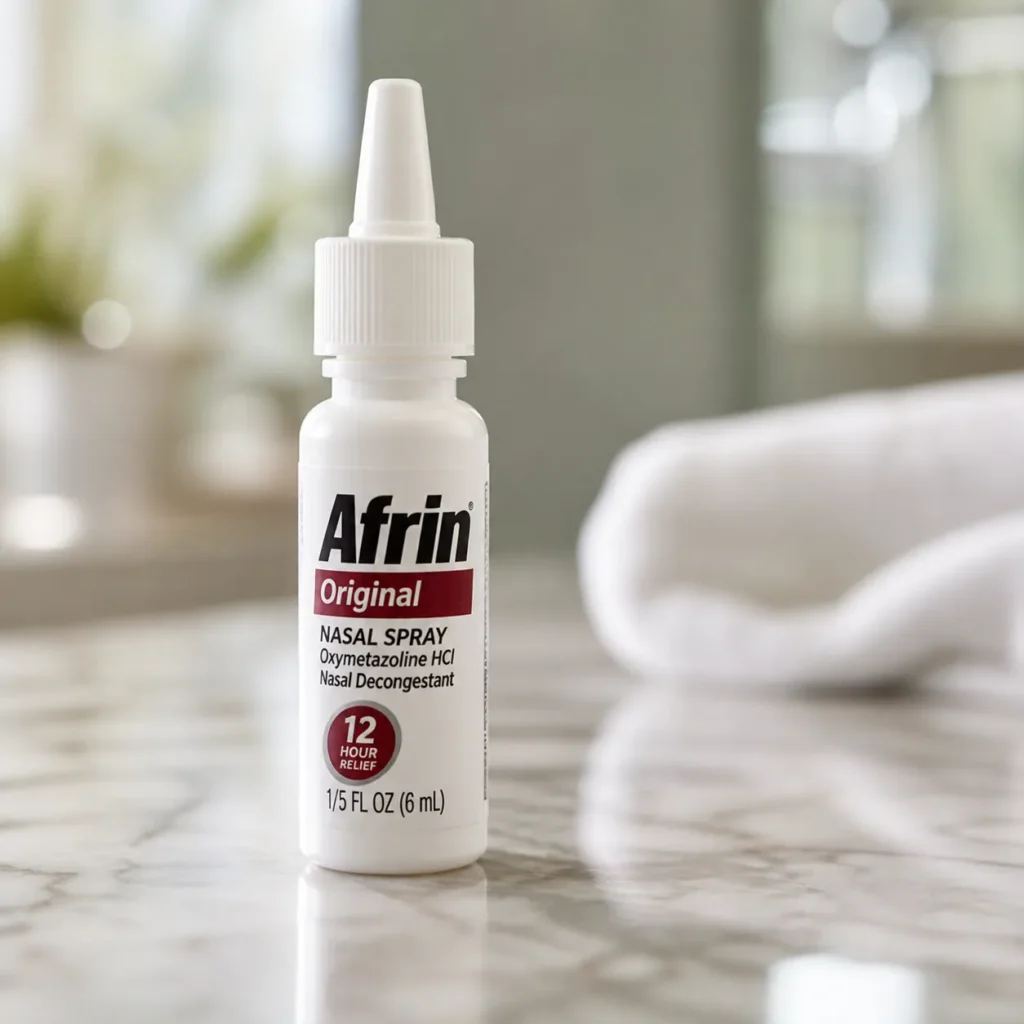

Afrin nasal spray recall concerns are spreading across U.S. households after regulators flagged a child safety issue affecting nearly 800,000 travel-size bottles of the popular congestion relief product.
The recall covers about 786,100 units of Afrin Original Nasal Spray in 6 mL travel-size bottles. The U.S. Consumer Product Safety Commission (CPSC) said the packaging is not child-resistant and does not carry the required warning statement, creating a potential poisoning hazard if young children swallow the contents.
Bayer issued the recall in cooperation with federal safety officials. The affected products are unexpired 6 mL bottles labeled “Afrin Original Nasal Spray” and “1/5 FL OZ (6 mL)” on the front of the bottle.
The recalled lot numbers are 230361, 240822, 241198, 250066, 250152, 250646 and 250831. Consumers should check the lot number on their bottle before continuing to use or store the product at home.
No injuries have been reported in connection with the Afrin recall, according to the notice. Even so, regulators warned that the packaging problem is serious because nasal spray products can be dangerous when accessed or swallowed by children.
The issue is not linked to contamination or the medicine’s formulation. Instead, it highlights a packaging compliance gap — a detail that often goes unnoticed by consumers but plays a crucial role in safety. Child-resistant designs are meant to act as a first barrier against accidental ingestion, especially in households with toddlers.
Travel-size medicines can present added risks because they are often stored in handbags, backpacks, bedside drawers or cars rather than secured cabinets. This increases the chances of unsupervised access, particularly in busy households.
Consumers who have the recalled Afrin bottles should keep them away from children and follow refund instructions issued by Bayer and the CPSC. Anyone who suspects accidental ingestion should immediately contact poison control or seek medical assistance.
The recall also comes amid a broader wave of product safety actions involving children’s items. Around the same time, regulators announced the recall of roughly 12,830 children’s tower stools sold under the Toetol, Wiifo and Amzcmj brands due to risks of collapse, tipping and entrapment.
Read More
Those stool recalls included about 3,000 Toetol Tower Stools, 9,700 Wiifo Children’s Tower Stools and 130 Amzcmj DGD Children’s Tower Stools. Officials reported multiple incidents, including 18 collapse cases involving Toetol products alone, resulting in 11 injuries such as cuts and bruises.
Although unrelated, both recalls point to a common concern — everyday products used around children can pose risks if design standards or safety requirements are not properly met. Regulators increasingly emphasize prevention, acting before injuries occur.
For households, this is a practical reminder to review how medicines are stored. Even with compliant packaging, keeping products out of reach and sight of children remains one of the most effective safety measures.
Child-resistant packaging is not foolproof. It is designed to delay access, not eliminate it entirely. That is why safety experts recommend layered precautions — proper storage, supervision and awareness of product recalls.
For more updates on consumer safety alerts and health-related recalls, readers can explore additional coverage on Swikblog’s latest consumer safety and recall news, where ongoing developments are tracked across multiple categories.
Consumers can also verify details, including affected lot numbers and refund procedures, through the official U.S. Consumer Product Safety Commission recall database.
The Afrin recall has not been linked to reported injuries, but the scale of the action makes it significant. With nearly 800,000 bottles affected, regulators are urging consumers to act promptly and remove recalled products from areas accessible to children.

Make Swikblog your go-to source on Google for reliable updates, smart insights, and daily trends.