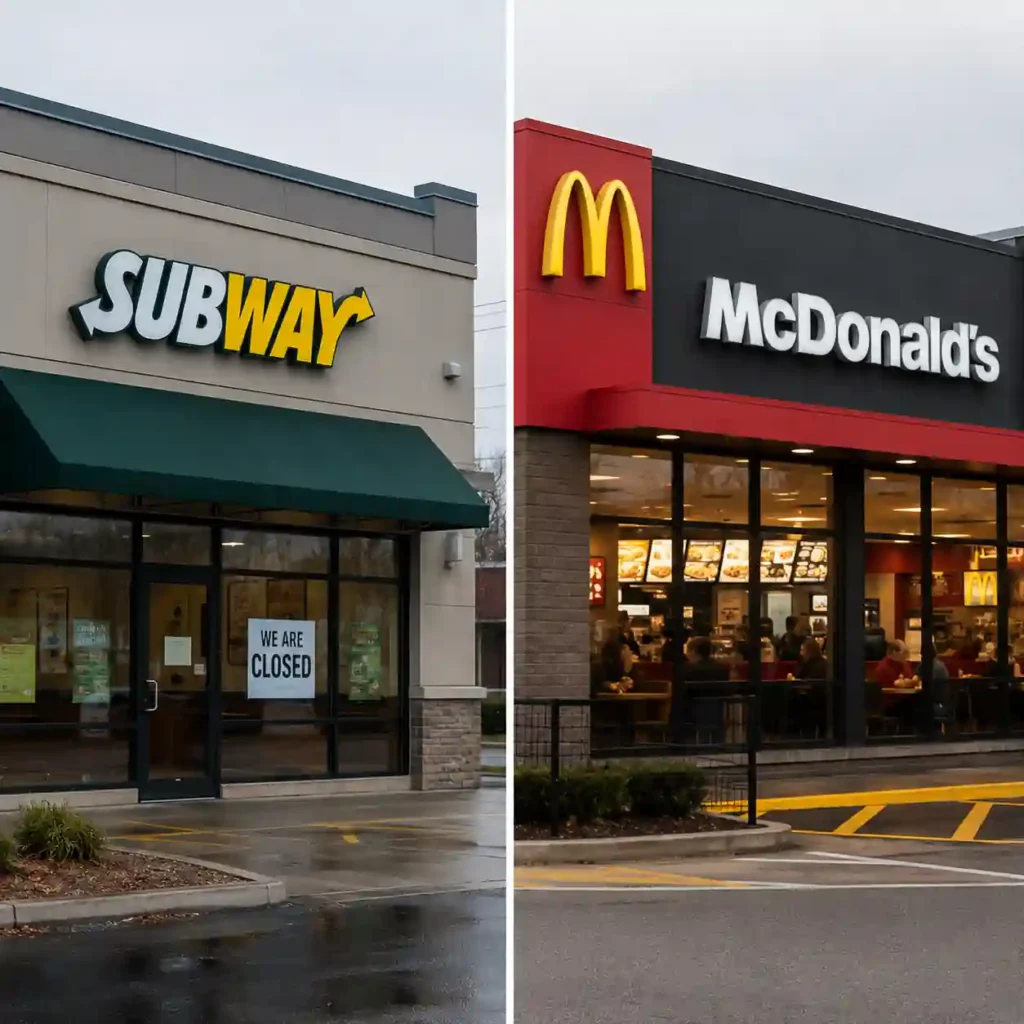

Subway’s shrinking US footprint has become one of the clearest signs of how quickly America’s fast-food market is changing. The sandwich chain closed 729 restaurants in the United States last year, reducing its domestic count to 18,773 locations and giving McDonald’s more room to narrow the gap in the race for fast-food dominance.
Subway is still ahead of McDonald’s by total US restaurant count, but the lead is no longer as comfortable as it once looked. McDonald’s operates close to 14,000 restaurants across the country, while Subway has now posted 10 straight years of net closures in its home market. For a brand that once built its identity around being almost everywhere, the latest decline is not just a routine store-count update. It is a major signal that Subway is trying to rebuild its business by becoming smaller, sharper and more selective.
The 729 closures follow years of steady contraction. Subway had more than 27,000 US restaurants at its peak in 2015, but the chain has since closed thousands of locations. According to QSR Magazine, Subway’s US restaurant count fell for a 10th consecutive year in 2025, with all of its domestic restaurants operated by franchisees. That franchise-heavy model helped Subway grow rapidly for decades, but it has also made weaker locations more exposed to rising costs and local sales pressure.
A Subway spokesperson said the closures are part of a strategy focused on making sure restaurants are placed in stronger long-term locations. The company said it wants stores with the right real estate, visibility and operations so franchisees have a better chance to succeed. In simple terms, Subway is no longer chasing store count at any cost. It is trying to close restaurants that no longer make sense while improving the ones that remain.
That shift matters because Subway’s old expansion model was built on convenience and density. For years, the brand appeared in shopping plazas, petrol stations, airports, small towns and retail corners across America. The strategy made Subway the largest restaurant chain in the US by number of locations, ahead of McDonald’s. But it also created a problem: in many areas, Subway restaurants were competing not only with burger chains and sandwich rivals, but also with nearby Subway franchisees.
Overexpansion is now one of the biggest questions hanging over the brand. A large footprint can help a company dominate search, delivery apps and roadside visibility, but only if stores are profitable. When traffic slows and costs rise, having too many small or poorly located restaurants can become a burden. Subway’s latest closures suggest the company is trying to clean up that problem before it weakens franchisee confidence further.
The timing is also important. US consumers are more selective with fast-food spending after years of inflation. Diners still want convenience, but they are comparing prices more carefully and expecting better value, better ingredients and faster digital ordering. Subway built much of its reputation on affordable sandwiches, but the broader market has moved. Chicken chains, burger brands, coffee shops and fast-casual restaurants are all fighting for the same lunch and dinner customers.
McDonald’s has benefited from that shift by leaning heavily on scale, brand recognition, drive-thru speed, mobile ordering and loyalty programs. The company has also kept value messaging at the center of its US strategy, an important advantage at a time when many customers feel restaurant prices have climbed too high. McDonald’s investor materials show how central digital sales, loyalty and restaurant modernization have become to its long-term plan, giving the brand more ways to keep customers inside its ecosystem.
According to McDonald’s Investor Relations, digital growth, loyalty programs and restaurant modernization remain key parts of the company’s wider business strategy. That gives McDonald’s an advantage at a time when fast-food customers increasingly expect speed, value and easier mobile ordering.
Read More
According to Nation’s Restaurant News, Subway’s continued store reductions reflect a broader industry shift where restaurant chains are prioritizing profitability, digital growth and franchise sustainability instead of simply expanding location count.
Subway is not standing still. The company has introduced menu changes, refreshed store designs and pushed digital ordering in an attempt to modernize its image. It has also leaned into value, including lower-priced menu options aimed at budget-conscious customers. These moves show Subway understands the pressure it faces, but the closures prove the turnaround is still a work in progress.
The chain also has new ownership behind it. Subway was acquired by Roark Capital, the private equity firm behind several major restaurant brands, in a deal completed in 2024. That change raised expectations that Subway would become more disciplined about operations, franchise performance and store quality. The appointment of new leadership has also added to the sense that Subway is entering a more aggressive restructuring phase rather than simply waiting for traffic to recover.
While the US story looks challenging, Subway’s global business gives the company another path for growth. The brand continues to operate in more than 100 countries and has been expanding internationally even as it trims weaker domestic restaurants. That contrast is important: Subway is not disappearing as a global chain, but it is clearly rethinking what its American business should look like after years of overbuilding.
For McDonald’s, Subway’s contraction is an opportunity, but not an automatic victory. McDonald’s still trails Subway in US restaurant count, yet it has stronger average sales per restaurant and a more consistent brand experience in many markets. If Subway keeps reducing locations while McDonald’s continues improving convenience and value perception, the gap in consumer attention could shrink faster than the gap in store numbers.
The bigger story is not just Subway versus McDonald’s. It is the changing definition of fast-food strength. A decade ago, having the most stores was seen as a sign of dominance. Today, restaurant chains are judged more by profitability, digital reach, franchise health, customer loyalty and how well they can hold traffic during economic pressure.
The National Restaurant Association has also highlighted how inflation, labor pressure and changing customer behavior continue to shape restaurant operations across the US. Those pressures make it harder for weaker franchise locations to survive, especially when brands are competing on both price and convenience.
Subway still has enormous brand recognition, a huge US presence and global scale. But closing 729 restaurants in one year shows the company is under real pressure to prove that a smaller American footprint can become a stronger one. For McDonald’s, the moment offers a chance to gain ground. For Subway, it is a test of whether the brand can turn years of closures into a cleaner, healthier business.
Readers can follow more business and market updates on Swikblog.

Make Swikblog your go-to source on Google for reliable updates, smart insights, and daily trends.