
A deadly highway crash in Indonesia has left at least 16 people dead after a passenger bus and a fuel tanker collided head-on on Sumatra Island, setting off a fierce fire that trapped victims inside the wreckage.
The accident happened around midday on Wednesday on the Trans-Sumatra Highway in North Musi Rawas Regency, South Sumatra province. The bus was travelling from Lubuklinggau to Jambi with at least 20 people on board when it struck a tanker truck coming from the opposite direction.
Local disaster officials said the crash quickly turned catastrophic after the impact ignited both vehicles. Flames swept through the bus and tanker, leaving several passengers unable to escape as smoke and fire consumed the vehicles.
Among the dead were the bus driver, 13 bus passengers, the tanker driver and the tanker driver’s assistant. Four bus passengers survived and were taken to a nearby health clinic. Three of them suffered severe burns, while one person sustained minor injuries.
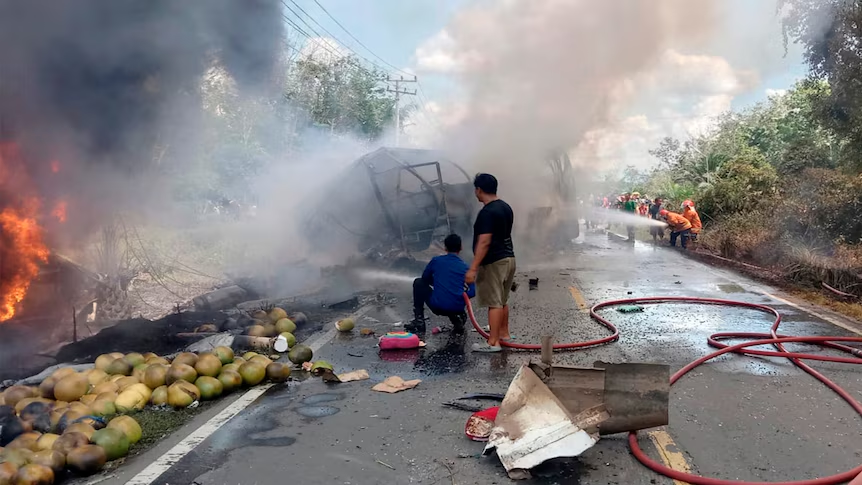
Emergency teams, including firefighters, disaster response officers and traffic police, arrived at the scene to extinguish the blaze and evacuate victims. Images from the crash site showed thick black smoke rising above the highway as rescuers worked around the charred remains of the bus and tanker.
The force of the collision left twisted metal and burned debris scattered across the road. Officials said some victims were pinned inside the wreckage, making rescue operations more difficult and forcing authorities to disrupt traffic while the highway was cleared.
Investigators are still working to determine exactly what caused the crash. Preliminary accounts suggested the bus may have developed mechanical trouble shortly before the collision. Officials cited possible sparks from the vehicle, while other reports pointed to a tyre burst that may have caused the driver to lose control.
The bus driver is believed to have moved toward the right side of the road moments before impact. A fuel tanker was approaching from the opposite direction, leaving little time for either vehicle to avoid the collision. The tanker was reportedly carrying diesel, which helped fuel the fire after the crash.
Authorities said they are still checking the passenger manifest and confirming the final number of casualties. Identification efforts may take time because several bodies were badly burned in the fire.
The tragedy has renewed attention on road safety in Indonesia, where long-distance buses remain a common form of travel between cities. On major routes such as the Trans-Sumatra Highway, passengers often rely on intercity buses because they are cheaper and more accessible than flights.
Read More
But Indonesia has long struggled with deadly transport accidents involving buses, trucks, trains and ferries. Poor vehicle maintenance, driver fatigue, weak inspection systems, ageing transport fleets and dangerous road conditions are often cited after major crashes.
According to the World Health Organization, road traffic injuries remain one of the leading causes of death worldwide, with low- and middle-income countries carrying a major share of the burden.
The Sumatra crash also comes after a series of recent transport disasters in Indonesia. Last month, a long-distance train hit the rear carriage of a stationary commuter train near Bekasi Timur station in West Java, killing 16 women and injuring at least 90 people. Days later, a train struck a car in Central Java, killing four people, including two children.
For families waiting for confirmation about their loved ones, Wednesday’s accident has brought another painful reminder of how quickly routine travel can turn fatal. Local officials said emergency teams will continue collecting data, identifying victims and reviewing evidence from the scene.
Investigators are expected to examine the condition of the bus, the tanker’s speed, the road layout and whether safety rules were followed before the crash. The findings could determine whether mechanical failure, driver error or maintenance negligence played the main role.
The scale of the fire has also raised questions about emergency readiness on busy highways that carry fuel tankers and passenger vehicles side by side. Safety experts have repeatedly urged stricter vehicle checks, better driver training and stronger enforcement against poorly maintained buses and trucks.
For more updates on global road accidents, transport safety and breaking international stories, readers can follow Swikblog.

Make Swikblog your go-to source on Google for reliable updates, smart insights, and daily trends.