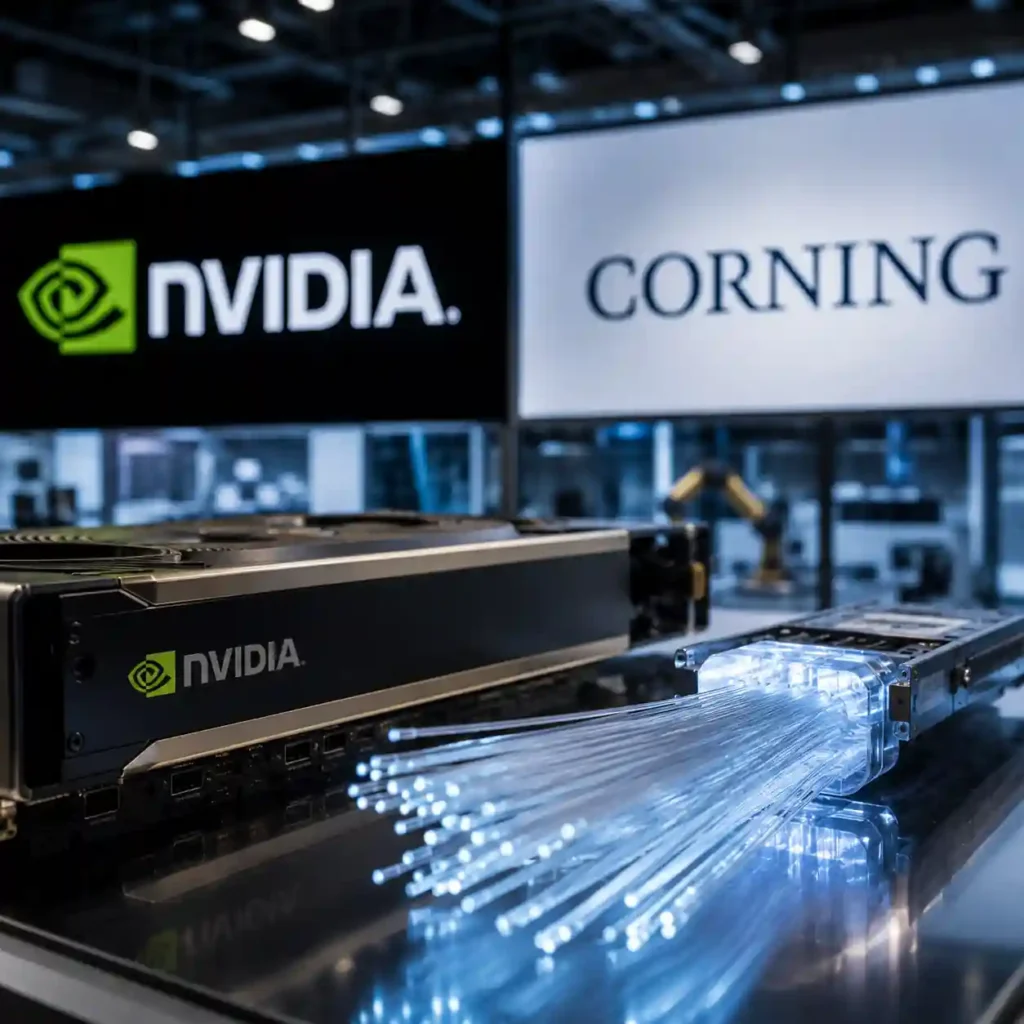

Nvidia’s deepening push into optical networking is giving Wall Street a clearer look at where the artificial intelligence infrastructure race may be heading next. The company’s multiyear agreement with Corning is not just another supplier partnership. It points to a widening battle for the physical backbone needed to keep large AI data centers running at speed.
The deal gives Nvidia the right to invest up to $2.7 billion in Corning and includes warrants to buy as many as 15 million shares of the glass and optical technology company. Corning also plans to open three advanced manufacturing plants focused on optical technology developed with Nvidia, a move the companies say could expand Corning’s optical manufacturing capacity by ten times.
Investors reacted quickly. Corning shares jumped more than 23% after the announcement, reflecting growing confidence that optical fiber could become one of the next major pressure points in the AI supply chain.
For much of the AI boom, market attention has remained fixed on graphics processors, cloud spending and semiconductor shortages. Nvidia has been at the center of that story because its GPUs power much of the world’s advanced AI training and inference infrastructure. But as AI clusters grow larger, another bottleneck is becoming harder to ignore: how quickly data can move between thousands of chips, servers and storage systems.
That is where Corning’s role becomes important. AI data centers do not operate as isolated machines. They depend on dense networks of connections that allow processors to communicate almost instantly. When models become larger and workloads become more complex, the amount of data moving through those systems rises sharply. Copper connections can become less efficient at that scale because of heat, power consumption and bandwidth limits.
Optical fiber offers a different path. By using light to move data, optical systems can support faster transmission over greater distances while helping reduce energy strain inside large computing environments. That makes the technology especially relevant as cloud providers continue building huge AI facilities designed to train and run generative AI systems.
The Corning agreement suggests Nvidia is not waiting for that demand surge to create shortages. Instead, the company appears to be locking in access to key infrastructure before optical components become harder to secure. That strategy mirrors Nvidia’s broader effort to build influence across the AI stack, from chips and systems to networking and supply-chain capacity.
Seaport analyst Jay Goldberg told MarketWatch that Nvidia has been working for months to secure AI supply-chain components that could become scarce. He said the amount of fiber-optic strands required by next-generation data centers makes Corning a logical partner for Nvidia.
The partnership also follows Nvidia’s earlier work with optical companies such as Lumentum Holdings and Coherent. Together, those moves show that Nvidia sees optical networking as more than a side market. It is becoming a core part of the infrastructure required to scale AI computing.
Read More
For Corning, the agreement strengthens its position in one of the fastest-growing technology investment cycles. The company is widely known for specialty glass and communications products, but AI infrastructure gives its optical business a new growth narrative. If demand for high-speed connections rises as expected, Corning could become a more visible player in the data-center supply chain.
The manufacturing expansion is also strategically important. A tenfold increase in optical capacity would give Corning greater ability to serve hyperscale customers at a time when technology companies are spending heavily on AI-ready infrastructure. Microsoft, Amazon, Google and Meta have all been investing aggressively in data centers, and those facilities require more than chips. They need power, cooling, networking hardware, memory and fiber systems that can support constant data movement.
This is why the Nvidia-Corning deal matters beyond one day of market reaction. It signals that the AI buildout is spreading into a broader industrial ecosystem. The biggest beneficiaries may not be limited to semiconductor makers. Companies providing the less visible infrastructure behind AI could also gain as the industry moves from early adoption to mass deployment.
Inference demand may make this shift even more important. Training large AI models is already bandwidth intensive, but running AI services for millions of users can also place enormous pressure on data-center networks. As businesses add AI tools into software, search, advertising, customer support and productivity platforms, the need for faster internal communication inside data centers could continue rising.
Nvidia’s investment rights and warrant structure also give the company a financial incentive tied to Corning’s growth while giving Corning a powerful commercial partner in AI infrastructure. That combination makes the deal more significant than a standard supply arrangement.
For investors tracking the next stage of the AI trade, the message is clear: the market is starting to look past chips alone. Optical networking, advanced manufacturing and data-center connectivity are becoming central themes. The companies that help AI systems communicate faster and consume power more efficiently may become increasingly important as the industry scales.
Readers following broader market moves and technology-stock trends can also explore related coverage on Swikblog, where AI infrastructure, semiconductor demand and Wall Street reactions remain key themes across the market.
Additional details about optical networking and AI infrastructure trends are available through Corning’s Communication Networks division, which outlines how fiber-optic technologies are becoming increasingly important for hyperscale data centers and next-generation AI systems.
Nvidia’s Corning deal shows that the AI race is no longer only about who owns the most powerful processor. The next advantage may come from controlling the networks that allow those processors to work together at massive scale.

Make Swikblog your go-to source on Google for reliable updates, smart insights, and daily trends.