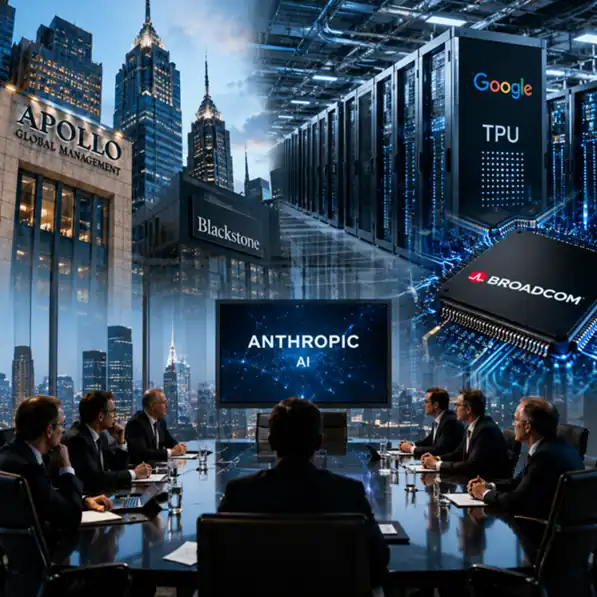

Anthropic has secured a $35 billion AI chip financing package backed by Apollo Global Management and Blackstone, underscoring how the race to build advanced artificial intelligence systems is reshaping both the technology industry and global capital markets. The transaction ranks among the largest private credit deals ever tied to AI infrastructure and highlights the growing demand for specialized computing power needed to train and run next-generation AI models.
While AI companies have raised billions of dollars in equity funding over the past few years, the industry’s rapidly increasing appetite for computing resources is creating new financing challenges. Instead of directly purchasing large quantities of hardware, Anthropic is using a financing structure that allows it to lease Google’s custom Tensor Processing Units (TPUs), providing access to critical infrastructure while reducing the upfront capital burden.
The deal revolves around a special-purpose vehicle that acquires the chips through a combination of debt and equity financing. Anthropic then leases the hardware, with those lease payments helping support returns for investors. The model resembles financing structures commonly used in aviation, energy and telecommunications, suggesting that AI infrastructure is increasingly being viewed as a long-term asset class rather than a conventional technology purchase.
According to Financial Times, the debt package was divided into three tranches. The senior portion includes $6 billion of A1 notes and $24 billion of A2 notes, while a separate $4.5 billion B-note tranche carries a higher yield because it does not benefit from the same credit support. The A1 notes were priced at one percentage point above U.S. Treasuries, the A2 notes carry a 5.75% coupon, and the B notes were issued with an 8.5% coupon.
A significant factor behind the deal is Broadcom’s involvement. The semiconductor company, which works alongside Google on the development of Tensor Processing Units, is providing residual value support for the senior debt layers. If Anthropic were unable to meet lease obligations and the chips were sold at a lower value than expected, Broadcom would help cover potential shortfalls for senior investors. This additional protection contributed to stronger credit characteristics and helped lower borrowing costs.
Investor interest in Broadcom has remained elevated as demand for AI infrastructure accelerates. Recent developments involving Broadcom’s AI partnerships with Google and Anthropic have highlighted the company’s growing influence across the AI supply chain, extending beyond chip manufacturing into broader infrastructure initiatives.
The financing also aligns with Broadcom’s larger AI strategy. During its latest earnings discussion, Chief Executive Hock Tan outlined the company’s AI XPV platform, an initiative being developed with Apollo, Blackstone and other investment partners. The project aims to deploy more than 20 gigawatts of compute capacity by 2028, serving some of the world’s leading AI developers, including Anthropic and OpenAI.
For Anthropic, the agreement arrives at a pivotal moment. The Claude developer has reportedly filed confidential paperwork for a U.S. initial public offering and continues to compete aggressively against OpenAI, Google DeepMind and Meta. As AI models become larger and more sophisticated, access to reliable compute infrastructure is emerging as one of the most important competitive advantages in the sector.
The transaction also reflects a broader trend unfolding across Wall Street. Private credit firms are increasingly stepping into areas traditionally dominated by banks, particularly where fast-growing industries require substantial long-term capital. AI infrastructure has quickly become one of those areas, attracting institutional investors searching for exposure to the sector without directly investing in high-valuation AI startups.
Another notable aspect of the deal is the level of outside participation. Roughly half of the financing was syndicated to external investors, demonstrating strong confidence in the long-term demand for AI computing resources. Institutional buyers, including insurance investors seeking stable long-duration assets, were among those participating in the transaction.
Read More
The structure has also drawn comparisons to other large-scale infrastructure financings, including arrangements used for major data center projects. As demand for AI computing continues to rise, similar financing models could become increasingly common across the industry, allowing technology companies to secure vast amounts of hardware without committing all capital upfront.
Anthropic’s $35 billion financing package ultimately signals that the next phase of the AI boom will be driven not only by breakthroughs in software and models but also by the ability to finance, deploy and scale the infrastructure powering them. As competition among AI developers intensifies, access to capital and computing capacity may prove just as valuable as the technology itself.

Make Swikblog your go-to source on Google for reliable updates, smart insights, and daily trends.