
Victorian public school teachers, principals and education support staff will hold a 24-hour statewide strike on Thursday, July 23, after negotiations between the Australian Education Union (AEU) and the Allan Labor government reached a deadlock.
The action is expected to disrupt schools across Victoria, but it does not mean every public school will close. Individual schools will decide their arrangements based on staffing levels, meaning parents should wait for updates from their child’s school.
Strike at a glance
- Date: Thursday, July 23
- Action: 24-hour strike and ban on unpaid overtime
- Who: Public school teachers, principals and education support staff
- Main issues: Pay, workload, staffing and school funding
- Impact: Some schools may close or operate with limited supervision
Will Victorian schools close?
Not necessarily. While some schools may close for the day, others could remain open with reduced classes or supervision if enough staff are available.
Parents should monitor emails, school apps and official notices for the latest information. Schools will determine attendance arrangements based on employee participation.
Excursions, sporting events, camps and some extracurricular activities may also be postponed depending on staffing.
Why are teachers striking?
The AEU says the dispute is about far more than salaries. Union leaders argue teachers are facing excessive workloads, staff shortages and chronic underfunding in Victoria’s public school system.
AEU Victorian Branch president Justin Mullaly said teachers, principals and education support staff complete an average of 12 hours of unpaid overtime every week.
The union also says only around three in 10 employees expect to remain in public schools until retirement because of growing workload pressures.
Alongside the strike, members will introduce a ban on unpaid overtime to highlight how much work is routinely completed outside paid hours, including lesson planning, marking and administration.
Why was the government’s pay offer rejected?
In May, the government and AEU leadership reached an in-principle agreement that proposed pay increases of between 28% and 32% over four years, along with additional student-free days.
Despite being endorsed by union leadership, members voted against the agreement in June, arguing it did not do enough to reduce workloads or improve long-term working conditions.
The Victorian Department of Education says enterprise bargaining is continuing and further negotiations remain possible. More information is available on the department’s official enterprise bargaining page.
What are teachers asking for?
- Higher salaries
- Reduced workloads
- Less unpaid overtime
- More education support staff
- Additional planning time
- Greater public-school funding
- Better staff retention measures
The AEU argues Victoria’s public schools remain the lowest funded in Australia and claims the system is missing at least $2.4 billion in funding needed to ease workload pressures and improve staffing.
What is the government’s response?
The Allan government has urged the union to cancel the strike and return to negotiations, saying the rejected agreement would have made Victorian teachers among the best paid in Australia while delivering improved employment conditions.
The government says it remains committed to reaching a new agreement, while the union insists meaningful workload reforms must accompany any revised pay offer.
How does this compare with the March strike?
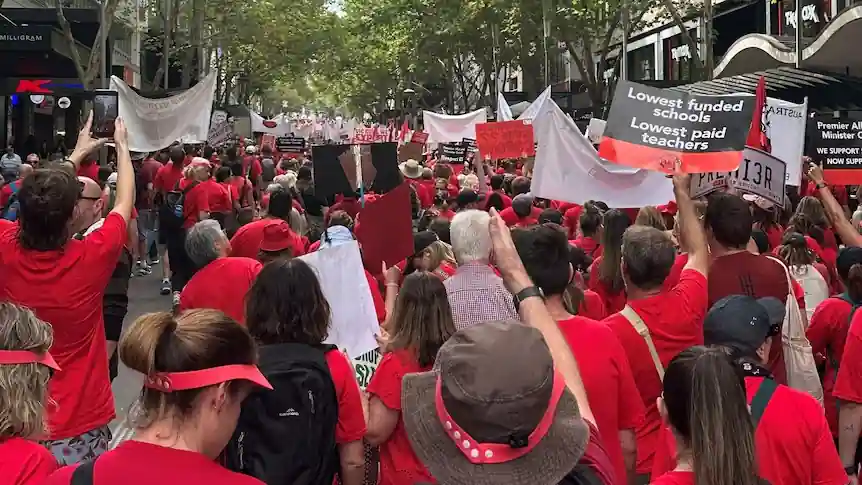
The July 23 action follows the major statewide strike held in March, when Victoria Police estimated about 35,000 people joined a rally in Melbourne.
That was the first statewide Victorian teachers’ strike since 2013. Readers wanting more background can read our report on the March Victorian teachers strike and the ongoing pay dispute.
Read More:
- How Telstra customers can claim compensation after the nationwide outage
- NSW issues stay-away order to protect southern right whales
- Visit the Swikblog homepage for more latest news
What should parents do now?
Parents should wait for advice from their child’s school rather than assuming all schools will close. Each campus will decide whether it can operate safely based on available staff.
Families may wish to prepare alternative childcare in case their school announces a closure or limited supervision. Students should also check for updates about assessments, VCE classes and extracurricular activities.
Although negotiations may continue before July 23, the strike is currently scheduled to proceed unless both sides reach a new agreement.
For more Australian education and public policy news, visit our latest news coverage.

Make Swikblog your go-to source on Google for reliable updates, smart insights, and daily trends.