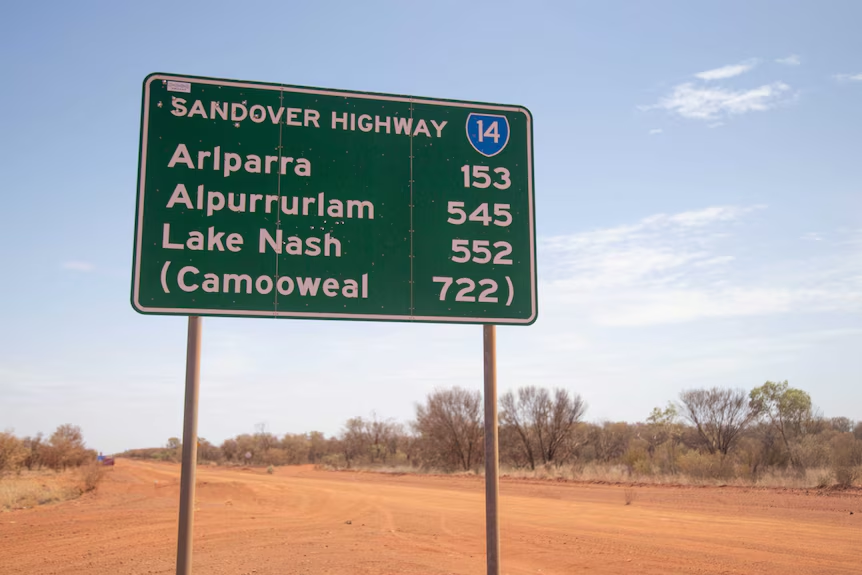

Nearly 350 kilometres of the Sandover Highway remains closed months after wet-season flooding damaged the remote Northern Territory route, with no repair work started and no reopening date announced.
The closure stretches from Ammaroo Station, about 300 kilometres north-east of Alice Springs, to the Queensland border. It is disrupting cattle transport and making travel harder for pastoral properties and remote Aboriginal communities as the next wet season approaches.
Where is the Sandover Highway closed?
The closed section begins near Ammaroo Station and continues east to the Queensland border. Most of the highway is unsealed, leaving it vulnerable to washouts, erosion and surface damage after prolonged rain.
Ammaroo Station owner Stewart Weir said the road had not received repair work or even an initial maintenance grade since it was damaged. He described the route as effectively impassable.
Cattle trucks are being forced to take substantial detours instead of using the highway to travel towards Queensland. The route also connects Ammaroo, Utopia, Lake Nash Station and other remote locations, making the closure a community-access problem as well as a pastoral industry issue.
When will the Sandover Highway reopen?
No repair starting date, project cost or reopening timetable has been released. The NT Department of Logistics and Infrastructure was contacted repeatedly by ABC Rural but had not provided a response.
It is therefore unclear whether the affected sections need grading, major reconstruction or replacement drainage infrastructure. Drivers should check restrictions through the official NT Road Report before travelling.
Why the repair delay matters now
The Northern Territory is moving through the final months of the dry season, normally the most practical period for repairing remote unsealed roads.
NT Cattlemen’s Association chief executive Romy Carey said the industry was frustrated by the uncertainty and wanted recovery funding allocated before wet-season conditions return.
Further rainfall could worsen the damage, restrict access for machinery and delay repairs. Longer cattle-truck routes can also increase fuel costs, driver hours, freight charges and the time livestock spend in transit.
Elkedra Station was also heavily affected by flooding, and its local road was repaired only recently, showing how long restoration has taken in some remote areas.
How much of the $100 million fund has been allocated?
The NT government created a $100 million Flood Recovery Fund from its budget following widespread flooding and cyclones during the 2025–26 wet season. It is intended to support roads, bridges, flood mitigation and more resilient infrastructure.
Only $12.5 million has been publicly allocated to named projects:
- $4.9 million for flood mitigation in Alice Springs.
- $4 million for levee and drainage improvements in Katherine North.
- $2.5 million for Territory-wide early-warning technology.
- $600,000 for Maud Creek bridge design work.
- $500,000 for a possible relocation plan for Daly River, or Nauiyu.
The remaining $87.5 million has not been attached to publicly identified projects. This does not mean the money has been lost or spent elsewhere, but it leaves affected communities uncertain about which damaged assets will receive funding.
What did the separate road package cover?
A separate $30.5 million Roads Repair Package is understood to have been fully spent or committed. It provided $8 million for Top End roads, $16 million for Big Rivers and $6.5 million for the Barkly region.
Named projects included Cox Peninsula, Daly River, Roper, Central Arnhem and Carpentaria highways, along with Bing Bong, Murray Downs, Elkedra Propacc and Kurundi roads. The damaged Sandover Highway section was not specifically listed.
The government had also committed more than $42 million in operational flood expenditure by late April, including emergency accommodation, evacuations, waste management, hardship payments and repairs to public assets.
Read More:
Why are the governments disagreeing?
NT flood-recovery minister Jo Hersey said she was discussing possible funding partnerships with federal minister and NT senator Malarndirri McCarthy.
The Commonwealth said further negotiation was unnecessary because the NT could apply through the Disaster Recovery Funding Arrangements. Under the DRFA, federal, state and territory governments jointly fund eligible disaster response and reconstruction costs.
A federal spokesperson said the NT announced its $100 million fund without Commonwealth involvement and should submit a DRFA application if additional assistance is required.
What affected communities need next
The prolonged closure adds to concerns about reliable access to essential transport and communication services across Australia. Other recent issues affecting road users include the Victoria vehicle registration rebate deadline, while the Optus Triple Zero outage court case has highlighted the consequences of disrupted connections.
The immediate questions are whether the NT will direct part of its remaining recovery fund to the Sandover Highway, seek Commonwealth support through the DRFA or use another infrastructure program.
Until funding and construction schedules are announced, pastoralists must continue using costly detours and remote residents face an uncertain wait for their direct road connection to be restored.

Make Swikblog your go-to source on Google for reliable updates, smart insights, and daily trends.