
A Ryanair-branded Boeing 737 suffered a serious engine failure shortly after taking off from Thessaloniki, Greece, sending engine fragments into the fuselage, shattering a passenger window and causing cabin depressurization. One passenger was seriously injured after becoming partially lodged in the damaged window before people inside the aircraft pulled him back to safety.
The July 10, 2026 incident is receiving renewed attention after the US National Transportation Safety Board released preliminary findings showing evidence of fatigue cracking in the fan blade that fractured. Investigators also recovered bird remains from the damaged engine, but they have not yet determined the final cause of the failure.
The aircraft was Malta Air flight 1879, operating for Ryanair from Thessaloniki to Memmingen, Germany. The Boeing 737-8AS, registration 9H-QEU, was carrying 149 passengers and six crew members.
What happened to Ryanair flight 1879?
The aircraft was climbing through about 16,000 feet when the pilots received a high-vibration indication from the No. 2, or right-side, engine.
The crew reduced engine power and began the high-engine-vibration checklist. The vibration initially decreased but later rose sharply. Around nine minutes after the takeoff roll began, the pilots heard a loud bang and the autopilot disengaged.
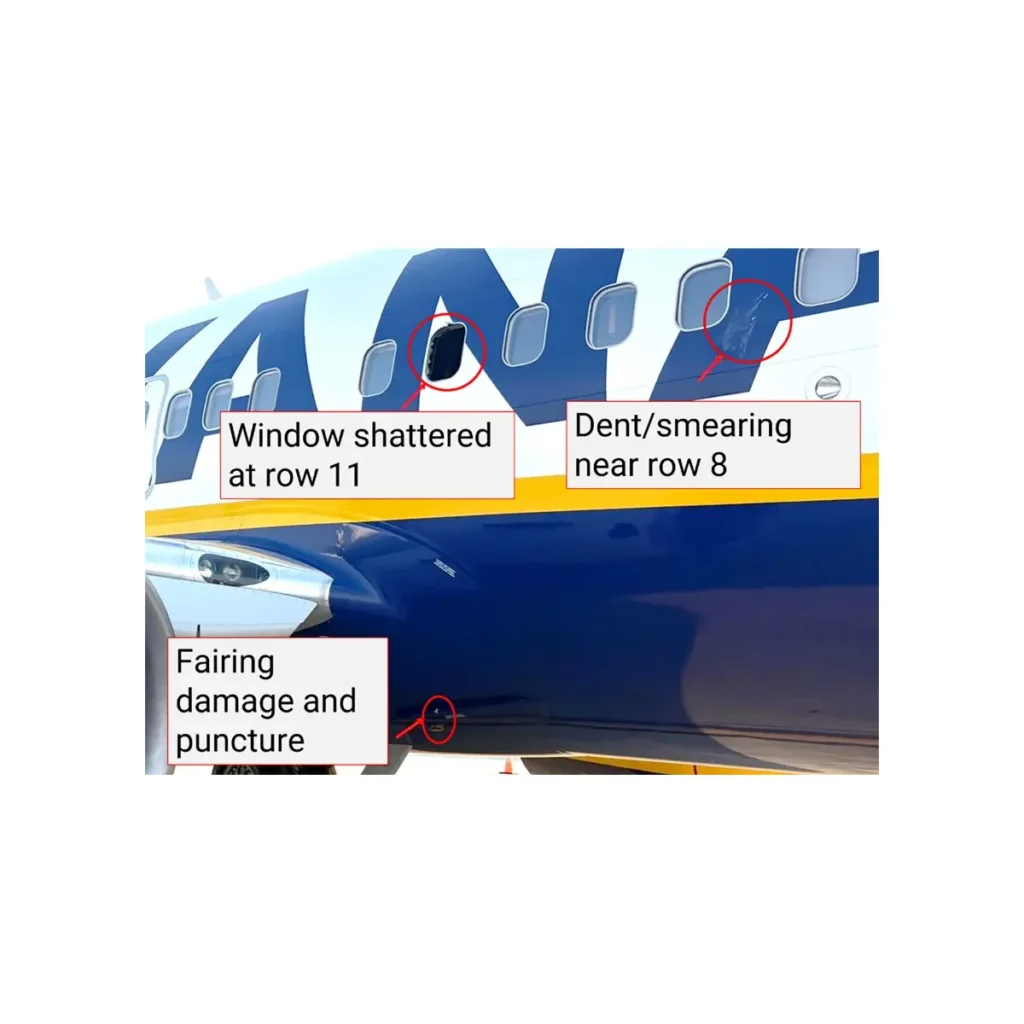
Investigators determined that the CFM International CFM56-7B26 engine experienced a fan blade separation. Engine fragments struck the fuselage and right horizontal stabilizer, leaving dents, punctures and other damage across the aircraft.
Most seriously, debris shattered the window at row 11. The passenger sitting in seat 11F became partially lodged in the damaged window opening during the depressurization. Other passengers and a flight attendant helped pull him back inside.
The injured passenger was identified in news reports as 61-year-old Ljubisa Karovic. Despite substantial aircraft damage, the pilots returned safely to Thessaloniki for an emergency landing.
Fatigue crack puts recent inspections under scrutiny
The fractured fan blade is now one of the investigation’s most important pieces of physical evidence. Investigators found signs of fatigue cracking on the portion of the blade that remained in the engine.
Metal fatigue can develop when repeated stresses allow a small crack to grow over time. However, the finding does not mean the NTSB has concluded that fatigue was the definitive cause. The report is preliminary, and investigators still need laboratory testing and maintenance evidence before determining probable cause.
Eight other fan blades also showed deformation along their leading edges.
The maintenance history is particularly important because the fan blades underwent ultrasonic inspections on November 11, 2025, and May 24, 2026. The most recent inspection recorded no findings.
Investigators will therefore need to determine when the crack developed, how quickly it progressed and whether it could have been detected earlier. A recent Qantas Boeing 737 engine failure linked to a turbine blade crack shows why investigators closely examine fractured engine components and maintenance histories, although the aircraft component and circumstances in that case were different.
Bird remains raise another unanswered question
Investigators recovered feathers and other bird remains from the damaged engine. Records also showed four suspected bird-strike events involving the engine during the previous year, with no damage found after those events.
The presence of bird remains does not establish that a bird strike caused the July failure. Investigators must determine whether the bird evidence and fatigue cracking are connected or represent separate findings.
Read More
Why the CFM56 engine history matters
The CFM56 family, produced by CFM International, a joint venture between GE Aerospace and Safran Aircraft Engines, is one of the most widely used commercial aircraft engine families.
The Ryanair investigation also has similarities to the 2018 Southwest Airlines flight 1380 accident involving a Boeing 737-700 and CFM56-series engine. A fan blade failed, debris struck the fuselage and a passenger window was broken. Passenger Jennifer Riordan was partially pulled through the opening and later died from her injuries.
That accident increased scrutiny of fan blade inspection requirements. The similarities do not establish that the Ryanair failure had the same cause, but previous cases can help investigators identify potential failure patterns.
Aircraft window problems can also force emergency diversions for very different reasons. In another Boeing 737 incident, a Southwest Airlines flight made an emergency landing after a cockpit windshield cracked at 37,000 feet, underscoring how crews may need to respond rapidly when the integrity of an aircraft window is compromised.
What investigators are examining now
Although the accident occurred in Greek airspace, Greece’s Hellenic Air and Rail Safety Investigation Authority asked the NTSB to lead the investigation under international aviation arrangements.
The NTSB investigation into the Ryanair Boeing 737 accident is examining the engine, aircraft structure, materials, maintenance history and survival factors. Investigators are also analysing cockpit voice, flight data and engine information to reconstruct the failure.
The preliminary findings have also challenged earlier comments from Ryanair CEO Michael O’Leary, who disputed reports that a passenger had been partly outside the aircraft and suggested foreign-object damage as an initial possibility. The NTSB report states that the passenger was partially lodged in the damaged cabin window and was pulled back inside by others.
The central question remains unresolved. Investigators still need to establish how the fatigue crack formed, whether previous bird strikes played any role, why recent inspections recorded no findings and whether lessons from previous CFM56 fan blade failures apply to this accident.
For passengers, the clearest finding so far is the sequence of events: engine vibration increased, a fan blade separated, debris struck the Boeing 737, a window was destroyed and the cabin depressurized. What caused the blade to reach the point of failure remains the focus of the continuing investigation.

Make Swikblog your go-to source on Google for reliable updates, smart insights, and daily trends.