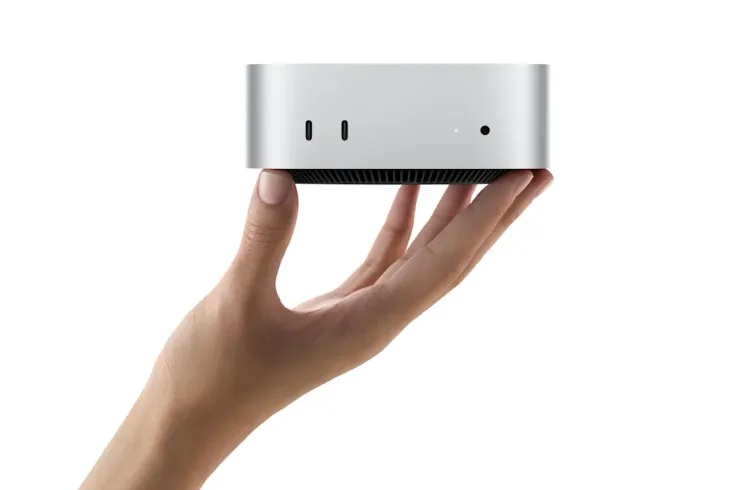

Apple has launched new Mac mini and Mac Studio desktops aimed increasingly at AI developers, updating its compact Mac lineup with faster chips and greater memory options. The Mac mini now comes with the new M6 processor or M5 Pro, while Mac Studio moves to M5 Max and M5 Ultra.
Here is Apple's launch video for the new M6 Mac mini pic.twitter.com/BpDrzjGTTl
— Aaron (@aaronp613) August 25, 2026
The refresh comes as both desktops have become popular among engineers who want powerful machines without built-in displays. Mac mini’s relatively small footprint makes it useful as a dedicated system for coding agents and other tasks that can be managed remotely from a laptop or smartphone.
Mac mini moves to M6 and M5 Pro
The new Mac mini starts with Apple’s M6 chip and can be configured with up to 32GB of memory. Buyers needing more headroom can choose the M5 Pro version, which supports up to 64GB.
Apple is promising substantial gains in AI processing, alongside improvements for gaming and video editing. The update also extends a broader Mac hardware cycle that has already brought the M5 generation to products such as the 2026 MacBook Air with M5.
For developers, the attraction goes beyond benchmark numbers. A small desktop that can remain connected and operate without its own screen can serve as a dedicated machine for development tools, automated agents or local model processing.
Mac Studio brings M5 Max and M5 Ultra
Mac Studio remains the more powerful option for engineers and creative professionals. Apple is offering the new model with M5 Max or M5 Ultra, targeting workloads that demand more computing resources than the Mac mini can provide.
The distinction matters as developers increasingly experiment with running AI locally instead of sending every task to cloud infrastructure. Local processing can provide more direct control over data and reduce reliance on remote services, although actual performance will depend heavily on the model and software being used.
Apple’s earlier M5 Pro and M5 Max generation already emphasized higher memory bandwidth and increased AI compute, showing how central machine-learning performance has become to the company’s silicon strategy. Full chip information can be checked through Apple’s official M5 Pro and M5 Max announcement.
New prices reflect a tougher component market
The base Mac mini now starts at $899, up from $799. The M5 Pro model begins at $1,699, compared with $1,599 for the previous M4 Pro version.
Mac Studio keeps its $2,499 base price, while the M5 Ultra configuration starts at $5,499. The previous M4 Ultra generation started at $5,299.
The increases arrive during an AI-driven global shortage of memory and storage components. Yahoo Finance reports that the pressure has already pushed Apple to raise prices on several Mac and iPad products, with component costs also being closely watched ahead of future hardware launches.
Demand is already stretching delivery times
Apple is launching the refreshed machines into a market where current Mac mini and Mac Studio supply has already been tight. As of Monday, Yahoo Finance reported that a base Mac mini order could take more than a month to arrive, while Mac Studio estimates stretched to roughly 10 to 12 weeks.
Apple is also continuing to develop the software side of its desktop ecosystem. Recent macOS 26.5 updates added new Mac controls and platform changes as the company prepares its next generation of hardware and software.
Mac remains a significant Apple business
Mac generated $33.7 billion in revenue for Apple in 2025, making it the company’s fourth-largest business by revenue, according to figures cited by Yahoo Finance. By comparison, iPhone contributed $209.5 billion to Apple’s $416.1 billion in total revenue.
The refreshed desktops therefore represent more than routine processor upgrades. Mac mini offers a lower-cost path for developers who want a compact dedicated system, while Mac Studio targets professionals willing to pay substantially more for higher-end computing power. Independent testing will ultimately show how large Apple’s claimed AI gains are in everyday development, gaming and creative workloads.

Make Swikblog your go-to source on Google for reliable updates, smart insights, and daily trends.