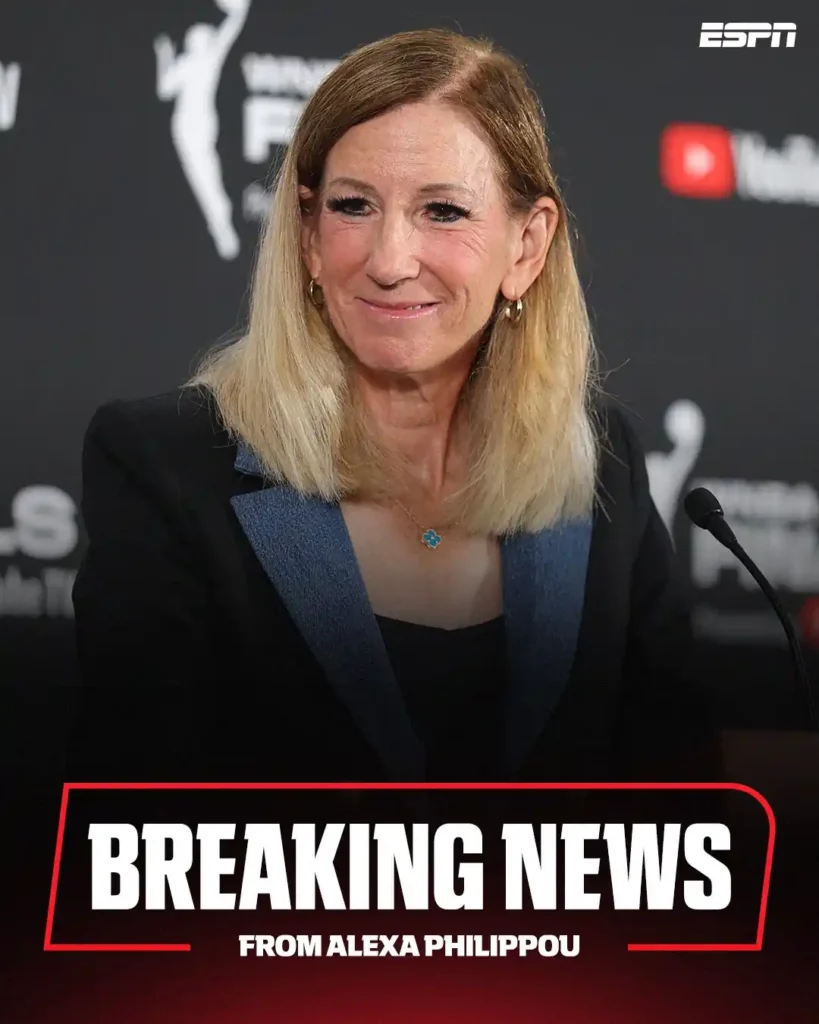

NEW YORK — Cathy Engelbert will retire as WNBA commissioner at the end of 2026, ending a seven-and-a-half-year tenure that helped reshape the league from a 12-team operation fighting for greater commercial footing into a rapidly expanding sports property with soaring franchise values, richer media rights and a much larger national audience.
The WNBA announced Engelbert’s decision on Friday, September 4. She has said the move is a planned retirement, not a firing, and that the timing reflects both personal goals and the fact that several major pieces of the league’s long-term business strategy are now in place.
Why is Cathy Engelbert retiring now?
Engelbert said she originally expected to serve only about three-and-a-half years when she took the job in 2019. By the end of 2026, she will have served roughly seven-and-a-half years.
She has also said retiring around age 62 had long been part of her plan. Her decision comes after the WNBA completed several major projects, including a new collective bargaining agreement, long-term media-rights deals and an expansion strategy designed to take the league to 18 teams by 2030.
That timing is important. Engelbert is leaving after helping establish a longer financial runway for the league rather than during the middle of a major labor or expansion negotiation.
Was Cathy Engelbert fired or forced out?
There is no verified evidence that Engelbert was fired or forced to resign.
Engelbert has said she did not feel pressure from NBA or WNBA stakeholders to leave. The WNBA has also described her departure as a retirement.
Questions about her future had grown because her relationship with players came under increasing scrutiny during labor talks and amid concerns over player safety, online abuse and communication between league leadership and stars.
Those controversies are part of the context surrounding her departure, but they should not be presented as proof that she was pushed out.
Family considerations also influenced the decision
Engelbert has said she wants to spend more time with family, including her two children and her mother, who is turning 90.
She has also acknowledged that increasingly personal online criticism affected members of her family, even as she continued to lead the league through a period of intense public attention.
The death of longtime Deloitte colleague and friend Greg Durant at age 67 also prompted her to reflect on how she wanted to spend the next stage of her life.
The WNBA became dramatically more valuable
The league Engelbert is leaving is financially very different from the one she inherited.
Engelbert has cited average franchise valuations of roughly $10 million in 2019. By 2026, that figure had climbed to approximately $460 million.
The WNBA also secured media-rights agreements worth more than $3 billion, while attendance, television audiences, digital engagement, League Pass subscriptions, merchandise sales and corporate partnerships all expanded.
The league office itself grew from roughly 12 employees to nearly 100, reflecting the increase in marketing, operations and commercial activity required to manage the WNBA’s growth.
Expansion is another major part of Engelbert’s legacy
Engelbert inherited a 12-team league. The WNBA is now moving toward 18 franchises by 2030.
Golden State entered through an expansion agreement reportedly worth $50 million, while Cleveland, Detroit and Philadelphia later agreed to significantly higher $250 million expansion fees, illustrating how much investor demand has changed.
The league’s wider rise has also been fueled by a new generation of high-profile players. Interest around Caitlin Clark and Team USA at the Women’s World Cup is another example of how women’s basketball is attracting a broader global audience.
The new CBA gives her successor more stability
One of Engelbert’s final major achievements was helping complete a new collective bargaining agreement in 2026.
The deal significantly raised player compensation and created the WNBA’s first group of million-dollar salaries, while also giving players a larger financial stake in the league’s growth.
For the next commissioner, that matters because one of the league’s most difficult labor questions has already been settled for the near term.
Shilo Sanders Bankruptcy Trial: $11.89M Creditor John Darjean Collapses in Court
49ers Arrive in Melbourne and Say It Feels Like They ‘Landed on Mars’
But player relations remain an unfinished issue
The business success does not erase the tensions that developed between Engelbert and some players.
Breanna Stewart, a players’ union executive committee vice president, said before the 2026 All-Star Game that players respected Engelbert but did not have much of a relationship with her. Sabrina Ionescu has also indicated that she communicated more frequently with NBA Commissioner Adam Silver.
Players have raised concerns over safety, online abuse and how league leadership communicates during high-profile controversies.
The pressure on athletes is not limited to basketball. Recent scrutiny surrounding Naomi Osaka and the Siniakova US Open controversy shows how quickly issues involving leading women’s sports figures can become major online and media debates.
Who will replace Cathy Engelbert?
No successor has been announced.
Engelbert has said succession planning has been underway for roughly three years, with both internal and external candidates considered.
She intends to help with the transition and has indicated that she would remain beyond her planned December departure if a successor is not ready, rather than leave the league without an orderly handover.
NBA Commissioner Adam Silver praised Engelbert after the announcement, saying she presided over the most significant period of growth in the WNBA’s 30-year history.
Why her departure matters for the WNBA
The next commissioner will inherit a stronger business but a more complicated job.
Expansion teams must be successfully integrated, media-rights growth must translate into sustainable revenue, player relationships need attention and the league must manage the expectations created by rapidly rising franchise values and larger audiences.
Engelbert’s tenure will therefore be remembered for both transformation and tension. The WNBA is richer, larger and more visible than it was in 2019, but that success means the next commissioner will face even greater pressure from players, owners, broadcasters and fans.

Make Swikblog your go-to source on Google for reliable updates, smart insights, and daily trends.