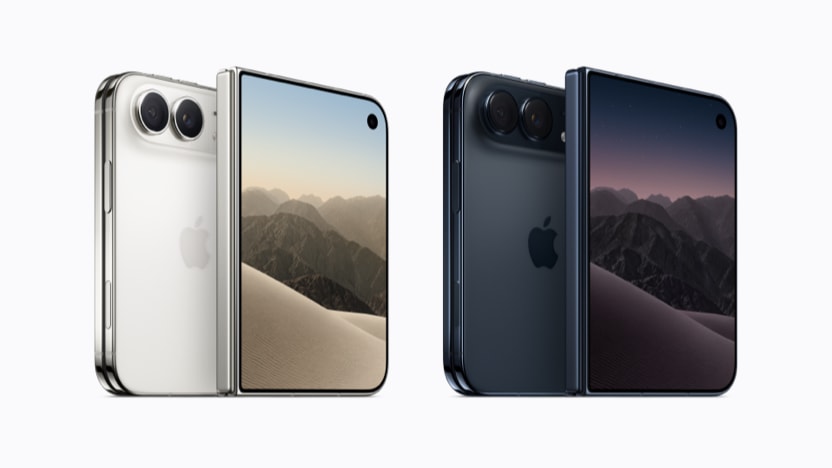

CUPERTINO, California — Apple has unveiled the iPhone Duo, its first foldable smartphone and the biggest physical redesign of the iPhone since the original model arrived.
The book-style device opens into a 7.6-inch screen, starts at $1,999 in the United States and will reach stores on October 23, 2026. Pre-orders open October 16.
While the folding display drew most of the attention, Apple’s detailed specifications reveal several important points that were easy to miss during the presentation: the Duo does not use Face ID, has no physical SIM-card slot anywhere in the world, weighs 254 grams and lacks some camera features offered by the less expensive iPhone 18 Pro.
Price: From $1,999 in the United States
Pre-orders: October 16, 2026
Release date: October 23, 2026
Displays: 5.4-inch outer and 7.6-inch folding inner screen
Storage: 256GB, 512GB, 1TB or 2TB
Colours: Night Sky and Star White
Weight: 254 grams
Security: Side-button Touch ID
SIM: eSIM only worldwide
The launch took place during Apple’s September hardware presentation, whose international viewing schedule was detailed in the Apple event and iPhone 18 guide.
It was also the first major product presentation led by John Ternus after Tim Cook stepped down as Apple CEO and moved into the chairman’s role.
iPhone Duo price, release date and full specifications
Apple will begin taking iPhone Duo pre-orders on Friday, October 16. General availability starts Friday, October 23 in the United States and more than 70 other countries and regions. A further 28 markets are scheduled to receive the phone on October 30.
There is no 128GB version. The entry model has 256GB of storage, while the most expensive configuration increases capacity to 2TB.
| Market | 256GB | 512GB | 1TB | 2TB |
|---|---|---|---|---|
| United States | $1,999 | $2,199 | $2,599 | $3,199 |
| United Kingdom | £1,999 | £2,199 | £2,599 | £3,199 |
| Australia | A$3,499 | A$3,899 | A$4,699 | A$5,899 |
| Canada | C$2,999 | C$3,299 | C$3,899 | C$4,799 |
| India | ₹299,900 | ₹324,900 | ₹374,900 | ₹449,900 |
Apple lists different local pre-order times: 5 a.m. PT in the United States and Canada, 1 p.m. in the UK, 10 p.m. AEST in Australia and 5:30 p.m. IST in India.
When closed, the iPhone Duo has a 5.4-inch Super Retina XDR OLED display with a 1398-by-2034 resolution. Opening it reveals a 7.6-inch folding OLED screen with a 1878-by-2670 resolution.
Both screens support ProMotion refresh rates up to 120Hz, Always-On functionality, HDR and outdoor brightness of up to 3,000 nits. The inner panel uses a 10-layer construction and a nano-texture surface designed to reduce glare and make the fold appear visually flatter.
The two screens have matching aspect ratios. That allows apps and content to move between them without the dramatic reshaping often seen when opening other foldable phones. Apple says the inner screen provides 50% more display area than the iPhone 18 Pro Max.
The device measures 5.2mm thick when open and 11.3mm when closed. It weighs 254 grams, making it noticeably heavier than a conventional iPhone despite Apple describing the open device as its thinnest iPhone.
The frame and hinge cover use Grade 5 titanium, while the outer surfaces are protected by Ceramic Shield. Apple has also secured an IP68 rating for water and dust resistance, covering immersion at a maximum depth of six metres for up to 30 minutes under laboratory conditions.
Apple has not published a hinge-folding cycle figure on its product or technical-specification pages. That means buyers currently have no official estimate for how many times the device can be opened and closed over its lifetime.
The iPhone Duo runs on the A20 Pro chip with a six-core CPU, seven-core GPU and two 16-core Neural Engines. A larger vapor chamber manages heat during gaming, multitasking and artificial-intelligence workloads.
Connectivity includes Apple’s C2 cellular modem, N1 networking chip, Wi-Fi 7, Bluetooth 6, Thread support and second-generation Ultra Wideband. The USB-C port supports DisplayPort and USB 3 transfers at up to 10Gbps.
The overlooked compromises and foldable-only features
Touch ID replaces Face ID: Apple’s official specifications list a fingerprint sensor inside the side button but do not list Face ID. This is one of the clearest departures from recent premium iPhones. Apple Watch owners can also use their watch to unlock the Duo.
It is eSIM-only in every market: Unlike previous iPhones, where physical-SIM availability varied by country, the iPhone Duo has no SIM tray worldwide. It can store eight or more eSIMs and operate with two active eSIMs, but travellers should check that their carrier supports eSIM before buying.
The cameras are not equivalent to the iPhone 18 Pro: The Duo has a 48-megapixel main camera with an f/1.6 aperture and sensor-shift stabilisation, plus a 48-megapixel ultrawide camera with a 120-degree field of view.
Its 2x option is an optical-quality crop from the main sensor rather than a separate telephoto lens. It also misses the iPhone 18 Pro’s dedicated telephoto camera, variable-aperture main lens and full set of Pro camera controls.
The outer display contains a 12-megapixel Center Stage camera. A second camera is hidden underneath the inner display, although that camera is limited to 1080p video rather than being presented as a full-resolution selfie camera.
The folding design creates several camera features unavailable on other iPhones. Duo Preview lets the person being photographed see the framing on the outer screen. Kid Cue displays animations to encourage children to look towards the camera, while Smart Take waits until people appear ready before automatically capturing the picture.
Duo FaceTime can place participants on both displays, allowing someone nearby to join a call from the opposite side of the phone. The device can also stand without a separate support for hands-free calls, video viewing or photography.
Apple has redesigned parts of iOS 27 for the larger screen. Users can place two applications side by side, open two windows from the same website, pin a video above another app or position the phone like a small laptop.
In its partially folded standing position, the Duo can show a clock, photographs or widgets through StandBy. In its seated position, content appears on the upper section while playback and other controls remain on the lower half.
The iPhone Duo supports the USB-C Apple Pencil, bringing stylus input to an iPhone for the first time. The Pencil is not included with the phone and must be purchased separately.
Battery capacity in milliamp-hours has not been disclosed. Apple instead advertises up to 24 hours of typical use, 44 hours of video playback on the outer display or 31 hours on the inner screen. Streamed-video estimates fall to 37 and 26 hours respectively.
A 60W or higher power adapter can charge the phone to approximately 50% in 20 minutes. MagSafe and Qi2 charging reach up to 25W, with Apple estimating around 30 minutes to reach 50% when using a compatible MagSafe charger and power adapter.
Neither power adapter nor Apple Pencil comes in the box. According to Apple’s official iPhone Duo specifications, buyers receive only the phone with iOS 27 and a one-metre USB-C charging cable.
The Duo enters a foldable market that remains relatively small despite years of devices from Samsung, Google, Huawei, Motorola and Honor. Counterpoint Research estimated that foldables represented only 1.5% of smartphone sales in Europe during the first quarter of 2025, with high prices and durability concerns still limiting adoption.
That makes the iPhone Duo more than a new premium model. It is Apple’s attempt to persuade mainstream iPhone owners that a folding screen offers enough practical value to justify a starting price twice that of many flagship phones.
Sources: Apple iPhone Duo overview, Apple technical specifications, Associated Press and The Verge.

Make Swikblog your go-to source on Google for reliable updates, smart insights, and daily trends.