
Lionel Messi’s final night in an Argentina shirt produced one last moment that left plenty of fans wondering what exactly had happened.
El árbitro no pitó el final: lo rindió. Con un gesto sobrio y firme, devolvió al jugador que se despide el mismo respeto que ese jugador dio al juego durante años. https://t.co/zzCkANEpvK
— Jhonf Fonseca (@Jhonffonseca) October 7, 2026
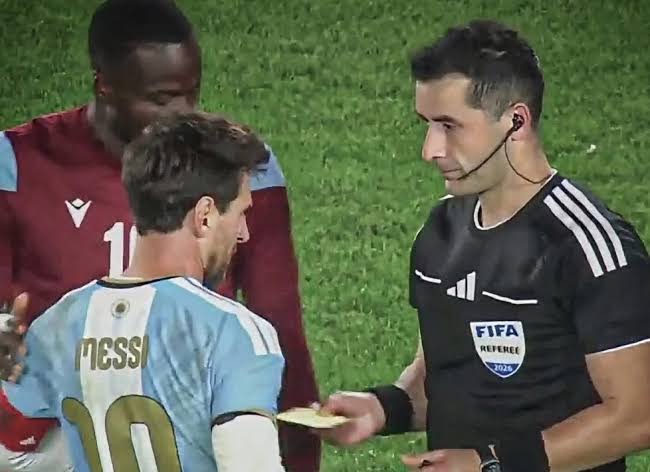
After the final whistle in Argentina’s farewell match against Benin, the referee walked towards Messi holding both his yellow and red cards.
For a few seconds, the scene looked almost absurd. Had Messi somehow been booked after the match? Had he been sent off during his own farewell?
No.
The referee was actually giving Messi both cards to keep as souvenirs from his final Argentina appearance.
Why did the referee give Messi both cards?
The unusual gesture came after an emotional night built around Messi’s final appearance for the national team.
Footage circulating after the match showed Messi smiling as he accepted the referee’s cards. Rather than punishment, they became two more keepsakes from a night Argentina had turned into a celebration of its No. 10.
And there was a remarkable piece of history behind the red card in particular.
Messi’s senior Argentina career also began with one.
He made his international debut against Hungary in Budapest on August 17, 2005. Messi came off the bench as an 18-year-old but was sent off less than a minute later following an incident with defender Vilmos Vanczák.
So more than two decades later, Messi’s Argentina story ended with another red card in his hands — only this time nobody was asking him to leave the pitch.
Instead, he was allowed to take it home.
The cards were only one part of Messi’s farewell
The referee’s gesture was far from the only unusual moment surrounding Messi’s goodbye.
Earlier in the match, play was deliberately stopped when the clock reached the 10th minute, a symbolic tribute to the shirt number Messi made synonymous with Argentina.
The stadium rose to applaud him while chants of his name echoed around the ground. Benin players also joined the moment, approaching Messi during the stoppage as the occasion briefly became bigger than the match itself.
Messi had already been emotional before kickoff as he walked onto the pitch with his sons Thiago, Mateo and Ciro.
But once the game started, the night was not simply ceremonial. Messi remained involved and found the net as Argentina completed a 3-0 victory.
The result closed a journey that began with that chaotic debut red card in 2005 and eventually included the Copa América, Finalissima and, most importantly, the World Cup.
Argentina’s triumph in Qatar took the country to three World Cup titles, behind only Brazil, Germany and Italy in the all-time standings — a wider history explored in our look at which country has won the most FIFA World Cups.
Yet on this night, the trophies were almost secondary.
The image that travelled fastest across social media was much simpler: Messi standing with a referee’s red and yellow cards in his hands, smiling at a moment that initially looked like one final controversy.
It was actually one final gift.
There was also a neat symmetry to it. Messi’s first Argentina appearance ended with a referee showing him red. His last ended with a referee handing one over for him to keep.
Few farewell souvenirs could have told the story of his international career quite so perfectly.

Make Swikblog your go-to source on Google for reliable updates, smart insights, and daily trends.