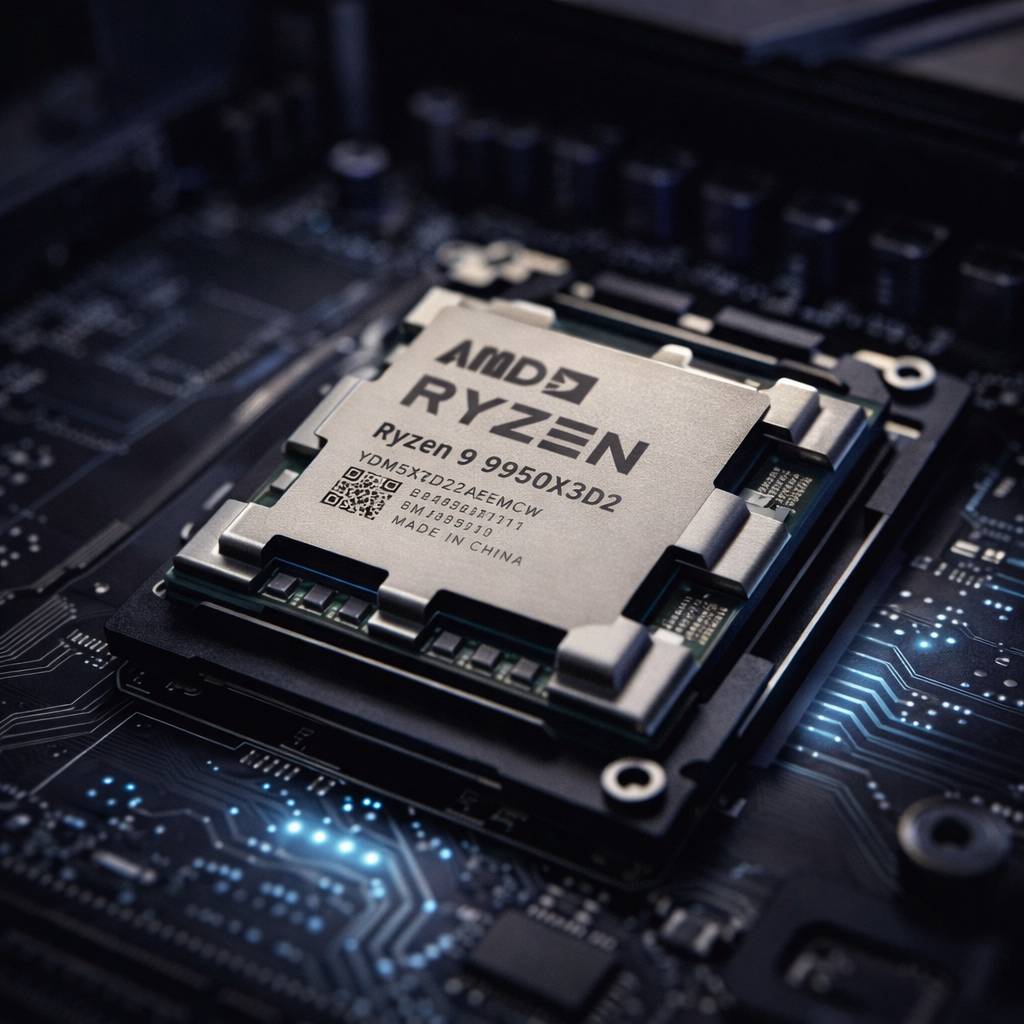

AMD Ryzen 9950X3D2 is quickly becoming one of the most talked-about CPU launches of 2026, and for good reason. The new chip pushes AMD’s 3D V-Cache technology further than ever before, packing a massive 208MB of total on-chip cache and promising up to double-digit performance gains in certain workloads. But while the headline numbers suggest a major leap, the real story is more nuanced—and there’s a catch that buyers should not ignore.
The AMD Ryzen 9950X3D2 arrives as a follow-up to the already powerful Ryzen 9 9950X3D, a chip that was designed for creators who also demand elite gaming performance. With this new “Dual Edition,” AMD is trying to eliminate the long-standing tradeoff between gaming CPUs and creator CPUs by extending its 3D V-Cache across both core complex dies (CCDs). That single design change could reshape how high-end desktop processors are evaluated.
AMD Ryzen 9950X3D2 Brings 208MB Cache and Dual-CCD 3D V-Cache
The biggest upgrade in the AMD Ryzen 9950X3D2 is simple but powerful. Instead of placing 3D V-Cache on just one chiplet like before, AMD has now equipped both CCDs with stacked cache. Each chiplet carries 104MB, bringing the total to an impressive 208MB of cache across the CPU.
This is a major jump compared to previous chips. The Ryzen 9 9950X3D offered 144MB of cache, while even popular gaming chips like the Ryzen 7 9800X3D come with around 104MB. By doubling down on cache, AMD is effectively increasing the amount of data that can sit close to the CPU cores, reducing latency and improving responsiveness in memory-heavy workloads.
According to AMD’s own explanation, more cache means more game assets, more working data, and more instructions available instantly to the processor without needing to fetch from slower system memory. This is the core reason why X3D chips have dominated gaming benchmarks in recent years.
Performance Gains: Up to 10% FPS Boost, But Not Everywhere
AMD claims the Ryzen 9950X3D2 can deliver performance improvements ranging from around 5% to 13% in certain workloads, particularly in creative applications like Unreal Engine compiling, Blender rendering, and Chromium-based tasks. For gaming, expectations are more modest but still meaningful, with potential FPS gains of up to around 10% in CPU-bound scenarios.
However, this is where the catch begins to show. Not every game benefits equally from larger cache sizes. Titles that are already GPU-bound or less dependent on CPU memory access may see minimal improvements. In fact, there is a real possibility of diminishing returns when cache sizes reach extreme levels like 208MB.
That means while the AMD Ryzen 9950X3D2 could be one of the fastest gaming CPUs ever built, the actual performance difference may vary significantly depending on the type of game, resolution, and system configuration.
Same Core Power, Higher TDP, Slightly Lower Clock Speed
Despite the major cache upgrade, the AMD Ryzen 9950X3D2 retains the same core configuration as its predecessor. It features 16 cores and 32 threads based on AMD’s Zen 5 architecture, maintaining its position as a flagship desktop processor.
But there are some trade-offs. The boost clock has been slightly reduced to 5.6GHz, down from 5.7GHz on the previous 9950X3D. At the same time, power consumption has increased, with the new chip rated at a 200W TDP compared to 170W before.
This suggests that AMD is prioritizing cache-driven performance over raw clock speeds, but it also means users will need better cooling solutions and should expect higher power draw under load.
Designed for Gamers and Creators—Finally One CPU for Both?
AMD’s messaging around the Ryzen 9950X3D2 is clear: you no longer need to choose between a gaming CPU and a creator CPU. This has been a long-standing dilemma for high-end PC users. Gaming-focused chips typically excel in latency-sensitive workloads, while creator CPUs focus on core count and sustained performance.
With dual-CCD 3D V-Cache, AMD is trying to merge these two worlds. The result is a processor that aims to deliver top-tier gaming performance while also handling demanding workloads like AI models, 3D rendering, and video editing efficiently.
If successful, this could make the AMD Ryzen 9950X3D2 one of the most versatile desktop CPUs ever released.
The Pricing Question and Market Position
One major detail still missing is pricing. The current Ryzen 9 9950X3D already sits around the $700 range, while gaming-focused X3D chips like the Ryzen 7 9850X3D are priced closer to $500. Given the increased cache and power requirements, the Ryzen 9950X3D2 is expected to carry a premium price tag.
The chip is set to launch on April 22, and pricing will play a critical role in determining its success. If AMD prices it too high, it may remain a niche product for enthusiasts. If priced competitively, it could redefine the high-end CPU market.
Intel Still Lags in High-End Gaming CPUs
Intel’s current response to AMD’s dominance has focused more on midrange processors like the Core Ultra 200S series. While these chips aim to offer strong gaming performance at lower price points, they still struggle to compete with AMD’s X3D lineup at the high end.
Notably, Intel has not announced a direct competitor to challenge AMD’s flagship gaming CPUs in this segment. Reports suggest that a true high-end rival may still be a generation away, leaving AMD with a clear advantage for now.
For more technical details, you can check AMD’s official page here and early coverage from Engadget.
The Real Catch: Who Actually Needs This Much Power?
While the AMD Ryzen 9950X3D2 is undeniably impressive, it raises an important question: who is this chip really for? For pure gamers, cheaper X3D processors may still offer nearly identical performance in most scenarios. For creators, traditional high-core CPUs without 3D cache may still provide better value in certain workloads.
The biggest advantage of the Ryzen 9950X3D2 is convenience. It offers a no-compromise solution for users who want the best of both worlds in a single system. But that convenience comes at a cost—both in terms of price and power consumption.
In the end, AMD has built a CPU that pushes boundaries, but not everyone will fully benefit from what it offers.
Final Take
The AMD Ryzen 9950X3D2 could boost FPS by up to 10% and improve creator performance at the same time, making it one of the most balanced high-end CPUs ever designed. But the catch is clear: the biggest gains are limited to specific workloads, and the premium positioning means it is not for everyone.
For enthusiasts who want maximum performance without compromise, this chip could be a game-changer. For everyone else, it may simply be a glimpse into the future of desktop CPUs rather than a necessary upgrade today.

Make Swikblog your go-to source on Google for reliable updates, smart insights, and daily trends.