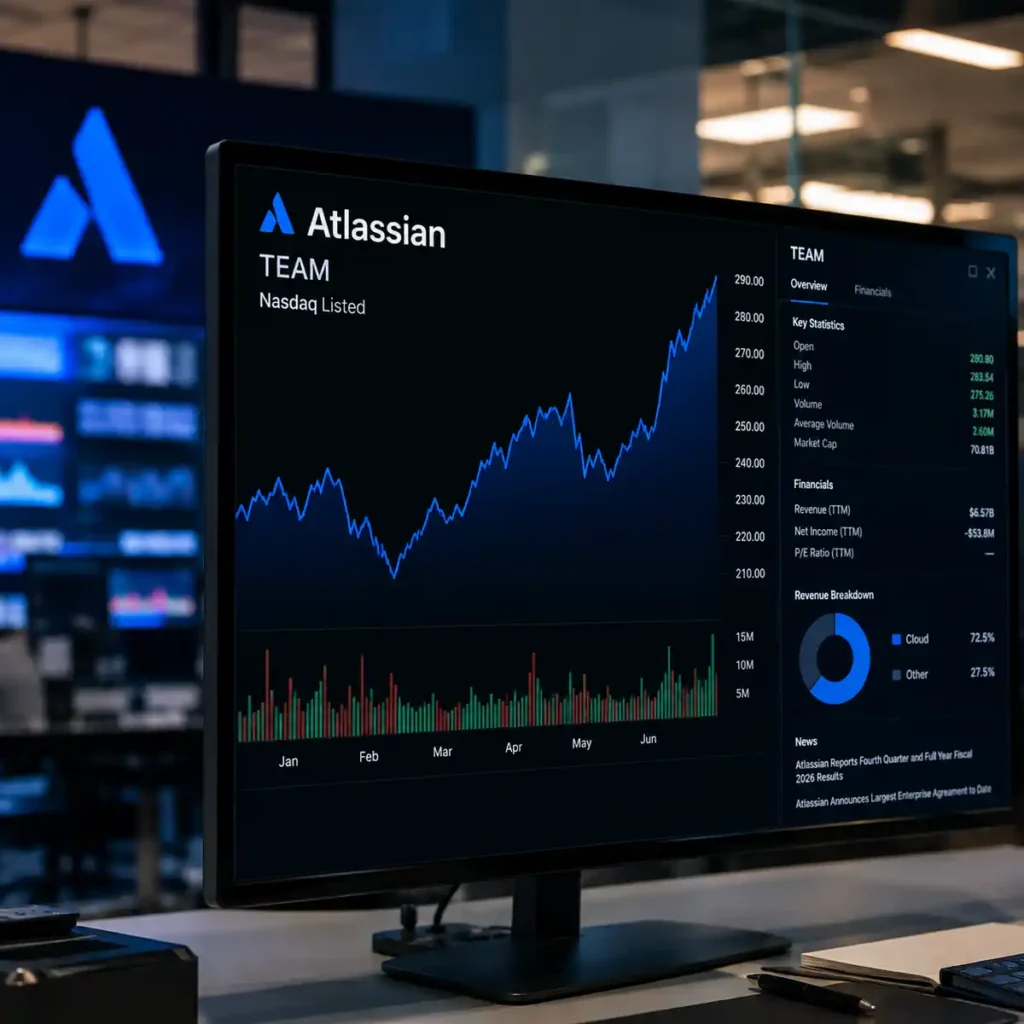

Atlassian shares surged more than 30% in after-hours U.S. trading after the Australian-founded software company delivered a stronger-than-expected fiscal fourth quarter, giving investors fresh reasons to rethink fears that artificial intelligence could weaken its software business.
The Nasdaq-listed maker of Jira and Confluence reported $1.77 billion in quarterly revenue, up 28% from a year earlier. Adjusted earnings reached $1.87 per share, ahead of expectations of about $1.50, while cloud revenue climbed roughly 31% to $1.2 billion.
The sharp move in TEAM stock matters because Atlassian had been heavily sold earlier in 2026 as investors questioned whether AI agents could reduce the number of developers and knowledge workers using traditional software platforms.
Atlassian earnings beat changes the mood around TEAM stock
Atlassian’s quarterly revenue came in around $110 million above the roughly $1.66 billion expected by analysts. The company also reported approximately $139 million in quarterly net income, reversing a loss of about $24 million in the comparable period a year earlier.
For the full 2026 fiscal year, revenue reached roughly $6.57 billion, up 26%, while the annual net loss narrowed to about $53.8 million from $256.7 million previously.
Enterprise demand was another important part of the report. Atlassian said the number of customers generating more than $3 million in annual recurring revenue increased by over 50%, while customers above $5 million grew more than 70%. It also signed what it described as its largest enterprise agreement to date.
Investors can review the company’s latest financial releases, shareholder material and official updates through Atlassian Investor Relations.
Why AI fears had hit Atlassian shares
Earlier this year, software stocks came under pressure as investors considered whether autonomous AI agents could write code, manage projects and automate work normally performed by employees.
That concern is particularly relevant for software companies that have traditionally charged according to user numbers. If businesses need fewer developers or IT workers, they may eventually require fewer conventional software seats.
The pressure has not been limited to Atlassian. Investors have been reassessing valuations across cloud and enterprise software as autonomous AI becomes more capable, with Snowflake and other software stocks facing similar agentic AI concerns.
Rovo AI is becoming central to Atlassian’s strategy
Rather than treating AI purely as a threat, Atlassian is building it directly into its platform. Rovo, its AI-powered search, chat and agent technology, is designed to work across company information stored in products such as Jira and Confluence.
Rovo usage increased more than 50% quarter over quarter, according to figures discussed around the results. More than 80% of Fortune 500 companies are also using Rovo, highlighting the scale of Atlassian’s enterprise reach.
The potential advantage is context. Atlassian software already contains project histories, workflows, tickets and internal documentation. AI systems that can securely understand that information may become more useful to large organisations than standalone tools with limited access to company data.
Atlassian’s layoffs remain part of the story
The earnings rebound follows a difficult period for employees. In March, Atlassian announced plans to cut roughly 10% of its global workforce, affecting about 1,600 jobs, including nearly 500 positions in Australia.
CEO and co-founder Mike Cannon-Brookes said the restructuring was intended partly to self-fund additional investment in AI and enterprise sales while improving the company’s financial profile.
The latest quarter offers early evidence that enterprise growth and AI adoption are improving, but stronger earnings do not erase the impact of those job losses.
Mike Cannon-Brookes plans a major Atlassian share purchase
Another significant development is Cannon-Brookes’ plan to buy up to US$250 million of Atlassian shares on the open market, equivalent to roughly A$355 million at recent exchange rates.
Such a large founder purchase can be viewed by investors as a confidence signal, although it does not guarantee further gains in the share price. Australian reporting also estimated that the latest stock surge added around A$2.6 billion to the value of Cannon-Brookes’ fortune within hours.
SpaceX Stock Rises After 911.5 Million Share Unlock: Is It Still a Buy Near $100?
Why Is GameStop Stock Down Today? Debt Exchange Plan Explained
Visit the homepage for the latest stock market news, business updates and financial insights
Why the 30% surge does not remove every risk
Atlassian is still guiding investors toward slower headline growth. Total revenue growth is expected to be around 13% in fiscal 2027, while subscription annual recurring revenue is expected to rise roughly 18%.
The outlook is also affected by Atlassian’s planned phase-out of Data Center products in 2029, which can influence renewal timing and cloud migration decisions.
The size of the rally should also be viewed in context. TEAM had already fallen sharply before the earnings release, meaning better-than-feared results had the potential to trigger an outsized rebound. The initial surge occurred in after-hours trading, where prices can move differently from the regular Nasdaq session.
Strong earnings reactions have become common across major software companies when cloud and AI results change investor expectations. A similar shift in sentiment was seen when Oracle shares jumped 10% as major AI and cloud spending eased software-sector fears.
What investors will watch next
The key tests now are whether Rovo adoption continues to grow, whether enterprise customers keep increasing spending and whether Atlassian can convert AI usage into higher recurring revenue.
The larger question is whether AI ultimately reduces traditional software seats faster than Atlassian can create new revenue from agents, cloud products and enterprise platform services.
For now, the combination of a 28% revenue increase, 31% cloud growth, stronger enterprise contracts, rising Rovo usage and Cannon-Brookes’ planned US$250 million share purchase has given investors a much stronger case for Atlassian than they had only months ago.

Make Swikblog your go-to source on Google for reliable updates, smart insights, and daily trends.