
A suspected sabotage incident in South Auckland triggered a major early-morning emergency response on Monday after what was initially believed to be a dangerous diesel leak near a petrol station turned out to be something far more unusual — but still deeply concerning.
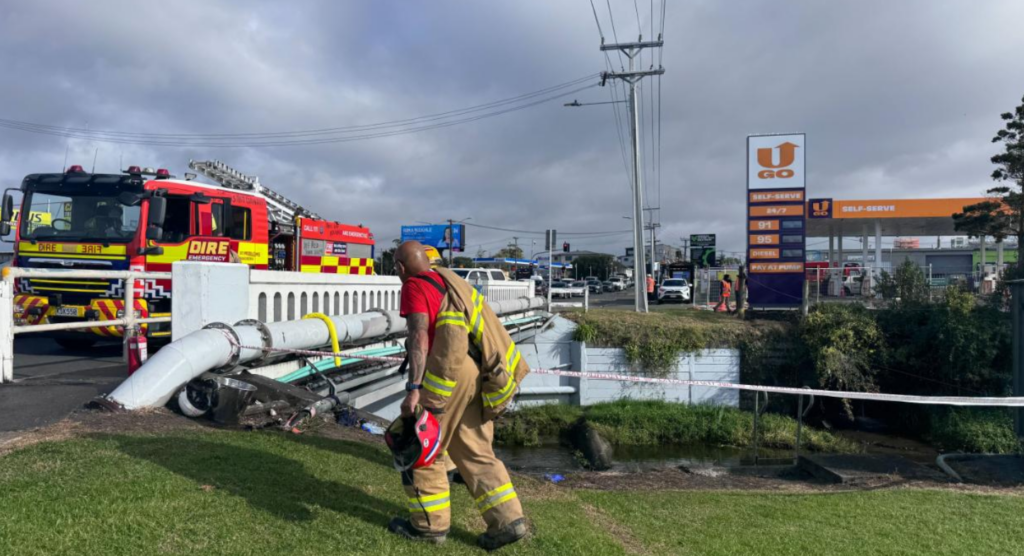
Emergency services were called to Great South Road in Manurewa shortly after 6.25am when a passerby reported a strong fuel smell in the area. Within minutes, Fire and Emergency New Zealand (FENZ) crews arrived to find a severed underground line leaking liquid near the U-GO petrol station. Given the smell and location, crews treated the situation as a potential fuel leak, prompting a high-alert response including hazardous materials support.
The site was quickly cordoned off, and the entire service station area was shut down as firefighters worked to contain what they believed could be diesel. Three fire crews were deployed, and responders began carefully decanting the liquid into containers to prevent further spread. At that stage, the situation was considered potentially life-threatening, particularly due to the risk of ignition in a fuel-heavy environment.
But as investigations continued, officials made a critical discovery. The leaking substance was not diesel at all. Instead, it was cable cooling fluid — a specialised insulating oil used in underground power cables. Authorities confirmed the damaged line was part of power infrastructure linked to the Vector network, with Northpower Energy Services contracted to carry out work in the area.
That revelation changed the nature of the emergency, but it did not reduce the seriousness of the incident. In fact, it raised new questions. Police confirmed they are now speaking with two individuals as part of ongoing inquiries, while officials suggested the damage to the line may have been intentional.
Detective Senior Sergeant Michele Gillespie from the Counties Manukau Crime Squad said police were initially alerted to a potential gas leak but later determined the pipe was not connected to the nearby petrol station. “Police do not believe the pipe is connected to the nearby service stations,” she said, clarifying early concerns.
At the same time, FENZ Assistant Commander Chris Delfos revealed another troubling detail — a nearby telephone line had also been cut. While he declined to provide further comment, the discovery added weight to suspicions that the incident may not have been accidental. A FENZ spokesperson later told media it appeared there had been “some sort of sabotage” to the pipe.
The danger involved in such an act was not lost on emergency officials. Delfos issued a stark warning, saying cutting into any line believed to be carrying fuel was “very, very dangerous” and simply not worth risking a life. Even though the fluid turned out not to be diesel, the initial uncertainty created a scenario where responders had to assume the worst.
Environmental and public safety concerns emerge
Beyond the immediate safety risks, the incident also raised environmental concerns. Auckland Council’s pollution response team was deployed to the scene to assess the potential impact. Compliance manager Adrian Wilson said the discharge had been largely contained, with only a minimal amount of cooling fluid believed to have reached nearby waterways.
However, the terrain around the site made it difficult to fully assess downstream effects. Council teams began monitoring the situation closely and prepared contingency measures, including deploying oil booms, absorbent pads, and even vacuum trucks if needed. Authorities are also working to determine whether any of the fluid may have reached the harbour.
The leak occurred near a bridge, increasing the risk of runoff entering drainage systems and waterways. While the environmental impact appears limited so far, officials remain cautious until a full assessment is complete.
Z Energy, which owns the nearby petrol station, clarified that the incident was not related to its operations and occurred adjacent to the site. Still, the proximity to a fuel station amplified the initial panic and explains why the response was so rapid and extensive.
Meanwhile, Northpower confirmed the affected cable falls within the Vector network area, noting that its teams were working under contract in the vicinity. The company did not comment directly on the cause of the damage but acknowledged its involvement in infrastructure work nearby.
The combination of a severed power cable, a second cut communication line, and the early fuel leak fears has made this incident particularly unsettling. It highlights how vulnerable critical infrastructure can be, especially in busy urban environments where multiple systems operate side by side beneath the surface.
For residents and commuters, the incident was a stark reminder of how quickly routine surroundings can turn into emergency zones. What began as a smell noticed by a driver escalated into a full-scale response involving police, fire crews, hazardous materials teams, and environmental specialists within minutes.
Police are continuing their investigation and are urging anyone with information to come forward. Members of the public can report details through the official 105 reporting channel or provide anonymous tips via Crime Stoppers.
While the situation has now been brought under control and the worst-case scenario avoided, the bigger questions remain unanswered. If the damage was indeed deliberate, the Auckland incident may not just be remembered as a false diesel alarm — but as a warning about the risks posed when essential infrastructure is targeted.
You may also like: Highway 99 crash in Squamish causes closure, multiple hospitalized

Make Swikblog your go-to source on Google for reliable updates, smart insights, and daily trends.