
Booking.com is facing increased scrutiny after hundreds of consumer complaints, refund disputes, security concerns and a high-profile property damage case in Australia raised questions about the travel platform’s customer support and booking safeguards.
The concerns include a short-stay property in south-west Sydney that was allegedly badly damaged after a reservation, complaints from travellers who struggled to recover money and an April 2026 security incident involving customer reservation information.
Read More
Sydney property damage case draws national attention
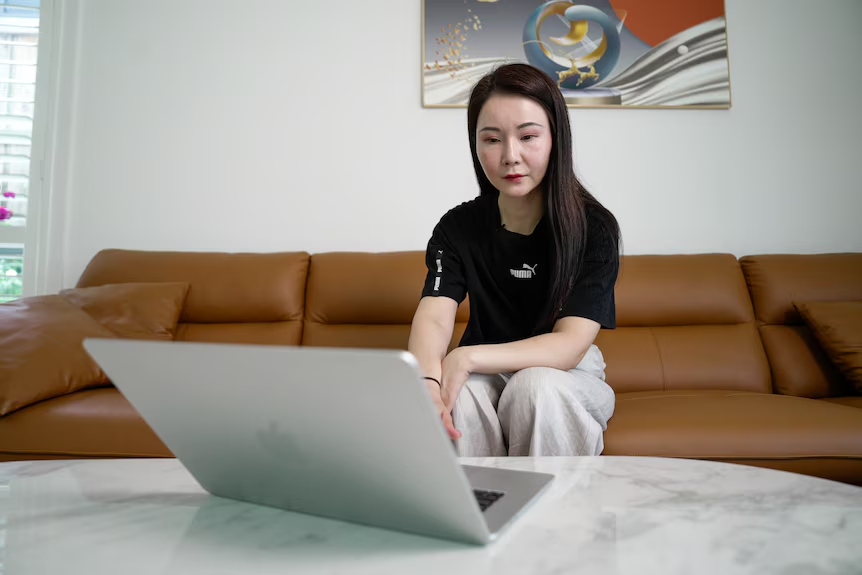
Homeowner Joyce Zhang said she accepted a Booking.com reservation shortly before Christmas after being told that only a small group would stay at her property. Instead, she alleges the booking turned into a house party attended by almost 200 people.
Security camera footage reportedly showed partygoers damaging fences, entering neighbouring properties and causing widespread disruption. Zhang said the property was left with holes in walls, missing kitchen knives and other damage estimated at about AU$15,000.
After lost rental income was included, her lawyer estimated that the overall financial impact exceeded AU$27,000.
Zhang also questioned the platform’s identity verification process. She said the reservation was made using a nickname and claimed she was later told that Booking.com did not carry out identity checks because of privacy considerations.
Her damage claim was initially rejected, with compensation limited to AU$500 under the relevant policy. Following media coverage, Booking.com agreed to pay the AU$500 and said it would assess whether any additional support was appropriate.
Describing the experience as a nightmare, Zhang said she would not list the property through the platform again.
Consumer complaints highlight refund and support problems
The Sydney case comes amid broader dissatisfaction among some Booking.com customers in Australia.
Data compiled from consumer authorities showed that at least 842 complaints involving Booking.com were lodged over two years. New South Wales accounted for 558 complaints during 2024 and 2025, while Queensland recorded 240. Additional cases were reported in South Australia, Tasmania and the Australian Capital Territory.
For comparison, Expedia Group recorded 180 complaints in New South Wales over the same period.
Reported problems included delayed refunds, accommodation cancellations, disputed charges, misleading listings and difficulties obtaining assistance from customer support.
Similar financial uncertainty can affect customers when a travel company runs into operational trouble, as demonstrated by the questions surrounding future reservations after Groupia entered administration and September bookings were placed in doubt.
In another reported case, a traveller attending Canberra’s Summernats festival said she had to sleep in her car after her accommodation was double-booked and refunded money was not available quickly enough to secure an alternative.
Booking.com said the customer was offered a relocation budget and later received a full refund.
Regulators raise concerns about the complaint process
NSW Fair Trading Commissioner Natasha Mann urged Booking.com to improve its handling of complaints, saying regulators should not have to operate as the complaints department for a major multinational platform.
Consumer authorities have highlighted what has been described as a responsibility loop. Customers may be directed by Booking.com to contact the hotel or accommodation provider, only for that provider to send them back to the platform.
This can leave travellers uncertain about who is responsible for authorising a refund, correcting a booking or arranging replacement accommodation.
The number of cases became significant enough for NSW Fair Trading to assign a dedicated officer to Booking.com-related complaints.
Medical emergency refund dispute adds to criticism
Another widely reported dispute involved Western Sydney resident Lesley Dodd, who had previously used Booking.com regularly and was a member of its Genius loyalty programme.
Dodd broke her leg while hiking near Hiroshima during a holiday in Japan. She required surgery and spent 17 days in hospital before returning to Australia.
She later requested a refund of almost AU$2,000 for accommodation in Tokyo that she could no longer use. The initial request was declined because the reservation carried a non-refundable cancellation condition.
Dodd said she found it difficult to obtain meaningful assistance and described the communication process as involving “crickets and bots” rather than direct support from a person.
Following media inquiries, Booking.com reversed the decision and approved a full refund. The company maintained that cancellation conditions are generally set by individual accommodation partners.
The reversal raised a wider question about whether customers without media attention would receive the same outcome or face a longer dispute process.
Booking.com faces fresh security concerns after data breach
Booking.com’s customer service challenges have also been accompanied by fresh security concerns. In April 2026, the company confirmed that unauthorised third parties had accessed information linked to a number of customer reservations.
The potentially exposed data included guests’ names, email addresses, phone numbers, postal addresses, booking details and messages exchanged with accommodation providers.
Booking.com said payment card information was not compromised and confirmed that the PIN codes associated with affected reservations had been reset as a precaution.
The company urged affected customers to remain cautious of phishing emails and messages that may use genuine booking information to appear trustworthy while requesting payments, passwords or other personal details.
Separate concerns continued into May, when reports highlighted travellers who said they had struggled to recover money after bookings involving allegedly fraudulent holiday rentals were cancelled.
Those cases added to questions about fake-listing prevention, refund procedures and how quickly disputes are resolved when an accommodation booking goes wrong.
Scam reports and legal action increase the pressure
Security and customer service are not the only areas attracting scrutiny.
Scamwatch data cited in reports showed 515 scam reports mentioning Booking.com during 2025, compared with 416 during the previous year.
In Europe, Dutch consumer organisations have pursued legal action alleging that travellers paid inflated accommodation prices because of price parity agreements used over several years.
Such clauses restricted hotels from offering cheaper prices through their own websites. The organisations involved have estimated that potential claims could reach approximately €1 billion.
Booking.com disputes the allegations and says it operates in a highly competitive market. The company has stated that commissions paid by accommodation providers average about 15% globally.
In Australia, the Australian Competition and Consumer Commission intervened in 2016 to address some price parity restrictions, although debate about competition and hotel pricing has continued.
What travellers should check before making a booking
Travellers should check the cancellation conditions before paying, confirm whether the platform or accommodation provider will collect the money and save copies of booking confirmations, receipts and customer-service messages.
The official NSW Government guidance on travel booking rights explains how Australian Consumer Law may apply to refunds, compensation and disputes involving travel services.
Customers should contact the accommodation directly before travelling when a listing appears unusual or when important details remain unclear. They should also avoid transferring money outside the official booking system unless the payment arrangement has been independently verified.
The same care is important when reserving admission to major attractions. Travellers planning a cultural visit can check the official booking process before applying for Bayeux Tapestry tickets and arranging nearby accommodation.
Unexpected emails, text messages or WhatsApp requests demanding urgent payment should be treated cautiously. A message containing genuine reservation details is not automatically legitimate, particularly when booking information may have been exposed.
Why the controversy matters for travellers
Booking.com says complaints represent less than 1% of the millions of reservations made through its platform in Australia each year. It also says customer support is available around the clock and that accommodation partners control many cancellation and refund conditions.
For travellers, however, responsibility can appear less complicated. When a reservation is found, arranged and paid for through one platform, customers generally expect that platform to help resolve serious problems.
Booking.com remains one of the world’s largest online travel marketplaces, connecting travellers with millions of hotels, apartments and holiday properties. Its size gives it significant influence but also creates higher expectations around verification, security, refunds and customer support.
The recent complaints, regulatory attention, security incident and legal action show why clear responsibility and faster dispute resolution remain important to maintaining customer confidence.
You may like: SA Lotto Results 28 March 2026 Draw 2632

Make Swikblog your go-to source on Google for reliable updates, smart insights, and daily trends.