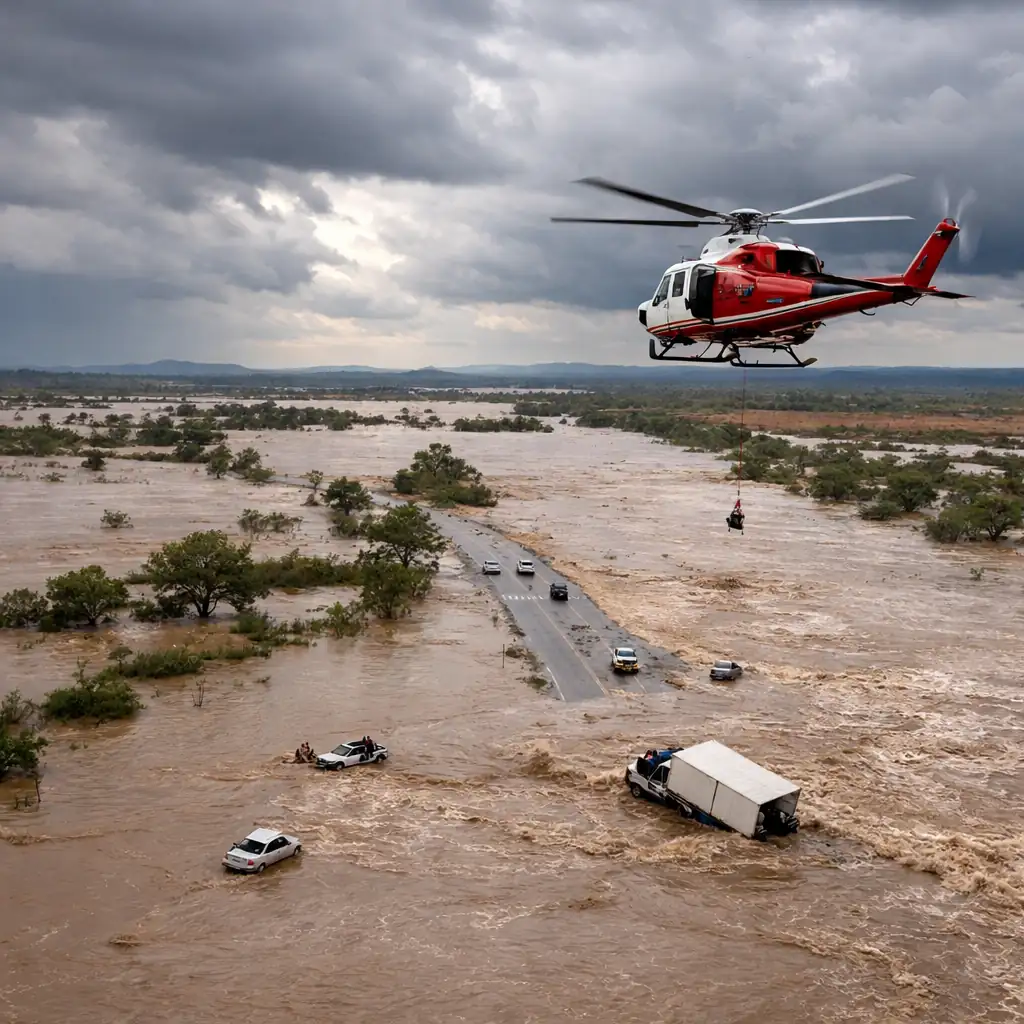

Western Australia’s Gascoyne region is facing a fresh wave of destruction after ex-Tropical Cyclone Narelle dumped more than 300 millimetres of rain in some areas, triggering widespread flooding, cutting off towns, and leaving farmers with heavy losses at the worst possible time of the year.
The crisis escalated quickly over the weekend as floodwaters surged across key roads, including the North West Coastal Highway — the main route connecting Carnarvon and Exmouth. Despite clear warnings and road closures, more than a dozen motorists drove into dangerous conditions, forcing emergency services into high-risk rescue operations.
In total, 20 people and a dog had to be rescued from 15 stranded vehicles, with helicopters winching people to safety from rising floodwaters. Among them were a couple trapped near the Minilya Roadhouse and a truck driver whose vehicle overturned in the flooded highway. Authorities said these incidents were entirely avoidable.
Emergency officials expressed serious concern over people ignoring road closures, warning that such actions not only put their own lives at risk but also those of rescue crews. In fast-moving flood conditions, even shallow water can become deadly within minutes, making every unnecessary rescue a dangerous operation.
Entire regions cut off as floodwaters spread
The scale of flooding has left parts of the Gascoyne region isolated. The town of Gascoyne Junction has reportedly been completely cut off by road, while multiple cattle stations, including Bullara, have been inundated. What was dry land just days ago after a long summer has now turned into a widespread flood zone.
Both Carnarvon and Exmouth have been significantly impacted by the cyclone’s aftermath. In Exmouth, buildings were damaged and roofs torn off during the storm, while in Carnarvon, the focus has shifted to rising river levels and the threat to agriculture.
The Gascoyne River, which runs through the heart of Carnarvon’s food-producing region, is approaching peak flood levels and is expected to reach between 6.5 and 7.2 metres. That puts it close to levels seen during the major flooding event in 2021, raising fears of a repeat scenario.
Authorities and local shire teams have rushed to build levees in an attempt to protect farmland, but there is growing uncertainty about whether those measures will be enough if water levels continue to rise.
Farmers face devastating losses again
For Carnarvon’s growers, the flooding could not have come at a worse time. Many were preparing their land and planting winter crops when the waters arrived, wiping out weeks of work in a matter of hours.
Mango farms have been left submerged, and ground crops have taken the worst hit. One local grower, Kevin Sullivan, said his entire pumpkin crop had been destroyed, while his irrigation system — essential for maintaining production — suffered major damage estimated at around $50,000.
He added that crop losses could reach roughly $15,000 per hectare, a figure that quickly escalates for larger properties. His farm alone includes around 5,000 mango trees across 18 hectares, highlighting the scale of impact for even a single grower.
Across the region, similar stories are emerging. Fields are waterlogged, equipment is damaged, and planting schedules have been thrown into uncertainty. For a farming community that relies on tight seasonal cycles, delays and losses like these can ripple across the entire year.
What makes the situation even more difficult is that this is not an isolated disaster. Carnarvon’s growers have already endured a severe heatwave earlier in 2026, followed by two cyclones before Narelle struck. This marks the fourth major weather event to hit the region this year alone, compounding financial pressure on farmers.
No disaster relief for growers
Despite the scale of damage, many farmers say they will not receive any disaster relief under the current state government support package, which applies only to homeowners. For growers whose livelihoods depend entirely on their land and crops, this has become a major point of frustration.
Farmers argue that while homes are protected under relief programs, agricultural losses — which can run into tens or hundreds of thousands of dollars — are being overlooked. Some have pointed out that other states, such as Queensland, provide disaster recovery grants that include primary producers, highlighting a gap in support systems.
The lack of assistance has left many growers questioning how they will recover from yet another setback. Replacing irrigation systems, replanting crops, and restoring damaged land all require significant investment, at a time when many have already been stretched by earlier disasters.
The broader concern is what repeated events like this mean for the future of farming in the region. Carnarvon plays a key role in supplying fruit and vegetables across Western Australia, and sustained disruptions could have long-term consequences not just for growers, but for supply chains and food availability.
Authorities continue to urge residents and travellers to avoid flooded roads and follow official updates. Real-time alerts and road conditions can be checked through the WA Emergency website, while weather forecasts and flood warnings are available via the Bureau of Meteorology.
For now, communities across the Gascoyne are watching river levels closely and hoping the worst is over. But even as the waters begin to recede, the real challenge lies ahead — rebuilding farms, restoring livelihoods, and finding a way forward after yet another year shaped by extreme weather.

Make Swikblog your go-to source on Google for reliable updates, smart insights, and daily trends.