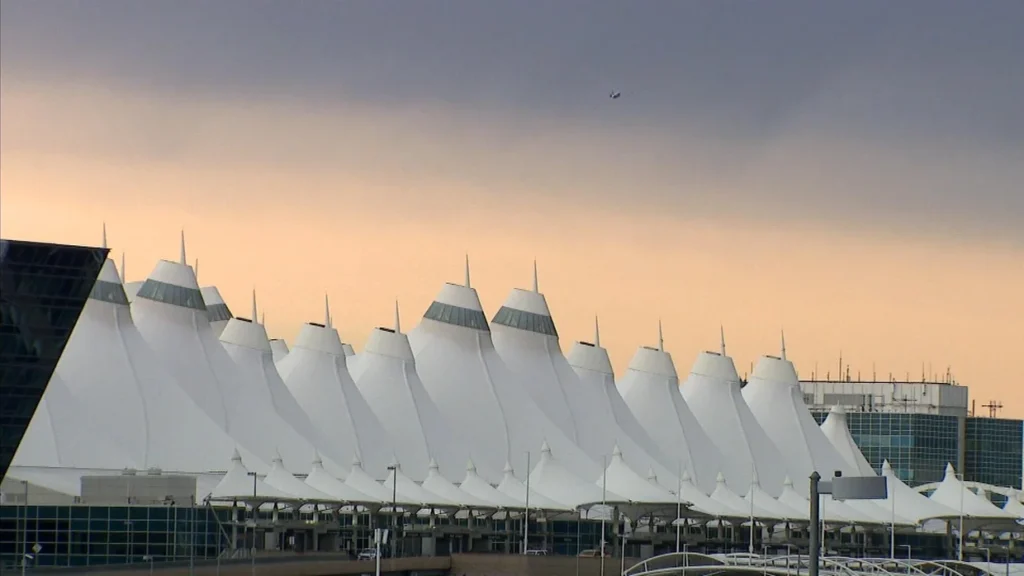

A power outage at Denver International Airport on Wednesday morning disrupted one of the busiest travel periods of the season, knocking out the train to the gates, triggering a Federal Aviation Administration ground stop, and sending flight delays sharply higher as spring break passenger volumes surged.
According to airport officials, the power incident began at around 9:20 a.m. MDT. About half an hour later, certain areas of the airport were still without electricity, with no estimate yet available for when full service would be restored. The timing immediately raised concern because Denver airport was already preparing for unusually heavy passenger traffic linked to spring break travel.
The most immediate impact inside the airport was on the train system between the main terminal and the gates. At Denver International Airport, that connection is a core part of passenger movement, so any disruption there quickly creates delays that spread across the wider terminal operation. Travelers reported confusion as the outage continued, with some saying they were not allowed to deboard planes and others saying access to restrooms had become difficult while systems were down.
FAA ground stop widened the impact across the country
The disruption quickly moved beyond the airport itself. The FAA issued a ground stop from 9:54 a.m. to 11:30 a.m., grounding flights headed to Denver because of the equipment outages linked to the power failure. That meant aircraft scheduled to depart for Denver from a wide range of major traffic control regions were held back while airport technicians worked to stabilize operations.
The affected regions reportedly included Los Angeles, Chicago, Salt Lake City, Houston, Fort Worth, Cleveland, Oakland, Seattle, Kansas City, Memphis, Indianapolis, Albuquerque, and Minneapolis. Taken together, those areas cover much of the United States, making the outage not just a local airport problem but a national travel disruption with knock-on effects for airline schedules, connections, and aircraft rotations throughout the day.
The operational picture worsened quickly as the morning unfolded. Flight tracking data showed 96 delayed flights and 6 cancellations as of around 10 a.m. By 10:20 a.m., the number of delays had jumped to 220, including 111 flights departing Denver and 109 flights arriving. That rise within just minutes underlined how quickly a systems failure at a major hub can cascade through the national aviation network.
Spring break passenger volumes added to the pressure
The outage came at a particularly difficult moment for Denver airport. Airport officials had already warned that both the previous weekend and the upcoming spring break weekend could bring more than 80,000 people a day through airport security. With that many travelers moving through the terminals, even a short operational interruption had the potential to create outsized disruption.
Denver urged passengers to continue arriving at least two hours before their scheduled departure, regardless of the season, and advised travelers to check directly with their airlines for the latest information about individual flights. At one point during the outage, security wait times were reported at around 10 minutes, although it was not fully clear whether Transportation Security Administration procedures had remained entirely unaffected by the broader power issues.
The disruption also landed during a period of wider concern around U.S. airport travel operations. CBS Colorado noted there were already issues involving long security lines in some parts of the country during the partial government shutdown, making Wednesday’s outage feel even more disruptive for travelers already bracing for delays.
Power source questions turned toward local utility service
As airport teams worked on restoration, attention also turned to the outside power network. Xcel Energy’s outage map showed an unplanned outage near the airport, and a spokesperson for the utility said the company serves Denver International Airport. That did not immediately answer every question about the cause of the disruption, but it did add to the picture of an event that appeared to extend beyond a minor internal terminal fault.
Airport officials said technicians were working as quickly as possible, but emphasized that there was still no timeline for full restoration during the key phase of the outage. That uncertainty was one of the most frustrating elements for passengers, because it made it difficult to judge whether to wait, rebook, or expect a much longer interruption to travel plans.
Incident tested DIA’s backup planning
The outage also drew attention because airport officials had previously described the chances of a power loss at DIA as very low due to backup power sources and infrastructure maintenance. A spokesperson had said last year that the airport’s emergency response framework was designed to maintain safety and reduce disruption in the event of a power failure. Wednesday’s incident became an early real-world test of that planning.
Even with that infrastructure in place, the morning showed how vulnerable modern airport operations remain when power interruptions affect transportation systems, passenger movement, and inbound air traffic at the same time. A train outage at a large hub is not just an inconvenience. It slows down boarding, strains gate access, disrupts timing for arriving aircraft, and creates immediate pressure on airline staff and airport operations teams already working through peak demand.
For travelers, the real impact was felt in more human terms: missed connections, uncertainty at the gate, longer waits inside crowded terminals, and a travel day that suddenly became unpredictable. For airlines, every delayed arrival and departure added another layer of complexity to a system already operating under spring break demand.
Passengers looking for the latest operational information and security wait times can follow updates through Denver International Airport’s official travel updates as crews continue working to restore normal service.
You may also like TSX drops 415 points to 32,513 as Bank of Canada rate holds at 2.25%.

Make Swikblog your go-to source on Google for reliable updates, smart insights, and daily trends.