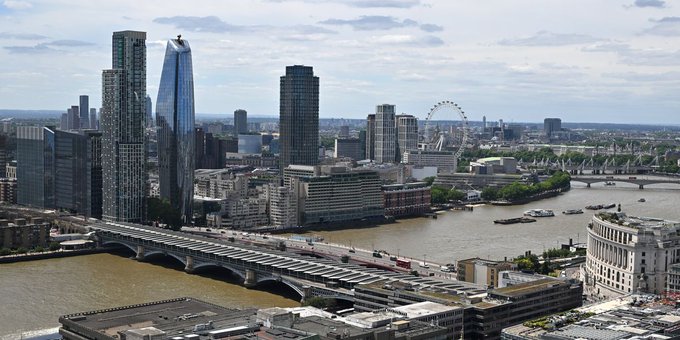
London, UK – December 6, 2025
A symbol of the “old” and “new” financial world is about to play out on one London skyline. Deutsche Bank, Germany’s biggest lender, is set to take around 250,000 square feet of office space in the YY London building at 30 South Colonnade in Canary Wharf – the same tower that carries the glowing logo of British fintech unicorn Revolut. :contentReference[oaicite:0]{index=0}
According to reporting first highlighted by the Financial Times and confirmed via Reuters , Deutsche Bank will take roughly twice as much space in the building as Revolut, instantly becoming its largest tenant and turning the tower into one of the most striking mash-ups of traditional banking and app-based finance in Europe. :contentReference[oaicite:1]{index=1}
Why Deutsche Bank Is Betting Big on YY London
The move marks a major bet on London’s Canary Wharf at a time when global banks, tech firms and fintechs are reassessing what their post-pandemic offices should look like. The YY London building – once known as the Thomson Reuters HQ – has been heavily refurbished, marketed as a next-generation, ESG-focused workplace and is now home to Revolut’s global headquarters . :contentReference[oaicite:2]{index=2}
For Deutsche Bank, taking 250,000 sq ft in the same building does three things at once:
- Signals confidence in London as a long-term financial hub despite Brexit and regulatory churn.
- Consolidates its footprint in a single, high-spec building able to support modern trading floors, risk teams and tech staff.
- Places the bank at the heart of a revived Canary Wharf, surrounded by peers like JPMorgan, Barclays, Morgan Stanley and now a new wave of fintech players. :contentReference[oaicite:3]{index=3}
Canary Wharf’s Office “Slump” Is Flipping Into a Comeback
The story isn’t just about one bank chasing nicer offices. It’s part of a bigger narrative: Canary Wharf, once written off as a casualty of hybrid work, is quietly stacking up major leasing wins. The district’s landlord, Canary Wharf Group, was hit hard by the work-from-home era and a sharp drop in office demand, but deals like Deutsche Bank’s show the tide is turning. :contentReference[oaicite:4]{index=4}
In just the past few months:
- Visa has signed a 15-year lease for around 300,000 sq ft at iconic One Canada Square, moving its European HQ to the tower from Paddington in 2028. :contentReference[oaicite:5]{index=5}
- JPMorgan Chase has unveiled plans for a new Canary Wharf tower that could pump roughly £9.9 billion into the local economy and support 7,800 jobs over six years. :contentReference[oaicite:6]{index=6}
- Fintech players like Revolut and Zopa are locking in long-term space, turning parts of the Wharf into a dense cluster of app-first, cloud-native financial firms alongside legacy banks. :contentReference[oaicite:7]{index=7}
For landlords, this is exactly the kind of “flight to quality” they hoped for: fewer but bigger, longer-term leases in high-spec, sustainable buildings rather than a patchwork of short-term tenants.
Old Bank, New Neighbour: What It Means for Revolut
Revolut only recently celebrated moving its own HQ into YY London, taking around 113,000 sq ft across four floors and plastering two giant logos on the building. :contentReference[oaicite:8]{index=8} Now, with Deutsche Bank set to occupy roughly double that space, the building becomes a physical metaphor: an established 150-year-old bank working under the same roof – and signage – as a less-than-a-decade-old fintech super-app.
For Revolut, sharing its HQ tower with a heavyweight like Deutsche Bank can be read two ways:
- As validation that the fintech chose the right building, district and long-term bet on London.
- As proof that the lines between “traditional bank” and “fintech challenger” are blurring – not just in apps and products, but literally in the office lobby.
What This Signals for Global Finance
Zoom out, and the Deutsche-Revolut co-location is part of a bigger global pattern where banks, Big Tech and fintechs are quietly re-investing in physical hubs while still talking about hybrid work. Major financial centres from London to Toronto are posting stronger jobs data and renewed corporate confidence, with recruiters once again competing for top trading, AI and risk-management talent.
In Canada, for example, explosive job growth reports and falling unemployment are fuelling similar conversations about how and where global firms deploy staff and capital. London’s Canary Wharf, with its new-look towers and ESG-driven refurbishments, clearly wants to stay in that race.
Why This Story Will Keep Trending
Expect this story to keep surfacing in business and tech feeds because it sits at the intersection of:
- Real estate – a battered office market trying to reinvent itself with greener, smarter buildings.
- Work culture – a push-pull between “come back to the office” and “work from anywhere”.
- Fintech vs. traditional banking – now literally sharing lifts, cafeterias and rooftop terraces.
For now, the headline is simple: Canary Wharf isn’t dead – and the biggest sign of life is a legacy bank quietly moving in under a fintech’s neon logo.

Make Swikblog your go-to source on Google for reliable updates, smart insights, and daily trends.