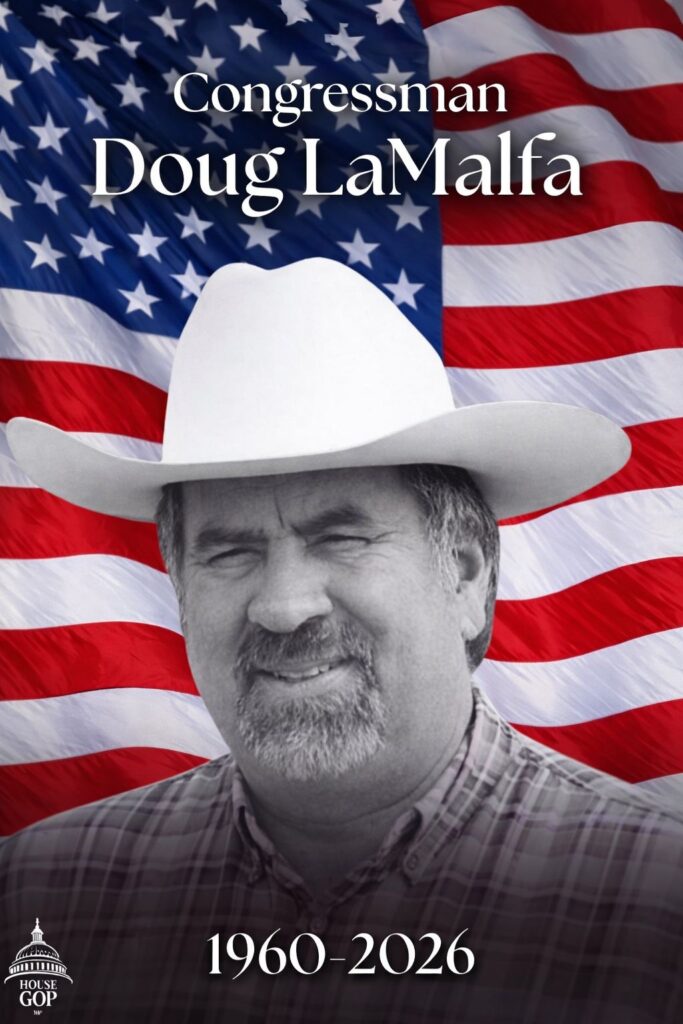

Washington is in mourning after the death of Rep. Doug LaMalfa, a veteran Republican congressman from Northern California, who died at the age of 65. The news spread quickly through Capitol Hill and across social media, triggering an outpouring of tributes from colleagues, political leaders, and constituents who had watched him represent a largely rural district for more than a decade.
LaMalfa, known for his strong focus on agriculture, water policy, and land management in the American West, served in the U.S. House after earlier years in California state politics. He was often described as a lawmaker who stayed closely tied to local concerns — farming, wildfire risk, forest management, and the pressures facing small towns — even as national politics grew louder and more polarized.
A sudden loss felt across Washington
Early reactions reflected both shock and respect. Statements of condolence circulated across party lines, with many lawmakers emphasizing his work ethic, his consistency, and his loyalty to his district. Reporting from the Associated Press noted that LaMalfa’s death also affects the delicate balance of power in the House, where margins can be razor-thin in a closely divided chamber.
While official details about the cause of death have not been publicly confirmed in full, leaders urged the public to avoid speculation as the family and colleagues process the loss. In moments like these, the political noise fades briefly — replaced by the simple reality that a public figure is also a spouse, a parent, and a neighbor to many back home.
From rice farmer to member of Congress
LaMalfa’s political identity was closely linked to Northern California’s rural economy. He frequently highlighted the needs of farming communities, arguing for policies he said would protect water access, support local jobs, and reduce bureaucratic burdens on growers and small businesses. Supporters often credited him with understanding the region’s challenges in a way that felt personal — because it was.
That background also shaped the issues he returned to again and again: forest health, wildfire prevention, land use disputes, and the long-running tension between environmental regulation and rural livelihoods. In committee work and public statements, he consistently framed these debates through the lens of communities that feel overlooked by decision-makers thousands of miles away.
“Nation reacts” as tributes pour in
The tributes weren’t limited to Washington. Local leaders, community members, and political organizations in California’s north shared memories of town halls, wildfire briefings, and constituency work — the quieter side of the job that rarely trends online but often matters most to voters. Several posts emphasized his responsiveness during emergencies and his visibility in rural areas where national politics can feel distant.
Coverage from CBS News highlighted how quickly the news moved through political circles, with colleagues describing him as a devoted family man and a relentless advocate for his constituents. Even political opponents acknowledged that his focus stayed rooted in the district he served.
What happens next
LaMalfa’s death creates an immediate vacancy that will be filled through the legal and electoral process in California. In the near term, his absence will also be felt in committee rooms and negotiations where experience and relationships can shape outcomes — particularly on issues tied to western land and water policy.
For constituents, however, the focus is more personal. There will be tributes, formal remembrances, and political discussions about the road ahead — but there will also be grief in the communities where he was a familiar name, a familiar face, and in many cases, a familiar presence at local events.
A legacy shaped by rural priorities
Doug LaMalfa’s legacy will be debated the way most political legacies are — through policy wins, voting records, and the arguments he made for his vision of the country. But for many in Northern California, he will be remembered most simply as a congressman who spoke their language, showed up, and kept his attention on the issues that define daily life far from major cities.
As tributes continue, one message repeats: a life in public service has ended, and a district — and a nation — is taking a moment to reflect on what that service meant.

Make Swikblog your go-to source on Google for reliable updates, smart insights, and daily trends.