
The Enhanced Games 2026 begins in Las Vegas with the kind of schedule built for one-night attention: sprint races, short-course swimming, Olympic lifts, a heavyweight deadlift clash and a prize structure that can turn a world-record attempt into a seven-figure moment.
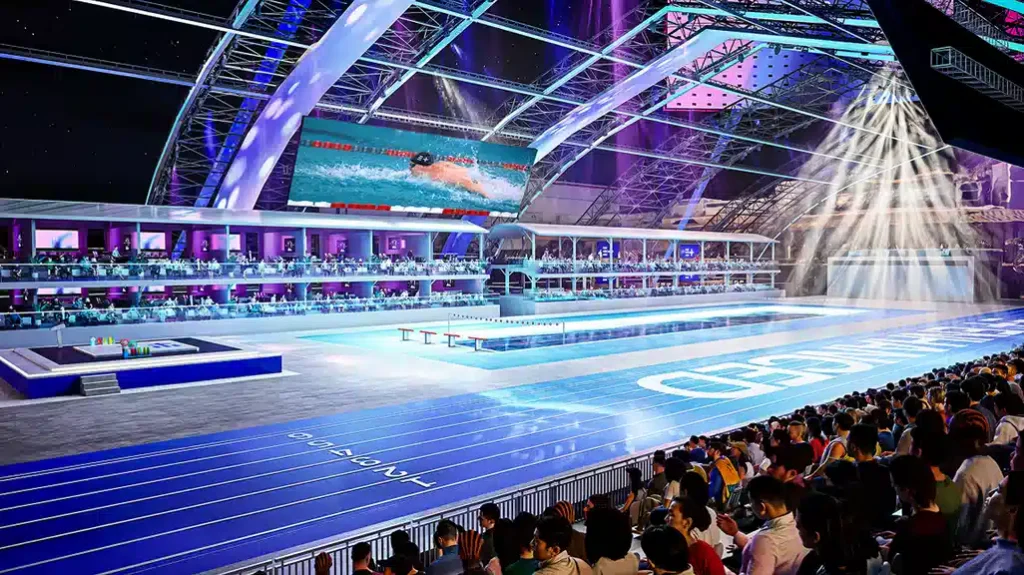
The inaugural event takes place on Sunday, May 24, 2026, at Resorts World Las Vegas, where organisers have built a compact competition setting for an invite-only crowd. The broader public will watch online, with opening coverage beginning at 6:30 p.m. ET and the main competitive card scheduled for 9 p.m. ET.
That makes the Enhanced Games more than a simple sports debut. It is a direct challenge to Olympic-style anti-doping rules, with athletes allowed to compete under a model that permits certain performance-enhancing substances under medical supervision. The result is a spectacle that mixes elite names, controversial science, streaming-first presentation and a prize pool designed to make athletes think twice about the traditional system.
Enhanced Games 2026 schedule, start time and streaming details
The first window begins at 6:30 p.m. ET / 3:30 p.m. PT on Sunday, May 24. That opening block is expected to include early competition and event build-up across free streaming platforms including YouTube, Rumble, Twitch and Kick.
Roku coverage is scheduled to begin at 8:30 p.m. ET / 5:30 p.m. PT, with an opening entertainment segment before the main competitive card. The main events are scheduled for 9 p.m. ET / 6 p.m. PT, with streams available through Roku, YouTube, Rumble, Twitch and Kick.
For UK viewers, the main card begins in the early hours of Monday, May 25, at around 2 a.m. BST. The opening block begins at around 11:30 p.m. BST on Sunday night. The timing matters because several of the biggest events are designed as short, high-impact contests rather than long heats or multi-day qualifying rounds.
The published programme includes swimming races, a 100m sprint showcase, Olympic-style lifting and a strongman deadlift contest. Swimming events are expected to include 50m freestyle, 100m freestyle, 50m butterfly and 100m butterfly. Track is centred on the 100m. Weightlifting includes the snatch and clean and jerk, while the strongman spotlight falls on a deadlift showdown.
The deadlift event has its own built-in drama. Former World’s Strongest Man Hafthor Björnsson, widely known as “Thor”, is expected to face Canadian strongman Mitchell Hooper in a contest that could become one of the night’s most watched moments. Björnsson has already pushed the deadlift record conversation beyond the 500kg barrier, while Hooper has been one of the most dominant strongman competitors of the past several seasons.
Fred Kerley, Ben Proud and the athlete names driving attention
The biggest mainstream name is Fred Kerley, the American sprinter who won the 100m world title in 2022 and an Olympic silver medal in Tokyo. Kerley has said he is not using performance-enhancing drugs at the Enhanced Games, even though the event allows athletes to compete under a drug-permissive structure. That detail gives his appearance a sharper edge: one of the event’s headline athletes is using the platform while distancing himself from its most controversial feature.
Kerley is also banned from the regular track circuit until August 2027 for missed tests, a violation that does not itself prove doping. He has said he still intends to compete at the Los Angeles Olympics in 2028, making his Las Vegas appearance one of the most closely watched storylines in athletics this year.
Swimming brings another layer of star power. Britain’s Ben Proud, an Olympic silver medalist in the 50m freestyle, is part of the field, along with Ukrainian swimmer Andriy Govorov, the 50m butterfly world record holder. Former 100m freestyle world champion James Magnussen has also become one of the most recognisable names attached to the project, after openly framing the event as a chance to chase times that conventional sport would not recognise.
Other athletes linked to the Las Vegas event include Olympic medalist swimmer Hunter Armstrong, American swimmer Cody Miller, weightlifter Wes Kitts, sprinter Marvin Bracy-Williams and strength athletes involved in the deadlift contest. The roster is not simply a group of unknown outsiders; it includes Olympians, world champions, record holders and athletes whose traditional careers have reached complicated points.
That is part of the event’s pull. The Enhanced Games is not asking viewers to watch a novelty contest between amateurs. It is putting recognisable elite athletes into a format where records, drug rules and prize money are all part of the same argument.
$25 million prize push and the $1 million record question
The financial pitch is central to the event’s identity. Enhanced says its Las Vegas debut carries a major athlete-compensation model, with millions committed to salaries, purses and record bonuses. Reports around the event have pointed to $500,000 prize pools for individual events, with winners able to earn $250,000 from an event victory.
The bigger hook is the record bonus. Athletes who break certain marks can earn extra payouts, with the most marketable races — especially the 100m sprint and 50m freestyle — carrying a possible $1 million bonus for a record-breaking performance.
That is where the tension becomes obvious. If Kerley or another sprinter runs faster than Usain Bolt’s 9.58 seconds, or if a swimmer beats a recognised world mark, the number may dominate the internet. But official bodies such as World Athletics and World Aquatics are not expected to recognise records set under drug-permissive rules.
In other words, Las Vegas could produce a time that goes viral without becoming an official world record. That gap between public spectacle and sporting legitimacy is exactly where the Enhanced Games wants to operate.
The drug rules behind the controversy
The Enhanced Games allows athletes to use selected performance-enhancing substances that are banned by the World Anti-Doping Agency in traditional sport. Reported categories include testosterone and anabolic agents, human growth hormone, EPO, certain metabolic modulators and stimulants. Organisers have argued that supervised use is more honest and safer than hidden doping.
Critics see the opposite. The strongest objection is that the event may create commercial pressure for athletes to take medical risks in exchange for money, attention and career extension. Anti-doping organisations and Olympic-aligned critics have warned that substances such as anabolic steroids, EPO and growth hormone can carry serious health consequences, even when framed as controlled or monitored.
Organisers have tried to answer that criticism by pointing to medical oversight and athlete choice. The event has also highlighted the idea that some competitors are not enhancing, creating a direct comparison between “natural” and “enhanced” performances. That comparison may become one of the night’s most discussed themes if clean athletes beat enhanced rivals, or if enhanced athletes produce times and lifts far beyond conventional benchmarks.
The event’s critics are not only worried about health. They are also worried about what happens if the format works commercially. If viewers tune in, clips spread across social platforms and athletes earn more than they would in conventional federations, the Enhanced Games could become a recurring pressure point for Olympic sports already struggling with athlete pay and audience attention.
The one-night format is built for viral sport
The Enhanced Games is structured differently from a traditional championship. Rather than stretching across several days of heats, qualifiers and finals, the Las Vegas event is being packaged as a compressed, streaming-first sports show. Many contests are short enough to be clipped instantly for social media.
That matters for a modern audience. A 100m sprint, a 50m freestyle race or a maximum deadlift attempt can be understood in seconds. The viewer does not need to follow a full season, a league table or a complicated qualification system. The question is immediate: did the athlete break the number or not?
That simplicity is also why the controversy is so powerful. The Enhanced Games is not hiding its central argument behind technical language. It is asking whether athletes, doctors and private organisers can build a new category of competition around substances that traditional sport bans. Las Vegas is the first real test of whether that idea becomes a spectacle people reject, a curiosity they sample once, or a format that refuses to disappear.
By the end of the night, the most important result may not be a time, a lift or a medal. It may be whether viewers treat the Enhanced Games as a sideshow or as the beginning of a serious rival conversation about the future of elite sport.

Make Swikblog your go-to source on Google for reliable updates, smart insights, and daily trends.