
The Grand National Festival at Aintree was hit by tragedy on Friday after Gold Dancer died shortly after winning the William Hill Mildmay Novices’ Chase, a shocking incident that has again pushed horse welfare to the centre of the national conversation.
Gold Dancer, a seven-year-old trained by Willie Mullins and ridden by Paul Townend, had looked set for one of the biggest wins of his career in the Grade 1 novice chase over 3m 1f. Instead, what unfolded in the closing stages turned a major festival success into what owner Eddie O’Leary later called a “hollow victory”.
The horse, carrying the maroon and white colours of Gigginstown House Stud, went off as the 100-30 joint-favourite in the 14:20 at Aintree. In a field that was reduced by incidents during the race, Gold Dancer travelled prominently throughout, tracking the pace before moving strongly into contention in the home straight. He was locked in a battle with Regent’s Stroll, the runner-up, before taking command near the business end of the contest.
The moment the race changed
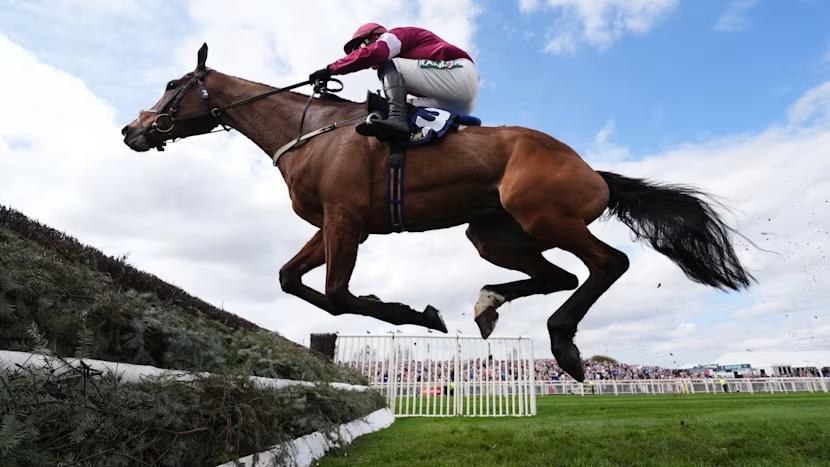
As the race built toward the finish, Gold Dancer jumped the second-last fence and moved to the front under Townend. He then came to the final obstacle travelling well clear, but made what was described afterward as a shuddering mistake. Reports from connections and racing officials said he lost his back legs at the fence and landed badly. Even so, he remarkably kept going, gathered himself, and ran on to win by four and three-quarter lengths.
For spectators watching live, it initially appeared to be a powerful winning performance from a horse finding plenty under pressure. But once Gold Dancer crossed the line and headed toward the pull-up area, it became clear that something was badly wrong. Townend soon dismounted, and the on-course veterinary team rushed to assist. Despite their quick intervention, the injury was catastrophic. Gold Dancer was later euthanised on welfare grounds.
Eddie O’Leary confirmed the severity of the injury in devastatingly direct terms, saying the horse had broken his back. He explained that Townend had felt nothing unusual as the horse ran to the winning line and that the seriousness of the injury only became obvious after the finish. O’Leary said Gold Dancer had jumped brilliantly apart from one little mistake and described the outcome as deeply cruel on the horse.
That account matched the sense of disbelief around the racecourse. Gold Dancer had not staggered home in obvious distress. He had still looked composed enough to finish the race first, which only made the aftermath more upsetting. The idea that a horse could summon the effort to win and then be lost moments later gave the incident particular emotional force.
Race result and drama elsewhere in the contest
The official result showed Gold Dancer first, with Regent’s Stroll second at 5-1 and Salver, who shared 100-30 joint-favouritism with the winner, finishing third. The result also confirmed earlier Cheltenham Festival form from the Jack Richards Novices’ Handicap Chase, where Gold Dancer and Regent’s Stroll had already advertised strong novice chase credentials.
There had also been drama earlier in the Mildmay Novices’ Chase. Miami Magic fell at the cross fence and brought down Jordans Cross, though both horses were reported to have emerged unscathed and walked back to the stables. Another runner, Wendigo, was kicked at the start but was examined by the veterinary team, deemed sound to continue, and eventually finished last of the six horses who completed the race. The official race card had listed eight runners.
The tote returns from the race showed a win return of £4.34, place returns of £1.50, £1.80 and £1.40, an Exacta of £20.20, a CSF of £20.21 and a Trifecta of £77.10, but those routine racing details were quickly overshadowed by the scale of the tragedy that followed.
Stewards inquiry and Townend’s explanation
After the race, the stewards opened an inquiry into the riding of Gold Dancer from the final fence until the point where the horse reached the pull-up area and was assessed by veterinary surgeons. Townend was interviewed, as was the director of equine regulation, safety and welfare, and recordings of the incident were reviewed in detail.
The inquiry heard Townend explain that after the mistake at the last fence, Gold Dancer took a stride or two to gather himself before running on in a straight line to the finish, where in the jockey’s judgment the horse still felt sound. Townend added that it was only when rounding the bend toward the pull-up area that Gold Dancer’s action changed, going from a canter to a trot, after which he dismounted immediately.
The stewards took no action. Their report said the director of equine regulation, safety and welfare considered the horse’s movement in the closing stages to be typical of a three-mile chaser at the end of a race and supported Townend’s evidence. After hearing the explanations and reviewing the footage, the panel noted the rider’s account and left the matter there.
Fresh pressure on Aintree and racing authorities
Gold Dancer’s death has intensified criticism of horse racing at Aintree, where the Grand National Festival has long been a focal point for the sport’s welfare debate. Figures cited by campaigners from Animal Aid say that 68 horses have died at the Aintree Festival since 2000, including 17 horses who died after racing in the Grand National itself.
The incident quickly drew a fierce response from the League Against Cruel Sports, which said the death reinforced calls for a public boycott and government intervention. Chief executive Emma Slawinski said that year after year horses die at Aintree for entertainment and gambling, and described Gold Dancer as the latest victim of what she called a heartless spectacle.
The RSPCA also issued a strong statement, saying it was devastated by Gold Dancer’s death. The charity said this was the 42nd fatality linked to competitive horse racing in the UK in 2026, even though the year is still only in April. It said lessons must be learned around contributing factors, pre-race and mid-race decision-making, and practical means of prevention. The charity also said it would speak with the British Horseracing Authority to discuss the incident, understand the assessment of what happened, and seek updates on the welfare of the other horses reported to have fallen earlier in the day.
That wider fallout is now likely to define the story more than the Grade 1 result itself. Gold Dancer’s final race was, on the surface, a display of quality and resilience from a talented novice chaser. Yet the image that remains is not of a rising star at the festival, but of a horse who made one late mistake, still found the courage to win, and was then lost within moments. At Aintree, that has left racing facing the same difficult question again: how many times can the sport talk about safety progress while scenes like this continue to unfold on one of its biggest stages?

Make Swikblog your go-to source on Google for reliable updates, smart insights, and daily trends.